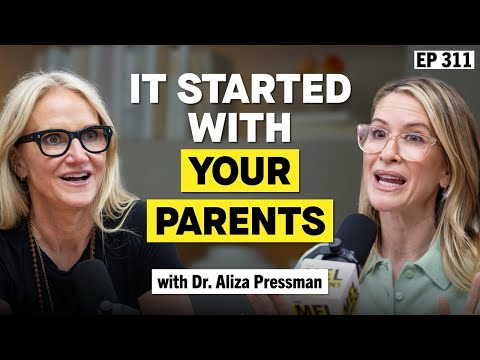
You Learn This Too Late: Understanding This Will Change the Way You Look at Your Relationships
Dr. Aliza Pressman (guest), Mel Robbins (host)
In this episode of The Mel Robbins Podcast, featuring Dr. Aliza Pressman and Mel Robbins, You Learn This Too Late: Understanding This Will Change the Way You Look at Your Relationships explores why ‘Good Enough’ Parenting Heals Generations And Builds Resilient Kids Mel Robbins interviews developmental psychologist Dr. Aliza Pressman about the science of parenting, focusing on how our own upbringing shapes how we love, relate, and raise children (or show up in any relationship).
Why ‘Good Enough’ Parenting Heals Generations And Builds Resilient Kids
Mel Robbins interviews developmental psychologist Dr. Aliza Pressman about the science of parenting, focusing on how our own upbringing shapes how we love, relate, and raise children (or show up in any relationship).
Pressman outlines her five research-backed principles—relationship, reflection, regulation, rules, and repair—and emphasizes that parenting is mostly about who *we* are and how we manage ourselves, not about fixing kids.
They debunk myths like “my job is to keep my kids happy” and “sensitive parents raise fragile kids,” showing how boundaries plus emotional validation actually build resilience.
A major theme is that it’s never too late: repair has no expiration date, a single stable caregiver can buffer even severe stress, and adult parents can still acknowledge past hurts and change present dynamics.
Key Takeaways
Aim to be a ‘good enough’ parent, not a perfect one.
Research shows children need mostly consistent connection and repair, not flawless parenting; perfectionism burdens kids with impossible standards and makes it harder for them to accept their own mistakes.
Get the full analysis with uListen AI
Use the five R’s as a simple roadmap: relationship, reflection, regulation, rules, repair.
Prioritize connection, regularly reflect on your reactions, regulate your own emotions, set clear safety-focused boundaries, and repair when you inevitably mess up—these are all within your control, regardless of your child’s behavior.
Get the full analysis with uListen AI
Treat all feelings as welcome, but not all behaviors as acceptable.
Validate the underlying emotion (“you’re furious you can’t go”) while clearly limiting harmful actions (“stealing the car is not okay”), which applies equally at home, with partners, and at work.
Get the full analysis with uListen AI
If you’re worried about repeating generational patterns, you’ve already started breaking them.
The act of reflecting on your own childhood and your impact means your behavior will shift, even in small ways; awareness itself creates tiny but meaningful breaks in negative cycles.
Get the full analysis with uListen AI
One stable, loving caregiver can buffer even severe stress in a child’s life.
Evidence shows that a safe, attuned adult can turn potentially toxic stress (like exposure to abuse) into tolerable stress, dramatically improving emotional, cognitive, and resilience outcomes.
Get the full analysis with uListen AI
Repair is always possible and has no time limit.
Whether your kids are young or adults, you can initiate repair by clearly owning your part (“that was about me, it wasn’t okay, and I’m sorry”) without defending or excusing—reconnection matters more than perfect words.
Get the full analysis with uListen AI
Don’t make children carry your unresolved life or conflicts.
Over-sacrificing your own life for your kids creates guilt and burden, and trashing the other parent effectively attacks a part of the child; instead, own your choices, protect them from adult conflict, and let them form their own relationships.
Get the full analysis with uListen AI
Notable Quotes
“All feelings are welcome. All behaviors are not.”
— Dr. Aliza Pressman
“You are born as a parent when your children are born.”
— Dr. Aliza Pressman
“If you’re afraid of repeating the mistakes your parents made, the very fact that you’re reflecting on that means you’ve already broken the cycle.”
— Dr. Aliza Pressman
“Parenting is the most powerful environmental input for children.”
— Dr. Aliza Pressman
“Repair has no expiration date.”
— Dr. Aliza Pressman
Questions Answered in This Episode
Where in my current relationships (with kids, partners, or parents) do I most need to shift from controlling others to regulating myself?
Mel Robbins interviews developmental psychologist Dr. ...
Get the full analysis with uListen AI
If I applied “all feelings are welcome, all behaviors are not” consistently, what specific conversations or boundaries in my home would change first?
Pressman outlines her five research-backed principles—relationship, reflection, regulation, rules, and repair—and emphasizes that parenting is mostly about who *we* are and how we manage ourselves, not about fixing kids.
Get the full analysis with uListen AI
What would it look like, in practice, for me to move from martyrdom (“I gave up everything for you”) to modeling an ‘unlived life’ I’m actually living?
They debunk myths like “my job is to keep my kids happy” and “sensitive parents raise fragile kids,” showing how boundaries plus emotional validation actually build resilience.
Get the full analysis with uListen AI
Is there a repair I’ve been avoiding—with my child or my own parent—and what exact words could I use to acknowledge my part without defending it?
A major theme is that it’s never too late: repair has no expiration date, a single stable caregiver can buffer even severe stress, and adult parents can still acknowledge past hurts and change present dynamics.
Get the full analysis with uListen AI
Given my child’s (or my own) temperament—orchid, tulip, or dandelion—how might I adjust the ‘environment’ instead of trying to change the ‘flower’?
Get the full analysis with uListen AI
Transcript Preview
(instrumental music plays) How we were parented-
Mm.
... how we grew, how we came to be who we are, and how we're growing others is kind of at the center of everything.
What if you realize, "My God, I've made a lot of mistakes. Like, I was the parent that was indifferent or cold or distracted, or I had a lot of anger, or I really screwed up the divorce." What would you tell somebody who feels like they're failing at parenting right now?
I would say...
Wow. I think that's a hard pill for a lot of parents to swallow. (cash register dings) Dr. Aliza Pressman, she's one of the world's most respected developmental psychologists. She has a New York Times best-selling book called The 5 Principles of Parenting: Your Essential Guide to Raising Good Humans. Today, Dr. Pressman is here to lay out the science behind the parenting mistakes most of us don't even realize we're making. Dr. Pressman is gonna give you so much clarity about what you've experienced and, more importantly, where you can go from here. What's the biggest myth parents believe about raising, quote, "healthy, resilient kids?"
The biggest myth is that...
Uh, my mouth is hanging open-
(laughs) .
... so I'm gonna close it for a second. How does wanting the best for your kids cause anxiety?
I should say this.
Wow, I've never heard that before. After a divorce, how long should you wait before you introduce who you're dating to your kids?
The research suggests-
Dr. Pressman, what is the best parenting advice you've ever heard? (clock ticking) Dr. Aliza Pressman, welcome to The Mel Robbins Podcast.
Thank you for having me.
Thank you for coming to Boston. Thank you for being here. Uh, you know, I was on the Today Show set, and Hoda pulled me aside and said, "My favorite parenting expert is Dr. Pressman. You have to get her on."
(laughs) .
And so I was like, "Hoda, I'm getting her on."
Ah.
So, welcome.
Thank you, Hoda.
(laughs) .
I love her.
I do too. I do too. I'm really excited to learn from you, and I'd love to start by having you tell the person who's listening right now what they could experience in their life that could be different if they take everything that you are about to teach us today, uh, and they apply it to their life. How could their life change?
How we were parented-
Mm.
... how we grew, how we came to be who we are, and how we're growing others is kind of at the center of everything, in my view. And I think that the science of parent- of the parent-child relationship is extraordinary, and it's inspiring, and it is overwhelmingly easier to get it, like, quote unquote right, and I think that that is game-changing, that there's- there's stuff that you can do that will change the relationships in your life, and that they're very easy to take on. There's so much information out there about how to do every single thing, but the- the science itself is quite generous with parents, is such a beautiful experience. Like, once you really buy into that, you have actionable steps that you can take that can be game-changing in your relationships, but they're not, like, this overwhelming, unattainable goal.
Install uListen to search the full transcript and get AI-powered insights
Get Full TranscriptGet more from every podcast
AI summaries, searchable transcripts, and fact-checking. Free forever.
Add to Chrome