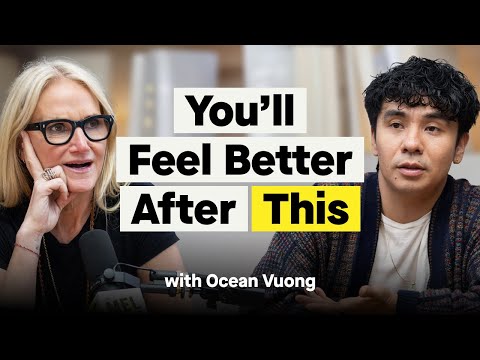
If You Feel Lost in Life, Listen to This One Conversation to Find Purpose & Meaning
Mel Robbins (host), Ocean Vuong (guest)
In this episode of The Mel Robbins Podcast, featuring Mel Robbins and Ocean Vuong, If You Feel Lost in Life, Listen to This One Conversation to Find Purpose & Meaning explores reclaim dignity through language, compassion, and living by your values Ocean Vuong reframes a “meaningful life” as one lived without needing to prove worth—by finding value where you already are, especially amid struggle, poverty, and outsiderhood.
Reclaim dignity through language, compassion, and living by your values
Ocean Vuong reframes a “meaningful life” as one lived without needing to prove worth—by finding value where you already are, especially amid struggle, poverty, and outsiderhood.
He explains how language can be used to manipulate and humiliate, and how reclaiming language (through poetry, intentional questions, and borrowed texts) can restore dignity and selfhood.
The conversation treats shame as both destructive and potentially propulsive, distinguishes shame of being vs shame of conduct, and offers practices to convert shame into action and care.
They close by redefining what “counts” in life: coming down from the mountain of status to the small moments, relationships, kindness-in-action, and the obligations we choose to honor.
Key Takeaways
Stop using your life to “prove” you’re valuable.
Vuong argues meaning isn’t earned by achievements or social approval; it’s discovered by locating power and value in your present life and circumstances, even if they’re imperfect or painful.
Get the full analysis with uListen AI
Dignity is living without shame by owning what you were told to discard.
He defines dignity as integrating the “failed,” stigmatized, or hidden parts of your story—poverty, outsiderhood, queerness, mistakes—so they become sources of pride and wholeness, not secrecy.
Get the full analysis with uListen AI
Reclaim language to reclaim yourself.
Because public language (ads, politics, corporate messaging) often diminishes people, intentional language becomes a personal tool for freedom—choosing words that restore wonder, accuracy, and self-respect.
Get the full analysis with uListen AI
Disrupt default conversations to open real connection.
Instead of automatic scripts (“How are you? ...
Get the full analysis with uListen AI
Borrow better words when your inner language turns toxic.
Vuong’s practice—hand-copying lines from poets and authors—works like “secular prayer”: it replaces self-attacking scripts with language that steadies and elevates you, building new mental grooves.
Get the full analysis with uListen AI
You can’t hold two emotions at once—use attention to set down self-hatred.
Drawing on Buddhist psychology, he suggests shifting focus from your suffering to someone else’s (starting with loved ones, radiating outward). ...
Get the full analysis with uListen AI
Redefine what “counts” by your values, not society’s scoreboard.
He contrasts society’s metrics (status, escape narratives, résumé wins) with an “alternative count”: obligations you choose—care, service, family support, community presence—especially when “escape” isn’t realistic or even desirable.
Get the full analysis with uListen AI
Imposter syndrome can be an immune system, not a pathology.
Feeling friction in centers of power can protect creativity and ethics; comfort can signal assimilation into hollow norms. ...
Get the full analysis with uListen AI
Return to your younger self to recover intention.
Vuong teaches students to “collaborate” with the version of themselves who first loved the craft (or first felt the need to change their life). ...
Get the full analysis with uListen AI
At the end, small moments matter more than big achievements.
After his mother’s death, what remained were ordinary memories (like chicken nuggets in a parking lot). ...
Get the full analysis with uListen AI
Notable Quotes
“A meaningful life is not a life that you use to prove to yourself or others that you are valuable. A meaningful life is finding the power and the value where you are.”
— Ocean Vuong
“Dignity is about looking at what people have said to you that you should discard, and realizing that it's always part of you.”
— Ocean Vuong
“It's like secular prayer.”
— Ocean Vuong
“The hardest thing in the world is to live only once.”
— Ocean Vuong
“Empathy as an end game is a trap… Kindness is now empathy via action.”
— Ocean Vuong
Questions Answered in This Episode
You say language is often “captured to humiliate us.” What are 3 common phrases or scripts people use daily that you think quietly reinforce shame, and what would you replace them with?
Ocean Vuong reframes a “meaningful life” as one lived without needing to prove worth—by finding value where you already are, especially amid struggle, poverty, and outsiderhood.
Get the full analysis with uListen AI
Can you give a concrete example of transforming “ontological shame” (shame of being) into dignity without pretending the pain didn’t happen?
He explains how language can be used to manipulate and humiliate, and how reclaiming language (through poetry, intentional questions, and borrowed texts) can restore dignity and selfhood.
Get the full analysis with uListen AI
Your practice of copying favorite poems is powerful—how long should someone do it, and what’s a good starter “bibliography” for people who don’t read poetry?
The conversation treats shame as both destructive and potentially propulsive, distinguishes shame of being vs shame of conduct, and offers practices to convert shame into action and care.
Get the full analysis with uListen AI
When does focusing on others’ suffering (as a displacement technique) become avoidance of your own needs, and how do you keep it balanced?
They close by redefining what “counts” in life: coming down from the mountain of status to the small moments, relationships, kindness-in-action, and the obligations we choose to honor.
Get the full analysis with uListen AI
You reject “escape plots” about poverty. What kinds of stories would actually change public understanding of class—without turning hardship into ‘poverty porn’?
Get the full analysis with uListen AI
Transcript Preview
If you feel lost in life, today's guest will help you find purpose and meaning. Ocean Vuong is a bestselling author and an award-winning poet. His debut novel earned him the American Book Award, the Mark Twain Award, and the New England Book Award. His newest novel, The Emperor of Gladness, debuted on the New York Times bestselling list, and it's one of the best books I have ever read. Ocean is currently a tenured professor of creative writing at NYU, where he teaches in the MFA program for poetry and poetics.
A meaningful life is not a life you use to prove to yourself or others that you are valuable. A meaningful life is finding the power and the value where you are. Shame is so perennial for so much of American life. It's very much true for the poor. I remember, you know, like, being in Stop & Shop's local grocery store, and my mother like, counting how many tomatoes she can afford. [laughing] All the struggles me and my family have gone through, they were all also sites of innovation and creative struggle.
What would you say to somebody who's listening right now and is in that place where they are feeling a tremendous amount of shame and feeling very lost?
Dignity is about looking at what people have said to you that you should discard, and realizing that it's always part of you, and being proud of that as, as, as a process of who you are. So owning all of your parts and not having to walk around with that shame, that to me, is what dignity is. None of us chose to be here, but we stay, and we stay around because we realize there's love here. And it doesn't make poverty better. It doesn't make it even tolerable, but it gives your life a kind of significance when you realize that you are still capable of giving and receiving love, and that's no small thing. I hope people realize is that wherever you are, it's, it's enough. No one has to escape to be worthy.
Ocean Vuong, welcome to the Mel Robbins Podcast.
Thank you so much for having me.
I am so excited to meet you. I loved your book so much. I've given it to so many people, and I was absolutely honored when you said yes, and said that you would come on and talk about purpose, and feeling lost, and about your work, and the themes in your work. So thank you for being here.
Oh, thank you so much for, for recognizing what I'm trying to do. It's a, it's a deep, deep honor to be here and to share with this beautiful audience, um, all around the world about what- at the heart of what I'm trying to do.
Well, let's talk about that. Let's talk about what is at the heart of what you're trying to do, and if I really listen and take in everything that you will teach me today, how could my life change?
Install uListen to search the full transcript and get AI-powered insights
Get Full TranscriptGet more from every podcast
AI summaries, searchable transcripts, and fact-checking. Free forever.
Add to Chrome