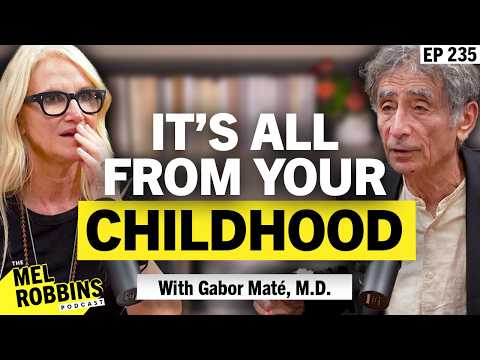
Dr. Gabor Maté: The Shocking Link Between ADHD, Addiction, Autoimmune Diseases, & Trauma
Mel Robbins (host), Dr. Gabor Maté (guest)
In this episode of The Mel Robbins Podcast, featuring Mel Robbins and Dr. Gabor Maté, Dr. Gabor Maté: The Shocking Link Between ADHD, Addiction, Autoimmune Diseases, & Trauma explores how Childhood Stress Hardwires ADHD, Addiction, Autoimmunity—and How To Heal Dr. Gabor Maté explains that conditions like ADHD, addiction, and many autoimmune diseases are not fixed genetic defects but adaptations to early-life stress and trauma. He argues that the developing brain is a social organ shaped by emotional environments from the womb onward, especially in sensitive children. ADHD traits (tuning out, poor impulse control, hyperactivity) and addictions are framed as coping mechanisms for unprocessed pain, not standalone diseases, while people‑pleasing and repressed anger are linked to autoimmune illness, particularly in women. Throughout, he emphasizes that understanding these roots reduces shame and opens pathways to healing by changing environments, relationships, and internal patterns rather than relying solely on medication or labels.
How Childhood Stress Hardwires ADHD, Addiction, Autoimmunity—and How To Heal
Dr. Gabor Maté explains that conditions like ADHD, addiction, and many autoimmune diseases are not fixed genetic defects but adaptations to early-life stress and trauma. He argues that the developing brain is a social organ shaped by emotional environments from the womb onward, especially in sensitive children. ADHD traits (tuning out, poor impulse control, hyperactivity) and addictions are framed as coping mechanisms for unprocessed pain, not standalone diseases, while people‑pleasing and repressed anger are linked to autoimmune illness, particularly in women. Throughout, he emphasizes that understanding these roots reduces shame and opens pathways to healing by changing environments, relationships, and internal patterns rather than relying solely on medication or labels.
Key Takeaways
ADHD is largely an adaptation to early stress, not a hardwired defect.
The developing brain’s dopamine and self-regulation circuits are sculpted by emotional conditions in utero and early childhood; tuning out, impulsivity, and hyperactivity often begin as protective responses to overwhelming stress that then get wired in.
Get the full analysis with uListen AI
Genetics create predisposition, but environment determines expression.
Maté distinguishes predisposition from predetermination: sensitive children inherit heightened responsiveness, but whether this becomes ADHD, addiction, or resilience depends heavily on the safety, stress, and attunement in their early environment.
Get the full analysis with uListen AI
Addiction is an attempt to regulate pain, not the primary problem.
All addictions—substances or behaviors—temporarily soothe emotional pain and boost dopamine or endorphins; asking “What was right about the addiction? ...
Get the full analysis with uListen AI
People‑pleasing and repressed anger are major risk factors for autoimmune disease.
Patterns like putting others first, over-identifying with duty, being ‘nice’ at the cost of suppressing healthy anger, and feeling responsible for others’ feelings chronically stress and dysregulate the immune system, which can then turn against the body.
Get the full analysis with uListen AI
Diagnosis describes behavior; it does not explain its cause.
Labeling someone with ADHD or addiction often becomes a circular explanation; real understanding requires examining their life history, relationships, and the stresses that shaped their brain and coping patterns.
Get the full analysis with uListen AI
Healing leverages neuroplasticity by changing environments and relationships.
Because the brain is plastic throughout life, shifting family dynamics, reducing stress, building supportive community, and increasing understanding (rather than blame) can meaningfully change ADHD symptoms, addiction patterns, and even autoimmune trajectories.
Get the full analysis with uListen AI
Learning to say both “no” and “yes” is central to recovery.
Using Maté’s reflective questions—where you can’t say no, the impact, the underlying belief, its origin, and who you’d be without it—helps reclaim authenticity over automatic attachment-seeking; equally important is noticing where you’re not saying yes to rest, play, and creativity.
Get the full analysis with uListen AI
Notable Quotes
“A predisposition is not the same as a predetermination.”
— Dr. Gabor Maté
“Don’t ask why the addiction, ask why the pain.”
— Dr. Gabor Maté
“The brain is a social organ. It develops in interaction with the environment.”
— Dr. Gabor Maté
“We’re actually hurting people for having been hurt.”
— Dr. Gabor Maté
“Everybody’s got the capacity to heal. As long as there’s consciousness, there’s the capacity to heal.”
— Dr. Gabor Maté
Questions Answered in This Episode
If ADHD and addiction are adaptations to early stress, how should schools, pediatricians, and parents change the way they respond to children’s ‘problem’ behaviors?
Dr. ...
Get the full analysis with uListen AI
What practical steps can someone take to safely explore and express healthy anger if they’ve spent a lifetime suppressing it to stay ‘nice’ and accepted?
Get the full analysis with uListen AI
How can people from disadvantaged or chronically stressful environments realistically change their ‘environment’ enough to support healing, when many factors feel non-negotiable?
Get the full analysis with uListen AI
What would mental health and addiction treatment look like if trauma and attachment history were treated as primary data, rather than optional background information?
Get the full analysis with uListen AI
How can a person begin to distinguish between choices driven by attachment (being liked, not disappointing others) and those driven by authenticity (staying true to their own needs and feelings)?
Get the full analysis with uListen AI
Transcript Preview
Is it fair to say that your childhood and the conditions and the experiences that you have directly create or cause ADHD, addiction, and autoimmune issues?
That's right. If you look at children in poverty or- or who experience racialized circumstances, they're more likely to be diagnosed with ADHD. The children of women with postpartum depression are more likely to be diagnosed with ADHD. The children of women who are stressed during pregnancy are more likely to be diagnosed with ADHD. There's no parent blaming here, but we have to recognize the importance and impact of early experiences. The diagnosis doesn't explain anything.
What do you mean the diagnosis doesn't mean anything?
Don't ask why the addiction, ask why the pain. And if you wanna understand the pain, look at the person's life rather than just their genes.
Hey, it's your friend Mel. I am so excited that you're here with me today. It is always an honor to be able to spend some time with you, to be together, to learn together. If you're brand new, I wanna take a moment and welcome you to the Mel Robbins Podcast family. Super excited that you're here. And because you chose to listen to this episode, I know something about you. You're the type of person who values your time and you're also in learning about simple ways that you can improve your own life, and I absolutely love that. And you know what I also love? I love that you and I are gonna get to spend time today learning from the extraordinary Dr. Gabor Maté. He's a world-renowned physician, a New York Times bestselling author, and a renowned addiction expert who dives deep into childhood development and the impact of physiological and psychological trauma, and how it shapes our mental and physical health over your lifetime. And today specifically, you and I are going to dive deep with Dr. Maté into how ADHD, people pleasing, addiction, your inability to say no, and autoimmune disorders are not things that you're born with. They were created by your childhood. So please help me welcome Dr. Gabor Maté to the Mel Robbins Podcast.
Thank you.
I'm really excited about the topic today and your work around how childhood conditions and experiences in your childhood are connected to ADHD, addiction, and autoimmune diseases and disorders.
Mm-hmm.
And I have so many questions I wanna ask you. Why don't we start with just your definition of what you're talking about when you mean childhood conditions, so that as the person is listening to us today and spending time with us together, we're all using the same words and concepts and we kinda start on the same page.
So child conditions include the physical conditions, um, nutrition, housing, um, comfort, protection, but they also include the emotional conditions, which it has to do with, um, a child's sense of being accepted or being loved, or not just as loved, but actually being seen, understood. And also on a parent's emotional states. Um, are the parents stressed? Are the parents struggling with economic difficulties? Uh, are the parents carrying traumas that they hadn't worked through yet like I had when I was a young parent? Um, are the parents in a marriage that's relatively peaceful, or is there a lot of conflict? Is there a lot of instability? Is there unpredictability? What kind of community support there is? Is there an extended family that can spell off the parents and give them some kind of emotional support, or are they rather isolated? Are you a single parent struggling to make a living and raise a child? So all these conditions affect the personality and the brain development of the child.
Install uListen to search the full transcript and get AI-powered insights
Get Full TranscriptGet more from every podcast
AI summaries, searchable transcripts, and fact-checking. Free forever.
Add to Chrome