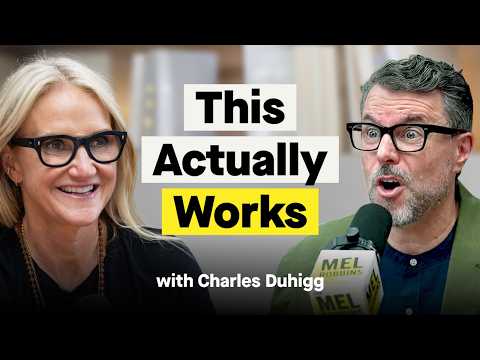
The 7‑Day Habit Reset: Start Today, Feel Different By Next Week
Charles Duhigg (guest), Mel Robbins (host)
In this episode of The Mel Robbins Podcast, featuring Charles Duhigg and Mel Robbins, The 7‑Day Habit Reset: Start Today, Feel Different By Next Week explores transform Your Life In A Week By Rewiring Daily Habits Mel Robbins interviews Charles Duhigg, author of “The Power of Habit,” about how any habit can be changed by understanding the simple habit loop: cue, routine, reward.
Transform Your Life In A Week By Rewiring Daily Habits
Mel Robbins interviews Charles Duhigg, author of “The Power of Habit,” about how any habit can be changed by understanding the simple habit loop: cue, routine, reward.
They explain keystone habits—exercise, a structured morning routine, and tracking—as high‑leverage behaviors that create a positive ripple effect across health, productivity, finances, and self‑image.
Using research examples and practical stories, they show how to design cues, pre‑plan routines in a “cold mind,” and intentionally savor rewards so behaviors become automatic instead of willpower‑dependent.
They also extend the habit framework to mental patterns, showing that even negative thought spirals can be reprogrammed by identifying their cues and deliberately installing more helpful responses.
Key Takeaways
Use the habit loop—cue, routine, reward—to intentionally design behaviors.
Every habit is triggered by a cue, followed by a routine, and ends with a reward. ...
Get the full analysis with uListen AI
Leverage keystone habits like exercise for maximum ripple effects.
Habits such as regular exercise don’t just improve fitness; research shows they also correlate with better eating, less procrastination, more disciplined spending, and stronger self‑discipline because they reshape how you see yourself (“I’m a disciplined person”).
Get the full analysis with uListen AI
Build a simple morning routine around ARC: Anticipation, Relaxation, Connection.
Powerful mornings don’t require elaborate rituals; even making your bed, eating breakfast, or a brief meditation can work if they help you look forward to the day, slow your nervous system, and connect with yourself or others, which improves focus and decision‑making all day.
Get the full analysis with uListen AI
Track one meaningful behavior to stay intentional and reveal patterns.
Whether it’s water intake, spending, sleep time, or food, basic tracking makes invisible patterns visible and constantly reminds you of your deeper why, which nudges better choices without requiring constant self‑control.
Get the full analysis with uListen AI
Change habits by swapping the routine, not by trying to “break” them.
The golden rule of habit change is to keep the same cue and reward but insert a different behavior that delivers a similar payoff—for example, calling a loved one for novelty and connection instead of snacking when bored at night.
Get the full analysis with uListen AI
Plan in a ‘cold mind’ so your ‘hot mind’ doesn’t derail you.
Decide details—what workout, what time, what route, what you’ll do after—before you’re tired or emotional. ...
Get the full analysis with uListen AI
Apply habit science to your thoughts and emotions, not just actions.
Negative mental spirals are also habits with cues and rewards; recognizing them as such lets you insert new mental routines, like deliberately recalling recent wins, which gradually shifts your default emotional state and sense of control.
Get the full analysis with uListen AI
Notable Quotes
“Every habit can be changed. You can become any person you wanna be.”
— Charles Duhigg
“Excellence, then, is not an act, it’s a habit. And so is slacking off.”
— Charles Duhigg (quoting and extending Aristotle)
“Our brains are constantly looking for clues as to who we actually are, and when we give them the right clues, our brain becomes our partner in changing our behavior.”
— Charles Duhigg
“The mistake we make is not giving ourselves a reward—and not letting ourselves enjoy the reward.”
— Charles Duhigg
“Habits are the foundation of your life… If you wanna change who you are, take a look at the habits of the kind of person that you wanna be.”
— Mel Robbins
Questions Answered in This Episode
Which single keystone habit—exercise, morning routine, or tracking—would create the biggest positive cascade in my life if I committed to it for 7 days?
Mel Robbins interviews Charles Duhigg, author of “The Power of Habit,” about how any habit can be changed by understanding the simple habit loop: cue, routine, reward.
Get the full analysis with uListen AI
What specific cues, routines, and rewards currently drive my most frustrating habit, and how could I swap the routine while keeping the same cue and reward?
They explain keystone habits—exercise, a structured morning routine, and tracking—as high‑leverage behaviors that create a positive ripple effect across health, productivity, finances, and self‑image.
Get the full analysis with uListen AI
If I designed a minimal ARC‑based morning routine, what three actions would I choose to build anticipation, relaxation, and connection each day?
Using research examples and practical stories, they show how to design cues, pre‑plan routines in a “cold mind,” and intentionally savor rewards so behaviors become automatic instead of willpower‑dependent.
Get the full analysis with uListen AI
What is one behavior I could start tracking this week (sleep, spending, steps, food, water) that would make my invisible patterns and excuses uncomfortably clear?
They also extend the habit framework to mental patterns, showing that even negative thought spirals can be reprogrammed by identifying their cues and deliberately installing more helpful responses.
Get the full analysis with uListen AI
Which negative mental habit—self‑criticism, rumination, worry—could I reframe as a habit loop, and what new mental routine could I insert when that cue appears?
Get the full analysis with uListen AI
Transcript Preview
You can become any person you wanna be. That habit that's been driving you crazy for years, you can change it. You can build the habits that make you into a marathoner. You can abandon the habits of drinking or overeating that have w- weighed you down. Every habit can be changed. Aristotle once said, "We are what we repeatedly do. Excellence, then, is not an act, it's a habit."
And so is slacking off.
So is slacking off, so is exercising every day, so is procrastination. Now, about 40 to 45% of what we do every day is a habit.
45%?
Yeah. Oftentimes when we talk about changing a habit, we refer to it as breaking a habit. "I'm gonna stop doing that thing." And what we know is we know that that's not enough. We have to use what's called the golden rule.
What's the golden rule?
Don't try and extinguish a habit. Rather... We have the power to be the people we want to be. We can be the person we want to be by changing our habits, and any habit can be created, any habit can be changed. You can live the life that you want.
Charles Duhigg! I am so excited that you're here to teach us all about habits.
Well, thank you for ha- this is such an honor for me. I really appreciate it.
Well, you know, your book The Power of Habits changed my life.
(laughs)
It is the best and it is the seminal and it is the original, incredible book about habits. The research is unreal, I cannot wait for you to unpack all that today, and I'd love to start by having you speak directly to the person who's listening. They do not have a lot of time, but they have found the time to spend it with you and me, and they cannot wait to learn about your research with habits, how to create a positive ripple effect in their life. Can you tell this person what might change about their life if they take everything that you're about to share today, and they apply it?
Absolutely. Absolutely. So here's the thing I would say. Every habit can be changed. You can create as many habits as you want. You can change, that, that habit that's been driving you crazy for years? You can change it. Because the way that habits work is that it's a very simple thing that happens inside our brain, and once we know how to take a habit and break it apart into its components, then suddenly, we can adjust anything that we want to in our life. So you can become any person you wanna be. You can build the habits that make you into a marathoner. You can abandon the habits of drinking or overeating that have b- weighed you down, once you understand how to change the habits.
Install uListen to search the full transcript and get AI-powered insights
Get Full TranscriptGet more from every podcast
AI summaries, searchable transcripts, and fact-checking. Free forever.
Add to Chrome