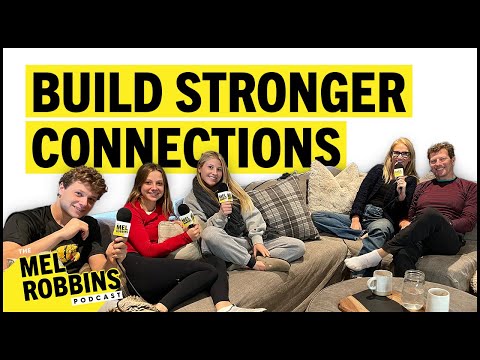
A Toolkit for Families: Practical Wisdom That Makes You Closer | Mel Robbins Podcast
Mel Robbins (host), Sawyer Robbins (guest), Kendall Robbins (guest), Chris Robbins (guest), Oakley Robbins (guest), Parent guest (likely Chris or Mel in a different mic/camera setup) (guest), Parent guest (likely Chris or Mel in a brief interjection) (guest), Mel Robbins (in extended advice segment) (host)
In this episode of The Mel Robbins Podcast, featuring Mel Robbins and Sawyer Robbins, A Toolkit for Families: Practical Wisdom That Makes You Closer | Mel Robbins Podcast explores mel Robbins’ Family Reveals Connection-First Parenting For Honest Kids Mel Robbins, her husband Chris, and their three kids unpack how they built an unusually open, emotionally honest family culture.
Mel Robbins’ Family Reveals Connection-First Parenting For Honest Kids
Mel Robbins, her husband Chris, and their three kids unpack how they built an unusually open, emotionally honest family culture.
They credit a few core principles: connection over correction, zero punishment for truth-telling, clear moral guardrails (not micromanaging behavior), and modeling vulnerability and honest communication.
The kids describe, in detail, what actually made them feel safe to share everything—from drinking and sex to mental health and relationships—and what shuts teens down.
Throughout, they answer listener questions with concrete examples, showing parents how to repair past mistakes, support kids through college struggles, tricky relationships, and social exclusion.
Key Takeaways
Prioritize connection over correction to keep communication open.
The family’s guiding rule is to seek connection first and correction last; when kids feel emotionally safe and respected, they’re more willing to share and accept guidance.
Get the full analysis with uListen AI
Never punish kids for telling the truth—and follow through consistently.
Mel’s kids emphasize that they were told, and repeatedly shown, that honesty wouldn’t be punished; this eliminated the incentive to lie or sneak around and made their parents the first call in tough moments.
Get the full analysis with uListen AI
Listen to understand, not to win or pre-decide the outcome.
The kids distinguish between parents who ‘hear words’ and those who genuinely internalize feelings; when parents enter conversations with fixed decisions, kids shut down or move into secrecy and resentment.
Get the full analysis with uListen AI
Set firm guardrails around values, not around every behavior.
Their parents enforced non-negotiables about safety, kindness, and morals, but were flexible on experiences like parties and alcohol; the focus was on how kids behaved within situations, not banning all risk.
Get the full analysis with uListen AI
Model vulnerability and honest communication if you want openness back.
Seeing their parents cry, struggle, and clearly explain, “This isn’t about you,” taught the kids that emotions are safe and normal—and invited them to share their own without shame.
Get the full analysis with uListen AI
Go to your kids’ world: show real interest in what they love.
Whether it was a video game convention or inviting friends over, parents gained trust and proximity by engaging with kids’ actual interests instead of forcing them into the parents’ preferred activities.
Get the full analysis with uListen AI
To repair past mistakes, say the hard thing directly to your kids.
For parents who feel regret, the kids’ advice is to explicitly tell your children what you wish you’d done differently and that you want to connect now; don’t just process this with friends—go straight to them.
Get the full analysis with uListen AI
Notable Quotes
“Most adults forget that kids are truth-tellers. And you also are lie-detectors.”
— Mel Robbins
“We were always focused on connection first, correction dead last.”
— Mel Robbins
“You brought us into the world not so you could live through us, but so we could be our own people.”
— Kendall Robbins
“If it’s not love, it’s a lesson.”
— Kendall Robbins
“Imagine how it would feel if you just told your kid, ‘I wanna connect with you and I feel like I fucked up a little bit in the past.’”
— Kendall Robbins
Questions Answered in This Episode
How can parents balance being emotionally vulnerable with still feeling like a strong, secure base for their kids?
Mel Robbins, her husband Chris, and their three kids unpack how they built an unusually open, emotionally honest family culture.
Get the full analysis with uListen AI
What are practical ways to shift from punitive habits (like grounding) to connection-focused consequences without feeling permissive?
They credit a few core principles: connection over correction, zero punishment for truth-telling, clear moral guardrails (not micromanaging behavior), and modeling vulnerability and honest communication.
Get the full analysis with uListen AI
How should parents respond in the moment when they feel terrified or angry about risky behaviors (e.g., drinking, drugs) but want to preserve trust?
The kids describe, in detail, what actually made them feel safe to share everything—from drinking and sex to mental health and relationships—and what shuts teens down.
Get the full analysis with uListen AI
If a teenager has already shut down and stopped sharing, what are realistic first steps to slowly rebuild openness?
Throughout, they answer listener questions with concrete examples, showing parents how to repair past mistakes, support kids through college struggles, tricky relationships, and social exclusion.
Get the full analysis with uListen AI
How can divorced or non-cohabiting parents apply these principles when the co-parent has a very different style or opposes this approach?
Get the full analysis with uListen AI
Transcript Preview
(ticking sound) I want to do some rapid fire questions.
I think this is a question for the both of you.
Wait, no, I actually have an answer.
So you're saying, in these conversations that we were having as you were growing up, you had that sense of feeling heard-
Yes.
Absolutely.
Oh. (laughs)
My dad is bowling.
It's cool.
Oh, Dad.
Oh.
Most adults forget that kids are truth-tellers. And you also are lie-detectors.
Mic drop. That was phenomenal. (instrumental music plays)
It was such a huge hit when Oakley introduced me-
That was so good.
... so we thought it would be fun for each one of us to introduce somebody else, okay? So I'm sitting here with my husband, Chris, of 26 years.
He is our rock. He's our spiritual center. You're the foundation.
You're the core of the earth.
(laughs)
We just revolve around you.
Yeah, clearly, except Oakley's Pluto.
What the fuck? Let me introduce Mel Robbins. She is our tornado.
Oh.
Our whirlwind. (laughs)
(laughs)
Our fun-seeker.
Our beautiful tornado.
And, uh, of course, my wife. Thank you for bringing us all together.
So should we do a little round robin?
Yeah.
I can, like... Everyone to the right.
Yeah.
Okay, so we have here the middle devil child-
(laughs)
... Kendall Robbins. She is an amazing sister, um, an amazing singer, very dedicated, very beautiful. We love her. She is the comedian of the family and, yeah, this is... Let's give it up for Kendall Robbins. Oh, Kendall is... How old are you? Oh, she's 22 and 18 months younger than me, thank God. (laughs)
And two grades below.
(laughs) Um, hello, everybody. Um, my name is Kendall. Thank you for that lovely intro, Sawyer. Um, to my right, we have the golden child.
(laughs)
Um-
(laughs)
... uh, mini Chris. He actually doesn't have his own personality quite yet. He's trying to steal everything from my dad.
(laughs)
Um, 17?
Yeah.
Okay, 17. Um-
Born on St. Patty's Day.
So... Born on St. Patty's Day. Little lucky bitch. Um, he... Sorry. He, um, is an amazing brother. He is the most mature, in touch, intelligent, just kind man I've ever met at his age, and I don't just say that because I'm biased, because trust me, I hated him for a very long time. (laughs) However, we- we've crossed that bridge. But this is Oakley. He's 17. He's great, and he's gonna introduce Sawyer.
Hi, guys, I'm Oakley. Kendall, thank you for that wonderful introduction. Um, to my left, Sawyer Robbins. 23, right? 22?
23. I am, in fact, older than Kendall, as no one notices.
(laughs) Anyway, she's 23. Um, she's graduated from college, BC. No, but-
Install uListen to search the full transcript and get AI-powered insights
Get Full TranscriptGet more from every podcast
AI summaries, searchable transcripts, and fact-checking. Free forever.
Add to Chrome