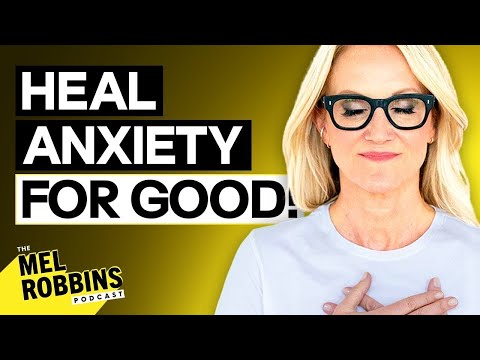
The TRUTH About ANXIETY And How To HEAL IT! | The Mel Robbins Podcast
Mel Robbins (host), Dr. Russell Kennedy (guest), Narrator
In this episode of The Mel Robbins Podcast, featuring Mel Robbins and Dr. Russell Kennedy, The TRUTH About ANXIETY And How To HEAL IT! | The Mel Robbins Podcast explores heal Anxiety By Listening To Your Body’s Alarm For Love Mel Robbins interviews Dr. Russ Kennedy, a medical doctor and neuroscientist, about a radically different way to understand and heal anxiety. Dr. Kennedy argues that anxiety is fundamentally a body-based 'alarm' rooted in childhood separation and blocked self-love, not just a thinking problem in the mind.
Heal Anxiety By Listening To Your Body’s Alarm For Love
Mel Robbins interviews Dr. Russ Kennedy, a medical doctor and neuroscientist, about a radically different way to understand and heal anxiety. Dr. Kennedy argues that anxiety is fundamentally a body-based 'alarm' rooted in childhood separation and blocked self-love, not just a thinking problem in the mind.
They distinguish between 'neck-up' cognitive tools (like Mel’s 5 Second Rule) that help you cope, and 'neck-down' somatic tools that address the root cause stored in the nervous system. Anxiety thoughts are reframed as a secondary symptom: the mind’s attempt to explain and amplify an underlying physical alarm.
The conversation focuses on how to locate alarm in the body, relate to it as your younger self asking for love and reassurance, and use simple practices to regulate your nervous system. Over time, repeatedly turning toward the alarm with compassion rather than escaping into thoughts or addictions can significantly reduce chronic anxiety.
Listeners are given concrete daily practices—like placing a hand where they feel alarm, repeating 'I am safe in this moment,' and using a specific breathing pattern—to start building a healing, self-loving relationship with their anxiety.
Key Takeaways
Anxiety usually starts in the body as 'alarm,' not in your thoughts.
Dr. ...
Get the full analysis with uListen AI
All anxiety is a form of separation anxiety, often rooted in childhood.
Experiences of feeling unseen, mismatched, unsafe, or emotionally distant from caregivers create a background alarm that lives in the body. ...
Get the full analysis with uListen AI
Healing anxiety requires a neck-down approach that reconnects you to your body.
While cognitive tools and talk therapy help you cope, deeper healing happens when you locate the alarm in your body, stay with it, and learn to regulate your nervous system instead of escaping into your head.
Get the full analysis with uListen AI
The alarm is your younger self asking for love, not an enemy to fight.
Kennedy reframes alarm as a frightened inner child reaching up to be held. ...
Get the full analysis with uListen AI
Addictions and overwork are common ways people mute alarm instead of healing it.
He notes he rarely sees chronic anxiety without some addictive behavior—alcohol, drugs, porn, work, stress, achievement—because these serve as quick ways to numb or sublimate the unbearable body sensations instead of addressing their source.
Get the full analysis with uListen AI
Simple physical practices can quickly reduce the intensity of alarm.
Tools include: putting a hand where you feel alarm and breathing into it; asking or affirming, 'Am I safe in this moment? ...
Get the full analysis with uListen AI
Coping changes thoughts; healing repairs your relationship with yourself.
Coping is like bailing water from a leaky boat—changing anxious thoughts without addressing why the hull is cracked. ...
Get the full analysis with uListen AI
Notable Quotes
“All anxiety is separation anxiety.”
— Dr. Russ Kennedy
“The reason why you're anxious in the first place is because you block love—for yourself.”
— Dr. Russ Kennedy
“You’re not going to solve anxiety, which is a problem of overthinking, with more thinking.”
— Dr. Russ Kennedy
“That alarm is not a signal to run away or to numb. It’s actually an alarm from a part of you that needs reassurance and love right now.”
— Mel Robbins
“If you regulate your body, your mind will follow. Your mind lies to you all the time; your body never can.”
— Dr. Russ Kennedy
Questions Answered in This Episode
If my anxiety is an alarm from my younger self, what specific childhood separations or mismatches might that alarm be pointing me toward?
Mel Robbins interviews Dr. ...
Get the full analysis with uListen AI
When I feel alarm in my body, what is my habitual escape—overthinking, scrolling, drinking, working—and what would it look like to stay and soothe instead?
They distinguish between 'neck-up' cognitive tools (like Mel’s 5 Second Rule) that help you cope, and 'neck-down' somatic tools that address the root cause stored in the nervous system. ...
Get the full analysis with uListen AI
Which part of my body most often holds alarm, and can I identify a contrasting 'safe' or neutral spot that I can practice shifting my attention to?
The conversation focuses on how to locate alarm in the body, relate to it as your younger self asking for love and reassurance, and use simple practices to regulate your nervous system. ...
Get the full analysis with uListen AI
In what subtle ways might I be blocking love—from myself or others—and how does that show up as anxiety in my daily life?
Listeners are given concrete daily practices—like placing a hand where they feel alarm, repeating 'I am safe in this moment,' and using a specific breathing pattern—to start building a healing, self-loving relationship with their anxiety.
Get the full analysis with uListen AI
If I committed to the 'I am safe in this moment' and breathing practices for 30 days, how might my relationship with anxiety—and with myself—realistically change?
Get the full analysis with uListen AI
Transcript Preview
(ticking clock) (upbeat music) Dr. Kennedy in the house, people. So let's go back to the basics, anxiety 101.
All anxiety is separation anxiety.
What does that mean?
The reason why you're anxious in the first place is because you block love. So when you say, "I love you-"
Whoa, whoa, whoa, whoa, whoa.
Yeah.
The reason why you're anxious is because you block love?
For yourself, yes.
What? I th- I just had a huge breakthrough here.
Good.
Holy shit, Russ. (upbeat music) Hey, it's Mel, and welcome to The Mel Robbins Podcast. Okay, so today's episode is freaking fire. And speaking of fire, I gotta throw some amazing celebratory fire in your direction. I gotta say thank you. Thank you so much for listening, for sharing these episodes, for being as excited as I am about this thing. I started this because I just wanted to connect with you on a deeper level, and I wanted to be able for us to inspire and empower each other to create better lives. And baby, (laughs) we are doing it. Um, I also want to say thank you for being a force for good. I love the fact that you're already pouring in topic and guest suggestions. Please keep them coming, because we are going to create this thing together. We are looking at the DMs, we're looking at the stuff that you're leaving on the forums on the website. This is something we are building together, and it is just incredible, so thank you, thank you, thank you. Okay, so today's episode, hello, game changer. This is fire, people. So what are we talking about? Um, anxiety. Yep, we gotta talk about anxiety. My mission with this episode of The Mel Robbins Podcast is to profoundly, fundamentally change the way you think about and approach anxiety. By the end of this episode, you will be empowered to do way more than just survive your anxiety or try to cope with it, okay? In just a few minutes, you are going to meet an incredible expert on the topic. His name is Dr. Russ Kennedy. He's a medical doctor. He has a degree in neuroscience. And in my opinion, he has written the book on anxiety. And so he's gonna come on and we're gonna talk all about the topic. We're gonna change the way that you think about it, that you approach it, and more importantly, Dr. Kennedy says you can heal your anxiety once and for all. Yeah, sure, you're gonna have moments where anxiety rise up, and, you know, you're gonna have stressful situations, but in terms of the ongoing overwhelm, nervousness, on edge feeling, he's gonna teach you how to heal that. His work is life-changing, and it has made a huge difference in my life, and I cannot wait for you to meet him in a few minutes. Now, the interesting thing about anxiety is that I am considered one of the world's leading experts on anxiety. And I'm what you call a life-tested expert, because my expertise has been earned the hard way, the painful way, and that is by living through and struggling with anxiety for almost 45 years. The truth is, when I really think about my past, I don't ever remember a time when I wasn't nervous, or feeling on edge, or anxious, or somewhere other than the room that I was currently standing in. I think if you can come out of the womb as a baby having a panic attack, that was Mel Robbins. And that panic that I was, I think, hardwired with in my nervous system, it only grew as I got older. In fact, you know how you go to those little camps when you're little, like with the Y or, you know, maybe you go to Girl Scout camp? I was so homesick at every single camp my parents tried to send me to, I would be sent home. In fact, there is this really infamous story about me, uh, in sixth grade. So in sixth grade at North Muskegon Elementary School, there's this huge crescendo at the end of the year, and the entire sixth grade takes over the Boy Scout and Girl Scout camp that's like 10 miles away, and everybody goes to camp for five days and four nights. And it is supposed to be the most amazing thing that happens during elementary school. Everybody talks about going to sixth grade camp. Here's the thing about Mel. I was so riddled with anxiety and panic while I was there that I called my parents every single day and begged for them to come and get me. I was so out of control that the counselors actually acquiesced and said I could go home. Now, I want you to stop and think about that. Do you know how anxious you have to be to get trained counselors to basically go, "This kid is out of control. We can't handle this. Y- we gotta get her outta h- get her parents to come pick her up. Like, I, I, d- I can't deal with this." And so I got what my anxiety wanted. I got to leave, and as I was packing up my cabin, my friends came in and they're like, "Where are you going, Mel? Tonight's the big scavenger hunt. It's the last night. Why are you leaving?" I lied to them and said, "Oh, my grandmother's had a heart attack, so my parents are coming. We gotta go. We gotta go see her." Yep, that was sixth grade Mel, full of anxiety. And it only got worse as I got older. In fact, before every track meet or tennis match that I had to play as a varsity athlete, I had such a nervous stomach. That was the term that was used back in the early '80s. "She has a nervous stomach." Well, you know how I dealt with my nervous stomach? I would stand behind, like, a bush next to the tennis courts, and I would have this blue bottle packed in my backpack. It was a blue bottle of Mylanta. This is an antacid medicine that old people drink for, for reflux. I would chug that stuff. It got so bad that my parents would start buying that stuff by the case. It was disgusting and chalky, but I chugged it anyway.Honestly, I can't believe I'm admitting this to you right now. (laughs) And here's the thing, it only got worse. I mean, little elementary school anxiety Mel turned into high school anxiety Mel, and then of course I was college train wreck anxiety Mel. I don't even wanna admit half the things I did in college when I was anxious, like jumping from one relationship to another or waking up every single morning with, uh, hangxiety full of regrets about the night before. You know, when I stop and think about... oh my God. I feel like I need Mylanta right now. My stomach is starting to be like, "Woah." And I laugh about it, but honestly at the time, it's sad. Like, I- I just didn't enjoy college. I don't even like to go to college reunions 'cause I did not like the person that I was back then as my anxiety was just raging out of control. Well, when I got to law school, thankfully, the anxiety got so unbearable that I got medical help and I was finally diagnosed with anxiety. And this would have been in the early 90s, and so anxiety was not a word that people threw around casually back then. I mean, anxiety meant there was something terribly wrong with you. People didn't talk about it. If you went to therapy, you were a freak. And so thankfully for me though, this diagnosis, it was a godsend because I finally had a word and a doctor validating what I had been struggling with for my entire life for 20 years. He prescribed Zoloft. It was a complete game-changer for me. It's almost like that medication acted like a ladder. You see, the anxiety and all the mental spiraling that it caused, that spiraling put me in a very deep hole mentally, physically, and spiritually, and that Zoloft was like a little ladder that allowed me, rung by rung, to start to climb out of that hole and do the work that you need to do to start to take control of your life. So, I took Zoloft for 20 years. In fact, the only time I didn't take Zoloft was when our first daughter, Sawyer, she's now 23 years old. So when she was born, I had been off Zoloft, uh, I had to taper off of it 'cause we didn't know if you could, like, breastfeed or whatever on that medication. They know now it's safe to breastfeed with it. But when she was born, I had such severe postpartum depression, the really scary kind where you couldn't be left alone because the doctors were afraid you were gonna hurt yourself or you're gonna hurt your baby. It was a terrifying eight-week experience in my life. And so I'm telling you, between the 45 years of dealing with my own anxiety and, on top of it, Chris and I having kids that have had anxiety that at times were so severe that they slept on the floor of our bedroom, I just always thought, "Okay, I have anxiety. That's the way that it is. It's just the way that I'm wired. I hate it. I hate having anxiety, but I just have to learn to live with it." I was wrong. You do not have to hate anxiety and you do not have to just learn to live with it. You can learn how to understand it and you can learn simple things that will help you take control of it and change how you respond to moments of uncertainty and moments of stress. And so in my early 40s, the anxiety got so crippling again because there were a lot of things going on in our life that were triggering it, that every single morning the alarm would go off and I would lay in bed for an hour and I would just stare at the ceiling. And the anxiety, it's almost like it felt like a gravity blanket pinning me to that bed. And as I would lay in that bed and think about all my problems, time would tick by, the kids would miss the bus. I became a person I didn't even recognize. But I want to just tell you that I know what it's like when anxiety is ruining or running your life, because when anxiety was at its worst for me, I created this thing called the Five Second Rule, and it was out of sheer desperation and fear that I created this thing. What is it? It's a brain hack. And if you ever feel overwhelmed by anxious thoughts or anxious feelings, just count backwards, five, four, three, two, one, and you can interrupt those thoughts and feelings and then physically move. And ever since I invented this thing, I've been teaching the Five Second Rule on stages around the world and it has changed the lives of millions of people. Now, here's one of the things I want to distinguish before we bring Dr. Kennedy on in just a second. A lot of the tools that I am known for and that I teach and the things that I've been researching that help with anxiety, that help with mindset, that help with mental health, I call these tools a neck-up approach because they attack your mindset. They focus on your thoughts. They help you change the patterns of thought in your mind and the default thinking and the self-criticism and the worry and the procrastination and the perfectionism that can take hold. On today's episode though, we're gonna go in a different direction. We're gonna talk about a whole body of tools that you need that I would classify as a neck-down approach to anxiety. We are going to focus on the body. We're going to focus on your nervous system. We're going to focus on thinking about anxiety as something happening in your body first, because the fact is that if you only attack from the neck up with talk therapy or using my tools, yeah, it's gonna help. Yes, they are an essential part of the toolkit that you need for coping, and yes, it will make a huge difference, but what Dr. Kennedy is going to explain to you today is game-changer because he's gonna teach you that you can actually heal your anxiety.But you have to attack it from the neck down. You have to stop running away from the anxiety and address what's going on in your body, and that's exactly what we're gonna talk about today, and we're also gonna talk about how the heck do you do this. This is gonna be packed with takeaways, because I'm going to just make sure that it is. So Dr. Kennedy, he is the best-selling author of the book Anxiety Rx. His work is changing the lives of people around the world. He is helping people heal their anxiety in his clinical practice. And you're gonna wanna bookmark this episode, because you're gonna learn so many takeaways that you're gonna absolutely wanna come back to this again and again, and you definitely are gonna wanna share this with your friends and family. In fact, you'll be trying his tools as you listen to this episode. He has a degree in neuroscience, he's a medical doctor, and perhaps most importantly, like me and maybe you, he's struggled with anxiety for decades. But using what you're about to learn in this episode, he has cured himself. So let's get him on the line. Hey.
Install uListen to search the full transcript and get AI-powered insights
Get Full TranscriptGet more from every podcast
AI summaries, searchable transcripts, and fact-checking. Free forever.
Add to Chrome