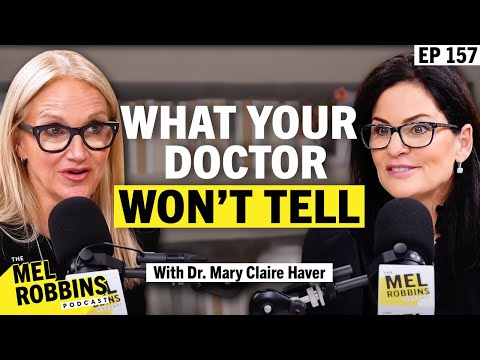
The #1 Menopause Doctor: How to Lose Belly Fat, Sleep Better, & Stop Suffering Now
Mel Robbins (host), Dr. Mary Claire Haver (guest), Narrator
In this episode of The Mel Robbins Podcast, featuring Mel Robbins and Dr. Mary Claire Haver, The #1 Menopause Doctor: How to Lose Belly Fat, Sleep Better, & Stop Suffering Now explores rewriting Menopause: Science, Symptoms, and Solutions For Women’s Health Mel Robbins interviews menopause specialist Dr. Mary Claire Haver about what actually happens to women’s bodies, brains, and hormones during perimenopause and menopause.
Rewriting Menopause: Science, Symptoms, and Solutions For Women’s Health
Mel Robbins interviews menopause specialist Dr. Mary Claire Haver about what actually happens to women’s bodies, brains, and hormones during perimenopause and menopause.
They explain how estrogen loss impacts every organ system, driving symptoms from hot flashes and belly fat to joint pain, brain fog, UTIs, and cardiovascular risk—most of which are poorly understood and under-treated by mainstream medicine.
Dr. Haver debunks long-standing fears about hormone replacement therapy (HRT), clarifies who can safely use it, and emphasizes that menopause-related declines in bone, heart, and metabolic health are largely preventable.
The conversation ends with practical guidance: how to find a knowledgeable provider, what to change in nutrition, movement, sleep, and supplements, and why talking openly about menopause can literally change and even save women’s lives.
Key Takeaways
Estrogen loss affects every organ system—not just hot flashes and periods.
Estrogen receptors exist in the brain, heart, lungs, joints, bones, gut, and genital/urinary tract, so when estrogen sharply declines, women can develop symptoms as diverse as brain fog, asthma flares, frozen shoulder, joint pain, UTIs, vaginal dryness, and cardiovascular changes.
Get the full analysis with uListen AI
Perimenopause can start as early as 35 and last 7–10 years.
Women may first notice vague issues—irregular or heavy periods, mood changes, migraines, brain fog, joint pain, or gut problems—long before their period stops, and many of these are hormone-driven even if blood tests look “normal.”
Get the full analysis with uListen AI
Menopause is one day; everything after is post-menopause—and risk accelerates then.
Medically, menopause is defined as one day, exactly one year after your last period; from then on you are post-menopausal, with rising risk of osteoporosis, cardiovascular disease, visceral belly fat, and genital/urinary problems unless you intervene.
Get the full analysis with uListen AI
HRT is far safer and more beneficial than many women have been told.
For most women within 10 years of menopause onset, appropriately prescribed estrogen (with progesterone when needed) lowers all-cause mortality and cardiovascular risk; prior hysteria largely came from a misinterpreted study done in older women and has since been substantially walked back.
Get the full analysis with uListen AI
Bone loss and many fractures are largely preventable with early action.
Because estrogen normally helps maintain bone remodeling, its loss leads to porous, fracture-prone bones; up to 50% of women will have an osteoporotic fracture, and a hip fracture after 65 carries about a 29% one-year mortality—yet bone strength can be protected with HRT, resistance training, adequate vitamin D, and lifestyle.
Get the full analysis with uListen AI
Nutrition and gut health are central: fiber, magnesium, omega-3s, vitamin D, and probiotics matter.
Dr. ...
Get the full analysis with uListen AI
Women need resistance training, better sleep hygiene, and usually much less alcohol.
Shifting from purely cardio and “skinny at all costs” to muscle-building work protects bones, joints, and metabolism; good sleep often requires addressing hormones, blue light, and anxiety, and even one drink can severely disrupt sleep for many midlife women.
Get the full analysis with uListen AI
Notable Quotes
“We’re going to live a third of our lives like this, and after reproductive options are taken off the table, it’s almost like medicine leaves us behind.”
— Dr. Mary Claire Haver
“Our ovaries age at twice the rate of the rest of our body.”
— Dr. Mary Claire Haver
“You will not die without estrogen—you’ll just die faster and less healthy.”
— Dr. Mary Claire Haver
“We need to normalize this before we can optimize it.”
— Dr. Mary Claire Haver
“If you’re choosing to drink, you’re choosing not to sleep.”
— Dr. Mary Claire Haver
Questions Answered in This Episode
How can a woman practically distinguish between depression, ADHD, or anxiety and hormone-driven brain changes during perimenopause and menopause?
Mel Robbins interviews menopause specialist Dr. ...
Get the full analysis with uListen AI
What specific lab tests and metrics should a midlife woman ask her doctor to run to assess bone, heart, and metabolic health related to estrogen loss?
They explain how estrogen loss impacts every organ system, driving symptoms from hot flashes and belly fat to joint pain, brain fog, UTIs, and cardiovascular risk—most of which are poorly understood and under-treated by mainstream medicine.
Get the full analysis with uListen AI
How should women with a personal or family history of breast cancer approach the risk–benefit calculus of starting or avoiding HRT?
Dr. ...
Get the full analysis with uListen AI
What does an ideal weekly exercise plan look like for a post-menopausal woman who wants to reduce visceral fat, protect bones, and improve longevity?
The conversation ends with practical guidance: how to find a knowledgeable provider, what to change in nutrition, movement, sleep, and supplements, and why talking openly about menopause can literally change and even save women’s lives.
Get the full analysis with uListen AI
If most doctors are undertrained in menopause, how can patients effectively advocate for themselves and evaluate whether a provider truly understands modern menopause care?
Get the full analysis with uListen AI
Transcript Preview
(gasps) Hey, I'm so glad you're here. I promised you I'd be in the studio today. Shay Hall Day, she's here too. You can't see Maddie, but she's right behind you. So we are about to have the amazing Dr. Mary Claire, uh, Haver jump in that seat. And I just wanna tell you, this is gonna be one of those episodes that's gonna change your life, and it will change the life of every girl and woman you know, so please share it, share it, share it, earth. You ready? You ready to start the Mel Robbins Podcast? I know you are. Me too. Don't forget to subscribe. Mwah. Let's do this.
We were living our lives, managing our stress, managing our weight, doing all the things-
Mm-hmm.
... and then all of a sudden, you can't put your finger on it, but something's changed.
That's exactly what everybody says. And whether this is happening to you, or you've heard your sister, or your mother, or your partner say this, we start going, "My, my pants are not fitting. I am grouchy. Suddenly I feel like I have ADHD, or brain fog, or dementia."
Mm-hmm.
"I don't feel like myself in my body."
You are every single patient who comes in my office, this exact same story.
(instrumental music)
Hey, it's Mel, and I'm so glad that you're here today, whether you're listening for yourself or because someone that you loved shared this episode with you. I wanna welcome you to the Mel Robbins Podcast family, and thank you. Thank you for making this podcast one of the most popular podcasts in the entire world. It is an absolute honor to be able to spend some time with you today, and I wanna start by acknowledging you for something. You could be listening or watching to a bazillion things right now, but you chose to take some time for yourself and listen to something that can help you create a better life. And today, holy cow, is that gonna happen, because we are digging into a topic that is impacting nearly 1.2 billion people. It also happens to be one of the most requested subjects that you've been asking me to cover, and one of the reasons why you want me to cover it is because there is so much confusion, so much conflicting information about this subject. What am I talking about? Menopause. It is time that you feel informed about what's going on with your body, your brain, and your hormones. And if this is not impacting you personally, do not change this. Listen, because it is impacting someone you love. Oh, I have been dying to have this conversation about women's hormone health and menopause with you, because I gotta be honest with you, every single friend of mine has been texting and DMing each other. We are lighting up the group chats. I am no longer sending my friends memes and funny quotes right now. You know what I'm sending them? Articles about hormone changes, articles about supplements. I've been complaining to my poor husband, Chris, about how bloated, itchy, irritated I am. I'm confused about what to do. And you know what? This approach is not helping Chris to understand me. It's not helping me to understand the changes that I'm experiencing, and I'm sharing this with you because if you're overwhelmed by the topic of hormone changes or menopause, or you're experiencing challenges with your monthly cycle, or maybe you're just tired, you're tired of hearing your mother or your significant other complain about the changes in her body, boy, oh, boy, are you about to learn a lot. One of the reasons why so many of you feel so powerless about your hormones is because your doctor is probably not informed about this topic either. So you're not getting the answers, the information, and the simple things that you can do that you deserve. Well, that changes today, because your friend Mel Robbins has tracked down one of the leading specialists on menopause and estrogen deficiency. She has hopped on a plane from Texas, and this woman is so busy, I cannot believe she's taken time out to be with you and me here in our studios in Boston. She has come to share with you everything that the research says, and more importantly, the simple things that you can do. And there's a lot that is going to surprise you today. For example, didn't know perimenopause can start as early as the age of 35. And, you know, I know that hot flashes and belly fat are symptoms of hormone changes. It's probably just the symptoms that I complain about the most, but current research is finding that things like ringing in your ears, frozen shoulder, I didn't even know that was a thing, dry skin, dry mouth, body odor, anxiety, fatigue, lack of a sex drive, autoimmune diseases, and on and on, can all potentially be tied back to the changes your body is experiencing because of menopause. I am so honored for you to meet our expert today, because she's gonna simplify this topic so that you no longer feel overwhelmed and left behind by the medical community, but rather you feel empowered and excited about what you can do. So let me tell you a little bit about Dr. Mary Claire Haver. She is a board certified obstetrics and gynecology specialist. Dr. Haver is also a certified menopause practitioner from the Menopause Society, and you're gonna learn why that's actually a very big deal a little bit later in our conversation. She's also a certified culinary medicine specialist from Tulane University, a best-selling author, and author of the incredible brand new book, The New Menopause. She's the founder of the Mary Claire Wellness Clinic, which is dedicated to the care of menopausal patients. And, this is really important, she has two kids. And just like me, she's 55. She's juggling a big career, a marriage, and motherhood, and she has so much to share with you today that you will be able to apply to your life as you're listening, as soon as you're done. And I wanna remind you, this is not just for you. Please share this with every single woman that you know, because what you are about to hear will change your life and hers. Without further ado, please help me welcome Dr. Haver to the Mel Robbins Podcast.
Install uListen to search the full transcript and get AI-powered insights
Get Full TranscriptGet more from every podcast
AI summaries, searchable transcripts, and fact-checking. Free forever.
Add to Chrome