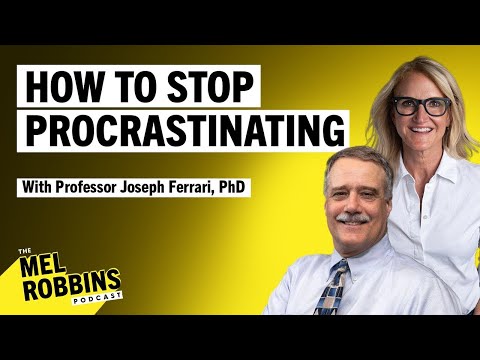
How to Stop Procrastinating, According to the World’s Leading Expert (It’s Not What You Think)
Mel Robbins (host), Dr. Joseph Ferrari (guest), Narrator, Narrator
In this episode of The Mel Robbins Podcast, featuring Mel Robbins and Dr. Joseph Ferrari, How to Stop Procrastinating, According to the World’s Leading Expert (It’s Not What You Think) explores world’s Top Procrastination Expert Exposes Myths And Teaches Real Change Mel Robbins interviews Dr. Joseph Ferrari, a leading psychologist on procrastination, to clarify what procrastination really is and how to overcome it. Ferrari distinguishes everyday delaying from true, chronic procrastination and defines it as the intentional, irrational delay of tasks that blocks goals and causes distress. He explains that procrastination is not about time management or genetics, but a learned, maladaptive coping style rooted in protecting self‑image, perfectionism, and avoiding failure. The conversation offers research-backed strategies—like cognitive-behavioral approaches, reward structuring, public commitments, and breaking tasks into smaller “trees”—while emphasizing that change is possible and self‑criticism is counterproductive.
World’s Top Procrastination Expert Exposes Myths And Teaches Real Change
Mel Robbins interviews Dr. Joseph Ferrari, a leading psychologist on procrastination, to clarify what procrastination really is and how to overcome it. Ferrari distinguishes everyday delaying from true, chronic procrastination and defines it as the intentional, irrational delay of tasks that blocks goals and causes distress. He explains that procrastination is not about time management or genetics, but a learned, maladaptive coping style rooted in protecting self‑image, perfectionism, and avoiding failure. The conversation offers research-backed strategies—like cognitive-behavioral approaches, reward structuring, public commitments, and breaking tasks into smaller “trees”—while emphasizing that change is possible and self‑criticism is counterproductive.
Key Takeaways
Procrastination is intentional, irrational delay that blocks your goals.
Ferrari defines procrastination as purposefully putting off a needed task even though you know it’s irrational and it will hurt your progress; this makes it a maladaptive lifestyle choice, not mere scheduling inconvenience.
Get the full analysis with uListen AI
Most people procrastinate sometimes, but only about 20% are chronic procrastinators.
Chronic procrastination shows up consistently across time and life domains (work, home, relationships, bills, logistics), not just on one hated task, and this group is more common than depression or alcoholism.
Get the full analysis with uListen AI
Time management systems are largely ineffective for true procrastinators.
Meta-analyses show that time management is the least effective intervention; what actually helps is cognitive behavioral therapy (CBT) that changes how you think and act, rather than how you schedule.
Get the full analysis with uListen AI
Procrastination is learned, not genetic—so it can be unlearned.
Ferrari stresses there is no “procrastination gene”; habits and modeled behavior (often from parents) teach procrastination, which means with effort and the right strategies, you can change those patterns.
Get the full analysis with uListen AI
The “I work best under pressure” story is a harmful myth.
Lab studies show last-minute workers make more errors and accomplish less, even though they believe they performed better; the pressure gives a thrill but not better results.
Get the full analysis with uListen AI
Procrastination often protects your image by blaming lack of effort, not ability.
By delaying, people can say, “I’d have done better with more time,” preserving social esteem and avoiding the more painful belief that they might lack ability; this self-protection keeps the cycle going.
Get the full analysis with uListen AI
Practical tools include pairing unpleasant tasks with rewards and making public commitments.
Using the Premack principle—rewarding a disliked task with a liked activity—and publicly posting your goals or deadlines increases follow-through; breaking big “forests” into tiny “trees” or even “leaves” makes starting far less overwhelming.
Get the full analysis with uListen AI
Notable Quotes
“Procrastination is the intentional delay of a target task that is irrational and prevents you from reaching your goal.”
— Dr. Joseph Ferrari
“Everybody procrastinates, but not everyone is a procrastinator.”
— Dr. Joseph Ferrari
“You learned to be a procrastinator, so you can unlearn it.”
— Dr. Joseph Ferrari
“The least effective technique, the technique that will not work with procrastinators, is time management.”
— Dr. Joseph Ferrari
“I procrastinated doesn’t mean I have to be a procrastinator.”
— Dr. Joseph Ferrari
Questions Answered in This Episode
How can someone realistically start applying CBT-style thinking to their procrastination if they don’t have access to a therapist?
Mel Robbins interviews Dr. ...
Get the full analysis with uListen AI
What are some concrete examples of “trees” and “leaves” for big, overwhelming life goals like changing careers or getting out of debt?
Get the full analysis with uListen AI
How do you distinguish between a legitimate constraint (like illness or childcare) and a sophisticated excuse you’re telling yourself?
Get the full analysis with uListen AI
If procrastination is learned in families, what can parents do differently to avoid passing this pattern to their children?
Get the full analysis with uListen AI
How should partners or coworkers set boundaries and consequences with a chronic procrastinator without becoming their “rescuer” or therapist?
Get the full analysis with uListen AI
Transcript Preview
What are we talking about? The big P, procrastination.
Do not listen to the current media people who are coming out and saying, "Procrastination," you know, "There's a good side to procrastination." (Imitates buzzer) Are we born this way? No.
What?
20% of adult men and women are chronic procrastinators. That's higher than depression, substance abuse, panic attacks, alcoholism. This is somebody who will not RSVP on time and wait till the gauge goes on empty before they get more gas or get the third bill before they pay it.
That's me. (laughs)
To them-
That's me.
Yeah, of course, 20% of people-
What do you mean, of course?
You showed up 20 minutes late.
What happens in your brain when you procrastinate?
Why are you going there? The least effective technique, the technique that will not work with procrastinators is time management. What works is- (ticking sound)
Hey, it's your friend Mel, and welcome to The Mel Robbins Podcast. I am so glad you tuned in today because today you and I have a doozy of a topic. This is something we all struggle with. What are we talking about? The big P, procrastination. That's right, we're going there. Is procrastination a coping mechanism? How do I stop? How do I focus? How can I help someone I love who is a procrastinator? Why the hell do I do it when I know it's not good for me? I feel like I do my best work when I'm under pressure, is that procrastination? I'll tell you what, I wanna know the answers to these questions. Don't you? I bet you do. My mission for you and me today is for us to understand, what is procrastination exactly? Now, I brought in the best of the best, Dr. Joseph Ferrari. I can tell you right now, this professor is fast like a Ferrari. He has got one hell of a personality and I gotta be honest with you, when I thought about the world's leading expert on procrastination, I did not think about the word personality, but boy oh boy, does he have a big one. And he's also warned me that once he gets going, he revs that engine up and he just can't stop. So who is Dr. Joseph Ferrari? He's a renowned psychologist and professor of psychology at DePaul University, he's an international researcher, author of seven bestselling books on this topic, and he is here to get you moving forward. Dr. Joseph Ferrari is here to cut through the crap and deliver you the truth. He's gonna tell you that you can unlearn it, and he's gonna give you tools that you can start using today to stop procrastinating and to actually overcome it for good. Why? Because you don't have to live the rest of your life doing this to yourself. You can stop hating yourself for never following through and you can start doing your best work. There is a solution to procrastination, and our guest today is going to teach it to you. This episode will enlighten, inform, and inspire you to change once and for all. And yes, this is the biggest takeaway regarding the science, change is possible. So let's not procrastinate on jumping into this any further, we're gonna just let it rip. Please help me welcome Professor Joseph Ferrari to The Mel Robbins Podcast.
Install uListen to search the full transcript and get AI-powered insights
Get Full TranscriptGet more from every podcast
AI summaries, searchable transcripts, and fact-checking. Free forever.
Add to Chrome