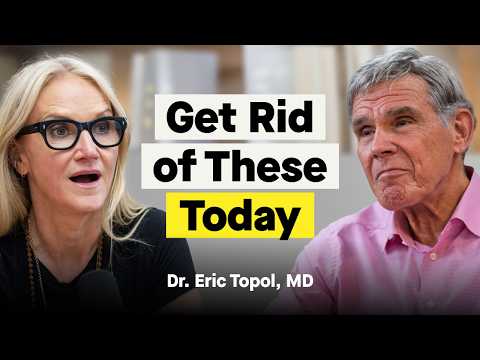
#1 Longevity Doctor: 7 Toxic Products Destroying Your Health
Mel Robbins (host), Dr. Eric Topol (guest)
In this episode of The Mel Robbins Podcast, featuring Mel Robbins and Dr. Eric Topol, #1 Longevity Doctor: 7 Toxic Products Destroying Your Health explores longevity Doctor Exposes Hidden Household Toxins Sabotaging Your Health Mel Robbins interviews renowned physician-scientist Dr. Eric Topol about how environmental toxins—microplastics, nanoplastics, and ‘forever chemicals’ (PFAS)—are silently undermining health and longevity.
Longevity Doctor Exposes Hidden Household Toxins Sabotaging Your Health
Mel Robbins interviews renowned physician-scientist Dr. Eric Topol about how environmental toxins—microplastics, nanoplastics, and ‘forever chemicals’ (PFAS)—are silently undermining health and longevity.
Topol links these pervasive exposures to rising rates of early cancers, infertility, cardiovascular disease, and systemic inflammation, especially in younger generations.
They walk through common household products (plastics, cookware, personal care items, scented candles) to show how everyday habits increase toxic burden.
While the problem is systemic and under-regulated, Topol stresses simple personal swaps plus collective pressure on industry and regulators as essential steps toward healthier aging.
Key Takeaways
Minimize contact between food and plastic, especially with heat.
Avoid microwaving food in plastic containers, storing food long-term in plastic, and using plastic utensils on hot pans, because heat and dwell time increase microplastic and nanoplastic leaching into food.
Get the full analysis with uListen AI
Replace nonstick and Teflon-type cookware with safer alternatives.
Nonstick coatings can shed plastic-related compounds into food, especially when heated and scraped; switching to stainless steel, cast iron, or uncoated alternatives reduces this ingestion pathway.
Get the full analysis with uListen AI
Scrutinize personal care and household products for fluorinated ingredients.
Hair sprays, deodorants, perfumes, menstrual products, diapers, and some cosmetics can contain PFAS; look for fluorinated or ‘perfluoro-/polyfluoro-’ chemicals and choose simpler, more natural formulations when possible.
Get the full analysis with uListen AI
Reduce indoor air pollutants from scented and treated products.
Strongly scented, colored candles and aerosol products may emit PFAS and other chemicals directly into the air you breathe; opt for unscented or clearly labeled, simple-ingredient candles and better ventilation or air filtration.
Get the full analysis with uListen AI
Adopt a ‘Lifestyle Plus’ mindset that includes environmental exposures.
Diet, exercise, and sleep remain foundational, but healthy aging now also requires consciously reducing exposure to microplastics, PFAS, air pollution, and ultra-processed foods that drive chronic inflammation.
Get the full analysis with uListen AI
Support structural change alongside individual behavior change.
Individual choices can lower personal burden, but lasting impact demands regulation, transparent labeling, and pressure on companies that rely on PFAS and plastics despite knowing their toxic potential.
Get the full analysis with uListen AI
Assume environmental toxins are harmful and act before ‘perfect proof.’
Given accumulating evidence of plastics and PFAS in arteries, brains, and reproductive organs, and parallel spikes in early cancers and infertility, Topol argues for precautionary action rather than waiting decades for definitive causality.
Get the full analysis with uListen AI
Notable Quotes
“It’s everywhere. It’s so pervasive…in our brain, reproductive organs, plastic everywhere.”
— Dr. Eric Topol
“We’re seeing people in their 20s now with colon cancer, women in their 30s with breast cancer. The question is why?”
— Dr. Eric Topol
“These things can’t be good for us. Let’s assume that they’re bad for us and do something about it.”
— Dr. Eric Topol
“The problem we have is we’re in a state of complacency. We’ve just accepted this.”
— Dr. Eric Topol
“There’s never been better prospects to prevent age-related diseases—but we have this environmental overhang getting in the way.”
— Dr. Eric Topol
Questions Answered in This Episode
How can an average person reliably identify PFAS and other problematic chemicals on labels when ingredient names are so technical and inconsistent?
Mel Robbins interviews renowned physician-scientist Dr. ...
Get the full analysis with uListen AI
What are the most impactful low-cost changes for people living in highly polluted areas with limited access to alternative products?
Topol links these pervasive exposures to rising rates of early cancers, infertility, cardiovascular disease, and systemic inflammation, especially in younger generations.
Get the full analysis with uListen AI
How strong is the current evidence linking microplastics and PFAS specifically to early-onset cancers versus other environmental and lifestyle factors?
They walk through common household products (plastics, cookware, personal care items, scented candles) to show how everyday habits increase toxic burden.
Get the full analysis with uListen AI
What policy levers or regulations would most quickly reduce population-level exposure to these chemicals without causing major economic disruption?
While the problem is systemic and under-regulated, Topol stresses simple personal swaps plus collective pressure on industry and regulators as essential steps toward healthier aging.
Get the full analysis with uListen AI
How should healthcare providers incorporate environmental exposure assessment and counseling into routine care for patients concerned about infertility, cancer risk, or autoimmune conditions?
Get the full analysis with uListen AI
Transcript Preview
What the heck is a microplastic and where is it?
(instrumental music plays) It's everywhere. It's so pervasive. In our brain, reproductive organs, plastic water bottles, plastic bags, plastic everywhere, you name it. And so this is a serious problem.
Hey, it's Mel. Today on the Mel Robbins podcast, we have Dr. Eric Topol. He is one of the most respected scientists and medical researchers who's alive today. His work has been cited in over 360,000 times in academic journals and he's gonna talk about microplastics and how there are seven toxic products that are in your home right now that are destroying your health. What are forever chemicals?
Yeah, so the PFAS, perfluoroalkylating agents. There's over 10,000 of these chemicals. Whether we're eating, breathing, or drinking, we're constantly exposed to these. They are in, you know, microscopic, minute quantities, but it isn't like they go out. I mean, (laughs) they just, we just are accumulating these into our body. A spoonful of microplastics in our brain? We're seeing people in their 20s now with colon cancer, women in their 30s, young 30s with breast cancer. The question is why? They had no genetic predisposition.
Is that your theory, that the rise in cancer in young people is due to forever chemicals and air pollution and water?
When you take that whole mix, they're all what you could consider as epidemics. The problem we have is we're in a state of complacency. We've just accepted this. I think it's time to hit the alarm now.
Dr. Topol, welcome to the Mel Robbins podcast. I am thrilled that you're here.
Thanks, I'm so thrilled to be with you.
Well, I just wanna start by congratulating you on a fantastic new bestselling book, Super Agers. I absolutely devoured this. And I'm thrilled that you're here because I cannot wait to get into a section of your book about how environmental factors are impacting how we age, our longevity, and our health overall. And so, I'm thrilled you're here and what I would love to do is start by having you speak directly to the person who's with us right now and tell them what might change about their life if they take everything that you're about to share with us and teach us today to heart, and they put it to use in their life.
Well, I mean, I think the principal things that we've been, known about for years, these lifestyle factors, I call them Lifestyle Plus because it's much more than just diet, exercise, and sleep. We have to now add in environmental factors. We haven't paid nearly enough attention and the compelling evidence that has come forth on air pollution, microplastics, nanoplastics, and the forever chemicals. These things are having a big impact and we're not doing anything about it.
For starters, I just wanna understand them because I had never heard the word microplastics, for example. And I think intellectually or common sense wise, you, of course, go, "Oh, well, you know, air pollution, of course, impacts your health," but some of the statistics that we're gonna unpack in your book in terms of the connection between environmental factors and the diseases that people get and the health, uh, challenges that people are facing, it's really scary, Dr. Topol.
Install uListen to search the full transcript and get AI-powered insights
Get Full TranscriptGet more from every podcast
AI summaries, searchable transcripts, and fact-checking. Free forever.
Add to Chrome