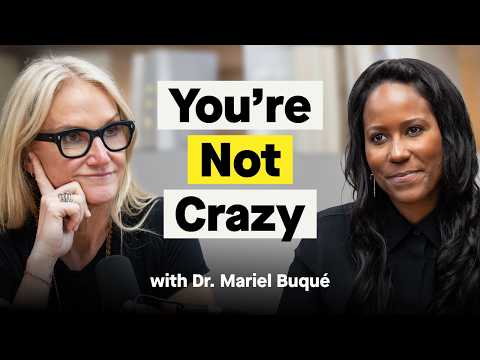
You’ll Never See Your Family the Same After This Episode
Dr. Mariel Buqué (guest), Mel Robbins (host)
In this episode of The Mel Robbins Podcast, featuring Dr. Mariel Buqué and Mel Robbins, You’ll Never See Your Family the Same After This Episode explores break Generational Trauma: Healing Yourself Without Losing Your Family Mel Robbins and psychologist Dr. Mariel Buqué explore how to recognize and heal intergenerational trauma while still staying connected to imperfect, often unhealed family members.
Break Generational Trauma: Healing Yourself Without Losing Your Family
Mel Robbins and psychologist Dr. Mariel Buqué explore how to recognize and heal intergenerational trauma while still staying connected to imperfect, often unhealed family members.
They emphasize that no one is broken; most people are carrying inherited pain and patterns, and genuine change begins with nervous system regulation, emotional literacy, and self-responsibility rather than demanding others change.
Key themes include the burden on “eldest daughters,” the loneliness of cycle breakers, the gap between women’s and men’s help-seeking, and the tension between boundaries and estrangement.
Throughout, Dr. Buqué offers practical micro-practices (breathing, rocking, humming, self-talk) and a reframing of ancestors as sources of both trauma and strength, helping listeners become conscious cycle breakers.
Key Takeaways
You are not broken; you’re carrying generations of unprocessed pain.
Reframing your struggles as inherited emotional and relational patterns reduces shame and opens the door to healing, rather than seeing yourself as fundamentally damaged.
Get the full analysis with uListen AI
Cycle breaking starts with honest self-acknowledgment, not family consensus.
The first courageous step is naming your own truth—what happened, how it hurt you, and what you need—without waiting for parents or siblings to agree or validate your experience.
Get the full analysis with uListen AI
Self-validation matters more than getting validation from family.
Because each family member had a different subjective experience, even in the same home, your healing depends on learning to believe and soothe yourself, not convincing them of your version of events.
Get the full analysis with uListen AI
Nervous system regulation is the foundation of sustainable generational healing.
Simple daily practices—conscious breathing, visualization, rocking, humming, gentle self-talk—integrated into ordinary moments (brushing teeth, commuting, cooking) gradually shift you from chronic stress to a calmer, more responsive state.
Get the full analysis with uListen AI
Buying back just one second of reaction time is proof of change.
If you can pause for a second before reacting—especially in triggering family dynamics—you’re exercising new agency instead of repeating automatic fight/flight/shutdown patterns, which is a concrete marker of cycle breaking.
Get the full analysis with uListen AI
Parentified “eldest daughters” must learn to express and receive care.
Adults who were cast as fixers and substitute parents often deny their own needs and over-function in relationships; healing means reparenting themselves, practicing asking for support, and allowing reciprocity without guilt.
Get the full analysis with uListen AI
Compassion and realistic expectations reduce unnecessary estrangement.
Seeing parents as flawed, often unhealed humans with limited tools allows you to grieve what you didn’t get, celebrate small improvements, set appropriate boundaries, and avoid cutting people off when repair is still possible and safe.
Get the full analysis with uListen AI
Notable Quotes
“You are not broken. You are simply carrying around generations of pain.”
— Dr. Mariel Buqué
“As long as we're living and breathing, we have an opportunity to initiate change in our lives and to change the trajectory of our emotional legacy.”
— Dr. Mariel Buqué
“No individual in your family can validate your experience because that's an internal job.”
— Dr. Mariel Buqué
“We first have to work with the person that wants to break the cycle.”
— Dr. Mariel Buqué
“Our ages don't determine the healing that we're capable of.”
— Dr. Mariel Buqué
Questions Answered in This Episode
Which family patterns or roles (like fixer, peacekeeper, eldest daughter) do I recognize in myself, and how are they shaping my adult relationships today?
Mel Robbins and psychologist Dr. ...
Get the full analysis with uListen AI
What truths about my childhood or family dynamics have I been avoiding naming clearly, even to myself?
They emphasize that no one is broken; most people are carrying inherited pain and patterns, and genuine change begins with nervous system regulation, emotional literacy, and self-responsibility rather than demanding others change.
Get the full analysis with uListen AI
In my daily life, where can I realistically insert five minutes of nervous system regulation—breathing, rocking, humming, or affirmations—without changing my whole schedule?
Key themes include the burden on “eldest daughters,” the loneliness of cycle breakers, the gap between women’s and men’s help-seeking, and the tension between boundaries and estrangement.
Get the full analysis with uListen AI
How might my perspective shift if I viewed my parents and ancestors as both sources of trauma and sources of strength, resilience, and dreams?
Throughout, Dr. ...
Get the full analysis with uListen AI
When I feel invalidated or minimized by family, what would self-validation look like in that moment instead of arguing or shutting down?
Get the full analysis with uListen AI
Transcript Preview
(instrumental music plays) You are not broken. You are simply carrying around generations of pain, and it can make your emotions feel, at times, unbearable and like healing is impossible. But I can tell you with certainty, you have an opportunity to create a different legacy than what you were handed. You can take that opportunity and transform your life starting today.
What's the first courageous step to take in order to start to break the generational cycle and to take responsibility for healing yourself?
The hardest step is the first step.
Dr. Mariel Bouque-
Mm-hmm.
... welcome to the Mel Robbins podcast.
Thank you. I'm so excited to be here with you, Mel.
I cannot wait for our conversation. I've been so looking forward to this. And I would love to have you start by telling me, how could my life be different? If I take everything to heart that you're about to teach-
Mm-hmm.
... me today and share with me today, h- how could that change my life?
My hope is that people can see the possibility of existing within their families in a way that feels nourishing, even if their families do not have the capacity to do the work that they need-
Ah.
... to do. That they can still take whatever they can out of that family life and leave the rest behind.
Wow. And that's why you're here, because we're gonna cover all of that today. And what I love about your work is that you put the power squarely within each and every one of us individually to create that connection, to create that nurturing experience, to shift things in a positive way through our own work in healing what we need to heal.
Absolutely. I mean, you know, you probably have been living in decades of pain, right? And taking the time to actually heal those decades, and even the preceding generations that are-
Mm-hmm.
... accumulated onto those decades that you've been suffering, you can actually shift the trajectory of your own life. So, decrease your own suffering while also modeling that for the next generation, and the next generation, and the next generation.
Um, I have a feeling that this is gonna be an episode that people listen to, and share within their family, and that they share intergenerationally.
Ah, yes.
And I'd love to have you, Dr. Bouque, to talk directly to a parent-
Mm-hmm.
... who has been sent this episode by one of their children-
Mm-hmm.
... or one of their siblings, and speak a little bit about the invitation and the opportunity-
Mm-hmm.
... that is there for them.
Mm-hmm. You have an opportunity to create a different legacy than what you were handed-
Hmm.
... to heal the parts of you that have been hurting for so long. You can take that opportunity and transform your life starting today. This is an invitation for you to be able to do that.
Is it ever too late to start this? Because I, you know, i- if you're older-
Install uListen to search the full transcript and get AI-powered insights
Get Full TranscriptGet more from every podcast
AI summaries, searchable transcripts, and fact-checking. Free forever.
Add to Chrome