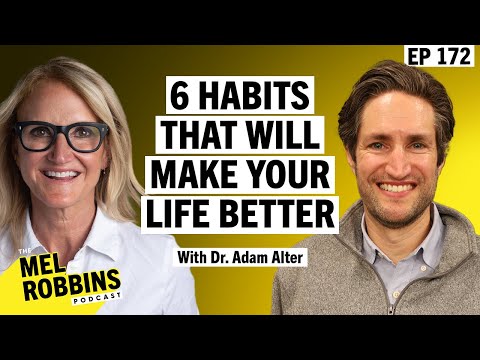
6 Simple Science-Backed Hacks That Will Make Your Life Better
Narrator, Mel Robbins (host), Dr. Adam Alter (guest)
In this episode of The Mel Robbins Podcast, featuring Narrator and Mel Robbins, 6 Simple Science-Backed Hacks That Will Make Your Life Better explores six Science-Backed Environmental Tweaks To Reclaim Time, Focus, Meaning Mel Robbins interviews psychologist and NYU professor Dr. Adam Alter about six underappreciated forces in our environment—nature, color, mirrors, money cues, clutter, and screens—that quietly shape our behavior, mood, and health.
Six Science-Backed Environmental Tweaks To Reclaim Time, Focus, Meaning
Mel Robbins interviews psychologist and NYU professor Dr. Adam Alter about six underappreciated forces in our environment—nature, color, mirrors, money cues, clutter, and screens—that quietly shape our behavior, mood, and health.
They explain how nature and "timeless" activities restore depleted attention, how specific colors can activate or calm us, and how simple tools like mirrors and plants can nudge better everyday choices.
A major focus is the addictive design of smartphones and social media, the loss of “stopping cues,” and how this rewires our tolerance for deep focus while consuming up to 15–20 years of our lives.
Alter offers practical, low-friction habits—like daily nature breaks, decluttered workspaces, screen-free rituals, and a fixed one-hour-a-day phone break—to reclaim time, agency, and a greater sense of meaning.
Key Takeaways
Schedule daily micro-doses of nature to restore attention and mood.
Even a few minutes near trees, running water, plants, or a small indoor fountain can measurably replenish your mental "battery" more than most other waking activities, counteracting the depletion from screens and focused work.
Get the full analysis with uListen AI
Use color strategically: red for dominance and attraction, blue/green for calm.
Research shows red clothing or borders can boost perceived dominance and attractiveness (e. ...
Get the full analysis with uListen AI
Place mirrors where you’re tempted to indulge to trigger self-scrutiny.
Seeing your own face makes you more honest and reflective; a small mirror on the snack cupboard, liquor cabinet, or similar "danger zones" can interrupt autopilot and reduce impulsive, misaligned choices.
Get the full analysis with uListen AI
Reduce visual clutter in work areas to improve focus and creative thinking.
Every visible object silently competes for attention; a simpler, less cluttered workspace lowers background distraction and makes scarce deep-focus blocks (even 10–20 minutes) more productive.
Get the full analysis with uListen AI
Differentiate between empty scrolling and meaningful screen use.
Not all screen time is harmful; the key question is whether you feel better, happier, and more fulfilled afterward. ...
Get the full analysis with uListen AI
Reintroduce ‘stopping cues’ to break endless digital consumption loops.
Platforms remove natural endpoints (like chapters or credits) via bottomless feeds and autoplay. ...
Get the full analysis with uListen AI
Protect at least one fixed, screen-free hour daily to reclaim years of life.
By placing your phone in another room or a “cookie jar” at the same hour each day and doing something more enriching, you gradually trade what could add up to 15–20 years of mindless scrolling for activities that build connection, health, and meaning.
Get the full analysis with uListen AI
Notable Quotes
“Being in a natural environment is one of the best forms of medicine we have.”
— Dr. Adam Alter
“When you are sitting in a forest, you could have been doing that a thousand years ago and seeing exactly the same thing.”
— Dr. Adam Alter
“It’s something that you want to do over and over again… despite recognizing that you’re not enjoying it and that it’s not very good for you.”
— Dr. Adam Alter (on screen addiction)
“That’s the only thing to ask yourself: ‘Do I feel better, happier, like my life is more meaningful after this, or do I feel worse off, like I’m empty?’”
— Dr. Adam Alter
“Twenty years of your life is spent just scrolling on your phone.”
— Dr. Adam Alter
Questions Answered in This Episode
If I audited my last week of phone use, how much of it would I honestly describe as leaving me feeling "better" versus "empty"?
Mel Robbins interviews psychologist and NYU professor Dr. ...
Get the full analysis with uListen AI
What specific hour each day could I most realistically designate as a non-negotiable, phone-free block, and what would I want to do instead?
They explain how nature and "timeless" activities restore depleted attention, how specific colors can activate or calm us, and how simple tools like mirrors and plants can nudge better everyday choices.
Get the full analysis with uListen AI
How could I redesign my bedroom, kitchen, or workspace using nature, color, and decluttering to better support the person I want to become?
A major focus is the addictive design of smartphones and social media, the loss of “stopping cues,” and how this rewires our tolerance for deep focus while consuming up to 15–20 years of our lives.
Get the full analysis with uListen AI
In what situations might wearing or surrounding myself with red be helpful, and when might it send the wrong social signal?
Alter offers practical, low-friction habits—like daily nature breaks, decluttered workspaces, screen-free rituals, and a fixed one-hour-a-day phone break—to reclaim time, agency, and a greater sense of meaning.
Get the full analysis with uListen AI
What timeless activities—nature, movement, conversation, creative work—do I miss most, and what small change this week would bring at least one of them back into my life?
Get the full analysis with uListen AI
Transcript Preview
(instrumental music plays)
20 years of your life is spent just scrolling on your phone?
Looking at your phone. It'll be about, for most of us, 20 years on average.
W- wait, what?
Yeah. It's something that you want to do over and over again. You wanna return to your screen, you wanna keep using it, despite recognizing that you're not enjoying it and that it's not very good for you. That's the only thing to ask yourself. "Do I feel better, happier, like my life is more meaningful after this? Or do I feel worse off, like I'm empty?"
It's true, I do feel empty.
Yeah. That's what people say when they spend huge amounts of time scrolling. They feel kinda empty.
I hate that you put it like that.
Yeah. I, I don't love that it's true, but I think that's what's going on.
How do you stop?
It's very difficult. I mean, I think... (swoosh sound)
(instrumental music plays)
Hey, it's your friend Mel, and today, you and I are talking with one of the top psychology experts and professors in the world, and he's gonna reveal six specific things that play a huge role in your success, happiness, and health. Now, these are things that you interact with in your day-to-day life that you probably don't think about at all. But after our conversation today, you're gonna know what they are, and more importantly, how to use 'em to your advantage. Dr. Adam Alter is here in our Boston studios today. He is a renowned researcher and professor at NYU's Stern School of Business, and the Robert Stansky Teaching Excellence Faculty Fellow. He received his PhD in Psychology from Princeton University, where he also completed two fellowships, which means he's really (laughs) smart. And he's the author of three New York Times bestsellers: Irresistible, Drunk Tank Pink, and the brand new best-selling book, Anatomy of a Breakthrough. Now, Dr. Alter is here today to break it all down, share his research with you about the unexpected forces that shape how you think, feel, and behave, including one change today that, based on the research, will give you 20 years of your life back. So please help me welcome Dr. Adam Alter to the Mel Robbins Podcast. Thank you so much for making the trip to Boston.
Thank you for having me. It's good to be here.
It's terrific to be with you. I'm so excited to learn from you today. And I wanted to start off by asking you if you could just speak directly to the person who's listening and tell them what they're about to learn, and how their life could change if they really apply what you're gonna teach 'em today.
Sure. So I think there are two things. The first thing is I think we sail through life generally not really understanding what's shaping how we feel and behave, and what's guiding us in the, the directions that we happen to be moving. So the first thing is I think you're gonna understand a number of the things that are guiding you that you don't recognize are there. But the second thing is because you understand what those things are, you're able to act on them. You're able to use them to your benefit. Maybe the ones that are pushing you in the wrong direction, you can kind of stave them off. So I think it's, it's a combination of both of those things.
Install uListen to search the full transcript and get AI-powered insights
Get Full TranscriptGet more from every podcast
AI summaries, searchable transcripts, and fact-checking. Free forever.
Add to Chrome