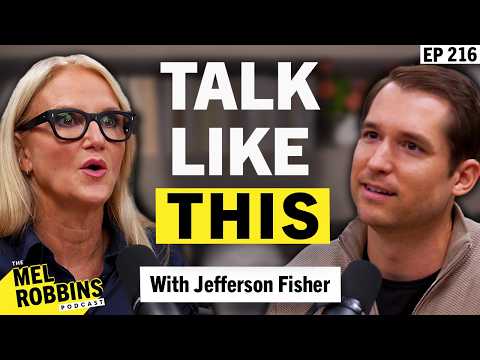
Communicate with Confidence: The Blueprint for Mastering Every Conversation
Jefferson Fisher (guest), Mel Robbins (host)
In this episode of The Mel Robbins Podcast, featuring Jefferson Fisher and Mel Robbins, Communicate with Confidence: The Blueprint for Mastering Every Conversation explores master Any Conversation: Transform Relationships With Intentional, Powerful Words Mel Robbins interviews trial lawyer and communication expert Jefferson Fisher on how to become a more confident, effective communicator in every area of life. Fisher argues that “what you say is who you are,” because most people only experience you through your words, and you can change your life by changing what you say next. They unpack practical strategies for handling conflict, criticism, disrespect, difficult conversations, social anxiety, and family/work dynamics. Throughout, Fisher emphasizes directness with kindness, separating the person from the problem, and aligning your communication with clear values and goals.
Master Any Conversation: Transform Relationships With Intentional, Powerful Words
Mel Robbins interviews trial lawyer and communication expert Jefferson Fisher on how to become a more confident, effective communicator in every area of life. Fisher argues that “what you say is who you are,” because most people only experience you through your words, and you can change your life by changing what you say next. They unpack practical strategies for handling conflict, criticism, disrespect, difficult conversations, social anxiety, and family/work dynamics. Throughout, Fisher emphasizes directness with kindness, separating the person from the problem, and aligning your communication with clear values and goals.
Key Takeaways
Treat arguments as knots to unravel, not fights to win.
Instead of yanking harder on your side, get on the same “side of the table” and ask clarifying questions like “What did you hear? ...
Get the full analysis with uListen AI
Use “what” instead of “why” to reduce defensiveness.
Questions starting with “why” feel accusatory (“Why did you say that? ...
Get the full analysis with uListen AI
Deliver hard truths directly, but frame them with respect and belief in the other person.
Skip the nervous tap‑dancing and say, “I have bad news,” or “This isn’t a fun conversation,” then add, “I’m telling you this because I know you can handle it,” or name a quality they’ll rise up to (e. ...
Get the full analysis with uListen AI
Separate the person from the problem to reduce blame and resistance.
Shift from “Your room is a mess” to “This room is messy—what should we do about it? ...
Get the full analysis with uListen AI
Disarm belittling and disrespect by slowing things down, not reacting.
When someone belittles you, ask them to repeat it (“I need you to say that again”) or question intent (“Did you say that to embarrass me? ...
Get the full analysis with uListen AI
Say less, more clearly: let your breath be your first word.
Before speaking, pause and breathe, then state your point simply (“This is not something I’m comfortable with”) instead of over‑explaining. ...
Get the full analysis with uListen AI
Guide every interaction with conversational goals and values.
Decide in advance what you want from a conversation (“I want us aligned after this”) and how you’ll show up (e. ...
Get the full analysis with uListen AI
Notable Quotes
“What you say is who you are to people. That’s the only time they will experience who you are.”
— Jefferson Fisher
“Arguments are knots in the conversation, not something to win.”
— Jefferson Fisher
“People will admire you more and see you as more confident every time you say what you want to say fully.”
— Jefferson Fisher
“Instead of being a waterfall, be a well.”
— Jefferson Fisher
“Even if you said things in the past that you regret, you can change everything about your life by what you say next.”
— Jefferson Fisher
Questions Answered in This Episode
How would my relationships change if I consistently asked, “What did you hear?” instead of defending myself?
Mel Robbins interviews trial lawyer and communication expert Jefferson Fisher on how to become a more confident, effective communicator in every area of life. ...
Get the full analysis with uListen AI
In my next difficult conversation, what quality could I name in the other person that I want them to rise up into?
Get the full analysis with uListen AI
Where am I confusing kindness with avoidance—soft‑pedaling the truth instead of being lovingly direct?
Get the full analysis with uListen AI
What conversational values do I want to live by, and how would they change the way I speak at home and at work?
Get the full analysis with uListen AI
In what recurring conflict could I immediately separate the person from the problem and invite them to sit “next to me” against the issue?
Get the full analysis with uListen AI
Transcript Preview
What you say is who you are. The power to communicate is that you compress your entire personality into just what they hear you say, because what is sent is not what is received. So what you thought you said is not what they heard.
Hmm.
The question is, what did you hear? People will admire you more. They will see you as somebody with more respect and more confidence every time when you say what you want to say fully.
No wonder so many people follow you. Hey, it's your friend, Mel. I am so excited that you're here. It's always such an honor to spend time with you and to be together. And if you're brand new, welcome to the Mel Robbins Podcast family. I also want to take a moment and just acknowledge you for taking time to listen to something that can truly help you live a better life. I've been super stressed because I've got some big deadlines with my next book coming out. And look, I'm human. I can try my best, but there are days where I still take my stress out on my family. And when I snap at them, I'm always quick to apologize, and I'm always saying, "I'm really sorry. I didn't mean to be a jerk. I didn't mean to use that tone of voice." I was just so stressed. Well, according to Jefferson Fisher, who is in our Boston studios today, blaming your bad behavior on stress is a bad apology. There's a better way for you to communicate, and you and I are going to learn how to be a better communicator from Jefferson Fisher. Let me tell you a little about him. He's a trial lawyer who has millions of followers online who turn to him every single day for his powerful and poignant communication tips. Jefferson says, "What you say is who you are." You can learn how to be more articulate, confident, and persuasive. And you know what I love most about Jefferson, is that the videos that millions of people are watching every day, he's making them in the front seat of his car in between court cases and meetings with his clients. His advice is simple, packs a powerful punch. So I tracked him down, and Jefferson has put his cases on hold. He's flown here from Texas to be in our Boston studios to tell you and me exactly what to say and when you should say nothing at all. Jefferson, welcome to the Mel Robbins Podcast.
Mel Robbins. Thank you for having me.
Oh my gosh, I'm so thrilled that you are here. Where I would really love to start is, Jefferson, could you tell the person listening how their life might change if they take everything that you're about to share with us today to heart and they apply it in their life?
They will have the power to change everything they could want to about their life, their relationships, and where they want to go, because for the vast majority of people, and especially any person who listens right now, what you say is who you are to people. That's the only time they will experience who you are. You can't be a kind person if you don't say kind things. When you hear somebody say, "Oh, that person was nice," well, what you mean is they said nice things to me. Same thing if somebody's rude. You, you hear something you don't like. So it's the power to communicate. And the tips that I give are short, concise, of how they can be better and improve the next conversation that they have.
Install uListen to search the full transcript and get AI-powered insights
Get Full TranscriptGet more from every podcast
AI summaries, searchable transcripts, and fact-checking. Free forever.
Add to Chrome