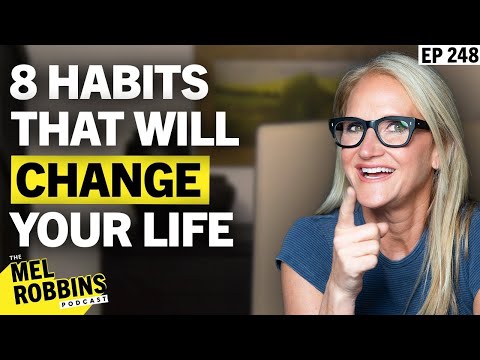
8 Habits That Will Change Your Life: The Expert Advice You Need This Year
Mel Robbins (host), Guest (guest), Guest (guest), Guest (guest), Guest (guest), Guest (guest), Guest (guest), Guest (guest), Guest (guest)
In this episode of The Mel Robbins Podcast, featuring Mel Robbins and Guest, 8 Habits That Will Change Your Life: The Expert Advice You Need This Year explores eight Expert-Backed Habits To Transform Stress, Health, and Self-Worth Mel Robbins curates the most shared and rewatched expert moments from her podcast, focusing on science-backed habits that change how you handle stress, health, mental illness, and self-worth.
Eight Expert-Backed Habits To Transform Stress, Health, and Self-Worth
Mel Robbins curates the most shared and rewatched expert moments from her podcast, focusing on science-backed habits that change how you handle stress, health, mental illness, and self-worth.
Neuroscientists and physicians explain how stress and lifestyle impact your brain, body, menopause, and mental health—and offer simple protocols like breathing resets, diet shifts, movement, and sleep hygiene.
Spiritual and psychological voices explore self-compassion, regret, and authenticity, sharing end-of-life lessons that reveal what actually matters: relationships, dropping performance, and embracing your whole story.
Across all clips, the through line is clear: you have far more power than you think to protect your brain, regulate stress, heal emotionally, and live a truer, more connected life—starting with small daily habits.
Key Takeaways
Chronic stress literally reshapes your body and brain.
Persistently high cortisol drives stubborn belly fat, corrodes immunity, and puts your brain into “low power mode,” weakening creativity, problem-solving, and emotional regulation—making stress management non-negotiable, not optional.
Get the full analysis with uListen AI
Stress is contagious, especially from leaders and loved ones.
Like silverback gorillas, the stress of bosses or parents cascades through a group. ...
Get the full analysis with uListen AI
Real productivity requires honoring breaks, not powering through.
Human performance follows a bell curve: too little stress and too much stress both tank your output. ...
Get the full analysis with uListen AI
Diet, movement, and sleep are powerful levers in menopause and mental health.
For menopause, fiber, magnesium, omega-3s, vitamin D, resistance training, hormone support, phone hygiene, and sharply limiting alcohol can radically improve symptoms. ...
Get the full analysis with uListen AI
You cannot heal while you are still punishing yourself.
Sitting with yourself while replaying shame and criticism just cements pain. ...
Get the full analysis with uListen AI
You are more than your worst moment—or your best achievement.
Sarah Jakes Roberts reframes identity as “this and that”: you can be a teen mom and a bestselling author, divorced and powerful. ...
Get the full analysis with uListen AI
End-of-life regrets center on misplaced priorities and performance.
Longitudinal research and hospice experience show people regret overworking, worrying what others think, and “performing” instead of being themselves. ...
Get the full analysis with uListen AI
Notable Quotes
“You cannot heal while you're still punishing yourself.”
— Sarah Jakes Roberts
“A break is not just a nice-to-have luxury. Your brain and your body need a break.”
— Dr. Aditi Nerurkar
“The biggest regret was, ‘I wish I hadn't spent so much time at work. I wish I had spent more time with people I cared about.’”
— Dr. Robert Waldinger
“Every being is whole and there's no need for a performance.”
— Dr. Zach Bush
“Emotional resonance makes hippocampal-dependent memories stick.”
— Dr. Wendy Suzuki
Questions Answered in This Episode
Which of my current stressors are truly threats—and which are just conditioned reactions that I can start to disengage from?
Mel Robbins curates the most shared and rewatched expert moments from her podcast, focusing on science-backed habits that change how you handle stress, health, mental illness, and self-worth.
Get the full analysis with uListen AI
If I treated breaks as a biological necessity rather than a reward, how would my daily schedule and phone use change?
Neuroscientists and physicians explain how stress and lifestyle impact your brain, body, menopause, and mental health—and offer simple protocols like breathing resets, diet shifts, movement, and sleep hygiene.
Get the full analysis with uListen AI
What would it look like to stop performing in one area of my life this week and show up more as my unedited self?
Spiritual and psychological voices explore self-compassion, regret, and authenticity, sharing end-of-life lessons that reveal what actually matters: relationships, dropping performance, and embracing your whole story.
Get the full analysis with uListen AI
If I fast-forwarded to the end of my life, what relationships or experiences would I most regret neglecting right now?
Across all clips, the through line is clear: you have far more power than you think to protect your brain, regulate stress, heal emotionally, and live a truer, more connected life—starting with small daily habits.
Get the full analysis with uListen AI
What’s one small, specific protocol—dietary, sleep, movement, or self-compassion—that I’m willing to commit to for the next 21 days?
Get the full analysis with uListen AI
Transcript Preview
This year, we had 43 amazing experts that appeared on the Mel Robbins podcast, and some of them were so incredible, they actually appeared a couple times. And I started to wonder, who were the favorites for you and your fellow listeners around the world? I mean, I'm talking the best of the best. So I decided to figure it out. What episodes did you share the most? What did you comment on? What specific moments did you watch over and over again on YouTube? Well, I've crunched the data, I've reviewed hundreds of hours of our podcasts from this year, and today, I am so thrilled because I have the best of the best of the best from this past year on the Mel Robbins podcast. All right. Let's do this. Hey, it's your friend Mel, and welcome to the Mel Robbins podcast. I am so fired up that you're here today. I mean, it's always an honor to be able to spend time together, but today especially. You want to know why? Because I'm gonna hand the mic over to you. This episode today, it's all about your favorite moments and your fellow listeners' favorite moments from the Mel Robbins podcast from over the past year. And if you're brand new, I wanna welcome you to the Mel Robbins podcast family. This is the perfect episode for you to listen to as your very first episode, because you're gonna get a sampling of the kind of experts that we talk to on this podcast every single week, and you're gonna love it. And the fact is, I get hundreds of messages and emails and comments from you about episodes that hit home all year long, the ones that made you stop in your tracks, the ones that made you replay a clip over and over, the ones that you kept sending to someone that you love. And so first of all, it was so fun to just dig in and crunch the data and compile this episode. In fact, if you're watching on, on YouTube, I'm gonna hold up this, like th- this piece of paper. I'm gonna describe it to you. My team assembled... You know when you were in high school and they did the end of the year superlatives where it's like, "the best this" and "the best that", "the best the other thing" or "the worst this"? I won teacher's pet, by the way. That was my superlative, which means I guess I'm a suck-up. Well, we actually, my team gathered this amazing collage of all of the experts that are featured today, so I kind of feel like it's the Mel Robbins yearbook that we're gonna be covering today, and we've spent hours reviewing these standout moments. We've looked at YouTube, these moments that you just would pause, go back, rewatch. We've looked at the episodes that you shared, that you commented on, that you wrote in about. We noticed which experts you were like, "Could you have them come back?" And here's what I wanna say. You and I, we are in for such a treat, and I'm excited because I know what you're about to hear, and even just compiling this, I was reminded of the experts that really changed a lot about our approach to relationships. There were episodes that helped you conquer your fears, stories that made you laugh, cry, or just feel like you're not alone. And so today, we have compiled it all for you, and we're diving into the greatest moments, the moments that left the biggest impression on this extraordinary global community. And whether you've been riding with me since the beginning of this podcast two years ago or you are tuning in for the first time, oh my gosh, did you pick a winner, because you're about to hear the moments that you said made the biggest impact in your life and in the lives of the people that you love. And one more thing I wanna say before we jump in, 'cause we got a lot to cover today, you and I, is that like every single episode that we do, if you look at the notes of the episode, you're gonna find links to every single one of the podcasts that we are discussing today. So you're not gonna miss a thing. And in fact, if you're brand new, this is like a playlist that is the best of the best, so it's the perfect place for you to start, and you can find all those links in the show notes. All righty. So, I wanted to start with one of the most viral clips of the entire year. What does that mean? It means this is one of the moments from the podcast this year that you shared more than any other moment. And the jury has decided, case is closed, you loved Dr. Tara Swart. She is an incredible MD, PhD, and neuroscientist. She's a professor at MIT, and she flew all the way from London to be in our Boston studios to be with you. You loved absolutely everything that she shared in this episode about how to apply neuroscience and the scientific findings in her research around the brain functioning to your life. But holy cow, did you love everything that she shared about stress, and she shared so much with us that I'm gonna break this down step by step so you really get it. I mean, this was a moment that went so viral that when you watched the podcast on YouTube, you would literally stop and go backward and play it over and over, and you shared this episode over and over. And so the first thing that you're gonna hear is something I had never heard before, and that is the impact that stress has, get this, on your belly fat. And so what you're about to hear is you're about to hear Dr. Tara talk about stress and the evolutionary background of the function of stress, and then we're gonna get into this shocking finding that the more stressed out you are, the more that your body creates belly fat. Check this out.
Install uListen to search the full transcript and get AI-powered insights
Get Full TranscriptGet more from every podcast
AI summaries, searchable transcripts, and fact-checking. Free forever.
Add to Chrome