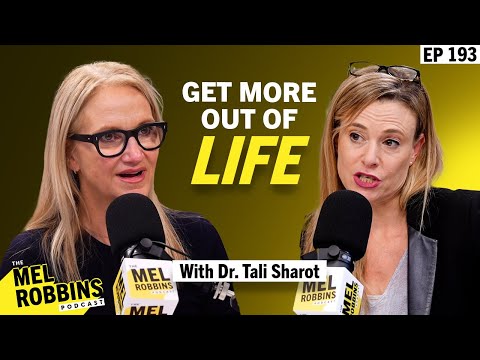
How To Make Your Life Exciting Again | Mel Robbins
Mel Robbins (host), Dr. Tali Sharot (guest)
In this episode of The Mel Robbins Podcast, featuring Mel Robbins and Dr. Tali Sharot, How To Make Your Life Exciting Again | Mel Robbins explores beat Midlife Boredom: Use Neuroscience Of Habituation To Reignite Joy Mel Robbins interviews neuroscientist Dr. Tali Sharot about habituation—the brain’s tendency to respond less to anything constant or repeated—and how it quietly makes life, work, and relationships feel dull over time.
Beat Midlife Boredom: Use Neuroscience Of Habituation To Reignite Joy
Mel Robbins interviews neuroscientist Dr. Tali Sharot about habituation—the brain’s tendency to respond less to anything constant or repeated—and how it quietly makes life, work, and relationships feel dull over time.
Sharot explains that while habituation protects us from constant overload and softens painful experiences, it also numbs us to the good things we already have, reducing daily happiness unless we deliberately inject change and novelty.
They discuss research on vacations, relationships, midlife dissatisfaction, and workplace creativity, showing that small breaks, new experiences, and anticipation significantly boost joy and motivation.
The episode closes with a call to run “experiments in living” by systematically trying (and sometimes removing) things in your life to discover what genuinely increases your well-being.
Key Takeaways
Your brain will always normalize the familiar, so you must add change on purpose.
Habituation means even great relationships, homes, and jobs stop feeling exciting simply because your brain stops responding strongly to what’s constant; you can’t rely on circumstances alone to feel happy—you have to periodically introduce something new.
Get the full analysis with uListen AI
Use short, varied experiences instead of rare, long ones to maximize joy.
Sharot’s vacation research shows people peak in happiness about 43 hours into a trip and are happiest of all the day before it starts; more frequent short breaks and weekends away create more “firsts,” more peaks, and more anticipation-driven happiness.
Get the full analysis with uListen AI
Intentionally create “anticipatory events” to feel happier right now.
Scheduling things you look forward to—a class, a hike, a special date, a future trip—boosts current mood because the brain derives substantial pleasure from anticipating positive experiences, often more than from the event itself.
Get the full analysis with uListen AI
Re-spark appreciation for what you have through breaks or mental subtraction.
Physically stepping away (a trip, a few days away, a change of routine) or briefly imagining life without your partner, home, or job can “dishabituate” your brain, making old blessings feel vivid and valuable again.
Get the full analysis with uListen AI
Inject novelty and variety into routines to keep life and relationships alive.
Trying new routes, learning new skills, seeing your partner in new contexts, talking to different kinds of people, or altering your environment interrupts habituation, increases learning, and contributes to a more “psychologically rich” life.
Get the full analysis with uListen AI
Change your environment to spark creativity—even for a few minutes.
Research shows simply moving from an office to a café or taking a walking meeting can boost creativity for about six minutes—often long enough for important ideas or solutions to surface, especially when you’ve been stuck.
Get the full analysis with uListen AI
Treat your life as a series of experiments to discover what truly works for you.
Sharot advocates “experiments in living”: systematically adding or removing behaviors (like trying a new hobby or going off social media) and observing how you feel, instead of assuming you know in advance what will improve your happiness.
Get the full analysis with uListen AI
Notable Quotes
“Maybe life isn’t boring. Maybe you’ve gotten boring.”
— Mel Robbins
“Our brain is like the front page of a newspaper—it cares about what’s new.”
— Dr. Tali Sharot
“Because of habituation, we might have great things in our life, but they don’t elicit as much joy on a daily basis as you’d expect.”
— Dr. Tali Sharot
“When you stare at your spouse or your work or your life for too long, it goes gray.”
— Mel Robbins
“You don’t really know what’s good for your life without doing experiments—just like in science.”
— Dr. Tali Sharot
Questions Answered in This Episode
Where in my life have I clearly habituated—what once felt exciting but now feels flat, even though nothing is “wrong”?
Mel Robbins interviews neuroscientist Dr. ...
Get the full analysis with uListen AI
What small, realistic experiments in novelty (new routes, hobbies, social circles) could I run over the next month to see what actually lifts my mood?
Sharot explains that while habituation protects us from constant overload and softens painful experiences, it also numbs us to the good things we already have, reducing daily happiness unless we deliberately inject change and novelty.
Get the full analysis with uListen AI
How can I intentionally build more anticipation into my calendar so I have regular events—large or small—that I’m genuinely looking forward to?
They discuss research on vacations, relationships, midlife dissatisfaction, and workplace creativity, showing that small breaks, new experiences, and anticipation significantly boost joy and motivation.
Get the full analysis with uListen AI
If I imagined my current partner, home, or job disappearing tomorrow, what would I suddenly miss most, and how could I honor that more now?
The episode closes with a call to run “experiments in living” by systematically trying (and sometimes removing) things in your life to discover what genuinely increases your well-being.
Get the full analysis with uListen AI
In my work or team, what simple rotations, environment changes, or project shifts could we try to combat habituation and spark creativity?
Get the full analysis with uListen AI
Transcript Preview
What is habituation?
It's basically our tendency to respond less and less and less to things that are constant, or they change very gradually or are frequent. So, for example, an easy example, you jump into a pool, it's really cold, but you tend to get used to it. After a few minutes, it's less cold. Why are people less happy in midlife? It is the least amount of change, right?
Mm-hmm.
If you think about it, as... When you're a kid, things are changing all the time. I mean, you're changing, you're growing, right? You're learning. Then you're in the 20s. You're trying different things, you're trying different partners, you're trying different professions, and then comes midlife, and things are kind of similar. Most people kind of stay in the same place.
You literally just explained the midlife crisis through the lens of (laughs) neuroscience. Hey, it's your friend Mel. I am so glad you're here with me today. It is always such an honor to spend some time together, and I want to start by acknowledging you for taking the time to listen to something that is going to help you create a better life, and I know our conversation today is gonna do that. If you're a new listener, welcome to the Mel Robbins Podcast family. I'm so happy you're here with me. And you're not going to believe what I did last night. I mean, just take a guess. What do you think I did last night? (laughs) You're never gonna guess this one. (laughs) Well, last night, my husband Chris and I pitched a tent in our backyard. We grabbed a blow-up mattress, a couple of comforters, two pillows, and we slept out under the stars in our backyard here in Vermont. It was a full moon. It was absolutely incredible. And we used to do this kind of stuff all the time when we were first dating. I mean, we were constantly planning fun adventures and camping and, like, doing cool things outside, and, you know, we've been married now, my God, it's gonna be 28 years this year. Holy smokes. W- And the other day, Chris turned to me and said, "Hey, Mel, you know, in a couple nights, it's going to be a full moon. Weather looks good. Do you have any interest in sleeping outside in a tent?" I was like, "Oh my God, yes!" And so we did. Here I was this morning, uh, after sleeping in the tent last night, I was having my coffee in the house, and if you're watching, you can probably tell based on the fact that I have greasy hair, I've pulled it back in a ponytail, and I'm wearing my red flannel that I look like I was camping, because I was, because I was. Um, but here I am, you know, we're out of the tent, I'm standing in my kitchen, I got my mug of coffee in my hand, and I started to wonder, "That was so fun. When did life get boring? Why don't I do this more often?" And then it dawned on me, "Mel, maybe life isn't boring. Maybe you've gotten boring." I want you to really think about that. Maybe the reason why you're not having enough fun in your life or your relationship or work is because you've gotten a little too used to your routine, and that's made you a little boring. Well, today, that's what you and I are going to talk about with a neuroscientist from MIT and University College London, who says habits and routines have a hidden cost. They can make your life feel boring, and she's here to tell you what to do about it. There are really fun ways that you can shake up your life, your work, y- your relationships, and even a really fun thing that research says you need to do to shake up your vacation. Aren't you so excited for this? I know you are, and so I'm thrilled that you're here with me on YouTube, and here's where we're going next. We are gonna go down to our studios in Boston for this incredible conversation. Are you ready to shake it up? Awesome. Let's do it. Welcome Dr. Sherratt to the Mel Robbins Podcast. I'm so thrilled that you're here.
Install uListen to search the full transcript and get AI-powered insights
Get Full TranscriptGet more from every podcast
AI summaries, searchable transcripts, and fact-checking. Free forever.
Add to Chrome