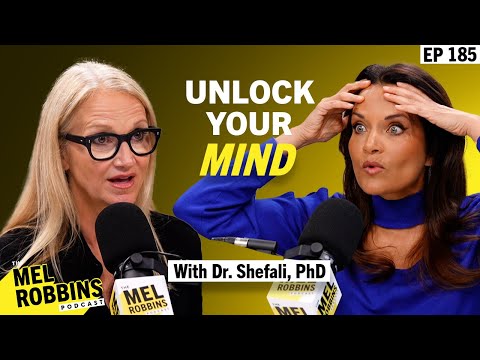
You Learn This Too Late: This One Idea Might Change Your Entire Life
Dr. Shefali Tsabary (guest), Mel Robbins (host)
In this episode of The Mel Robbins Podcast, featuring Dr. Shefali Tsabary and Mel Robbins, You Learn This Too Late: This One Idea Might Change Your Entire Life explores conscious Parenting: Stop Controlling Children And Start Healing Yourself Mel Robbins interviews Dr. Shefali on conscious parenting, a philosophy that shifts the focus from fixing children to awakening and healing the parent’s own inner wounds and need for control.
Conscious Parenting: Stop Controlling Children And Start Healing Yourself
Mel Robbins interviews Dr. Shefali on conscious parenting, a philosophy that shifts the focus from fixing children to awakening and healing the parent’s own inner wounds and need for control.
They argue that anxiety, unworthiness, and cultural conditioning drive parents to use children as trophies or emotional medicine, creating cycles of guilt, obligation, and inauthentic relationships.
The conversation expands beyond parenting to include being parented, romantic relationships, technology addiction, and midlife crises, framing all close relationships as mirrors of our relationship with ourselves.
Practical guidance includes letting go of control, setting boundaries rooted in self-respect, reducing screens, increasing presence and curiosity, and learning to validate and parent your own inner child.
Key Takeaways
Shift from fixing your child to healing yourself.
Conscious parenting says the child is not broken; your reactions, control, and anxiety are invitations to look at your own unhealed wounds and conditioning rather than trying to micromanage your child’s behavior.
Get the full analysis with uListen AI
Recognize that your child owes you nothing.
When you drop the belief that children are indebted for your sacrifices, you stop using guilt, duty, and obligation to control them and begin relating from unconditional love instead of entitlement.
Get the full analysis with uListen AI
Let go of the “successful” and “happy child” myths.
Chasing achievement or even ‘happiness’ for your kids is still ego-driven; it creates anxiety, teaches them they are never enough as they are, and pulls everyone out of the present moment where real life and growth happen.
Get the full analysis with uListen AI
Increase presence and reduce screens in your own life first.
Technology has become a proxy for real connection for both parents and kids; reclaiming connection starts with parents limiting their own screen use, creating phone-free spaces/times, and embodying genuine presence.
Get the full analysis with uListen AI
Use curiosity and unconditional acceptance instead of criticism and control.
Show up as deeply interested in who your child (or loved one) is, without trying to fix, script, or judge; that non-controlling, validating presence is more attractive and regulating than any phone or lecture.
Get the full analysis with uListen AI
Understand that real boundaries are about your behavior, not theirs.
A healthy boundary is, “Here’s what I will or won’t do or stay for,” not demanding someone else change; you control conditions (e. ...
Get the full analysis with uListen AI
View pain and crises as calls to awaken your authentic self.
Midlife crises, relationship conflicts, and psychological pain expose where you’ve lived by cultural prescriptions instead of inner truth; asking, “What is this here to show me about my unhealed self? ...
Get the full analysis with uListen AI
Notable Quotes
“Your job is not to change or fix the child, but to use the experience to change or fix and heal something about yourself.”
— Dr. Shefali
“Your child owes you nothing. No human being owes you anything.”
— Dr. Shefali
“We have children so that they can make us feel good about ourselves… We need them to fulfill all that is unfulfilled within.”
— Dr. Shefali
“Imagine raising your children without anxiety and control. Is that possible? Of course. But it requires a lot of inner work on the part of the parent.”
— Dr. Shefali
“Every human is a parent to their own inner child.”
— Dr. Shefali
Questions Answered in This Episode
In what specific moments with my children or parents do I feel the strongest urge to control, and what unhealed fear or belief might that be pointing to in me?
Mel Robbins interviews Dr. ...
Get the full analysis with uListen AI
How has the pursuit of my child’s ‘success’ or ‘happiness’ actually pulled both of us out of the present moment and away from who they really are?
They argue that anxiety, unworthiness, and cultural conditioning drive parents to use children as trophies or emotional medicine, creating cycles of guilt, obligation, and inauthentic relationships.
Get the full analysis with uListen AI
If I accepted that my child (or partner) owes me nothing, how would that change the way I speak to them and what I expect from them?
The conversation expands beyond parenting to include being parented, romantic relationships, technology addiction, and midlife crises, framing all close relationships as mirrors of our relationship with ourselves.
Get the full analysis with uListen AI
What would it look like, in concrete daily actions, to be more curious and unconditionally accepting with a loved one I usually criticize or try to fix?
Practical guidance includes letting go of control, setting boundaries rooted in self-respect, reducing screens, increasing presence and curiosity, and learning to validate and parent your own inner child.
Get the full analysis with uListen AI
Where in my life am I calling something a ‘boundary’ that is actually a wall or a form of control, and how could I reclaim that boundary as a change in my own behavior instead?
Get the full analysis with uListen AI
Transcript Preview
Imagine raising your children without anxiety and control.
Is that possible?
(instrumental music plays) This whole idea that we need to raise a successful child, that is a myth. Parents get really upset with me because they're like, "Oh! You didn't give me the three keys to fix my child's, you know, social media addiction." I said, "Because they are not the problem only."
You know, I'll be the first to admit that this behavior of feeling like, "Well, you owe me."
Yes.
"I did everything I could-"
Yes.
"... I paid for that, so I expect you to behave a certain way."
Yes. Yes.
This is the single biggest behavior and way of thinking that I am trying to break.
Yes. Your child owes you nothing. Parents don't like when I say that.
Your child owes you nothing?
Your child owes... No human being owes you anything.
Your job is not to change or fix the child, but to use the experience to change or fix and heal something about yourself.
Right. The child is not broken, so there's no- nothing to fix. We're searching for that thing on the outside because we never cultivated it on the inside.
Okay, well, ho, ho, ho, ho, ho, ho. (clock ticks) (instrumental music plays) Alrighty, it's your friend Mel. I'm so glad that you tuned in today, that you're here with me, and I'm thrilled to welcome Dr. Shefali to the Mel Robbins Podcast. Let me tell you a little bit about her. Dr. Shefali received her doctorate in clinical psychology from Columbia University. She is an expert in family dynamics and is known as the pioneer of the conscious parenting movement. Now, she specializes in the integration of Western psychology and Eastern philosophy. She's a New York Times best-selling author of seven books. Her newest book is The Parenting Map. And I also wanna congratulate Dr. Shefali because she's finally launching her own podcast, Parenting And You with Dr. Shefali. Now, I've been wanting to have her on the Mel Robbins Podcast since I launched this almost two years ago, because she uses the parent-child relationship as a lens to examine your relationship with yourself and you becoming conscious of your own destiny. Before we jump into it, I wanna ask you, share this with your parents, share this conversation with your children and with your partner, because I know that Dr. Shefali is going to inspire you to think about yourself, your life, and your relationships in a whole new way. So please help me welcome Dr. Shefali to the Mel Robbins Podcast. I am so excited. We finally have you here-
Yes.
... on the Mel Robbins Podcast.
Yes. I'm so excited to be here, I can't even tell you.
Well, I'm both excited for the person listening, but as a parent of three adult children, I cannot wait to learn from you. Could you speak directly to the person who's listening to us today and explain what they might experience in their life if they take to heart everything you're about to share?
Install uListen to search the full transcript and get AI-powered insights
Get Full TranscriptGet more from every podcast
AI summaries, searchable transcripts, and fact-checking. Free forever.
Add to Chrome