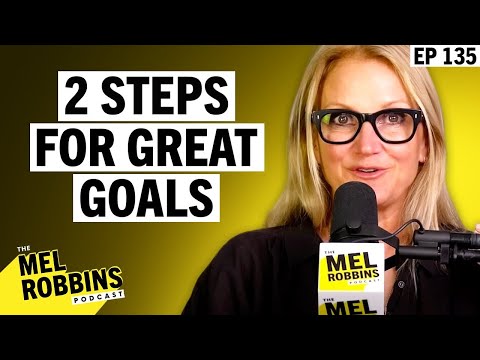
How to Set & Achieve Goals: 2 Surprising Science-Backed Steps You Must Follow
Mel Robbins (host), Dave (guest)
In this episode of The Mel Robbins Podcast, featuring Mel Robbins and Dave, How to Set & Achieve Goals: 2 Surprising Science-Backed Steps You Must Follow explores mel Robbins Reveals Two-Phase Formula For Goals That Actually Stick Mel Robbins breaks down why most people fail at goals: they never get truly honest about what they want now, and they skip the science-backed steps that make change stick. Drawing on research from universities like Oregon, Wisconsin, Florida State, Cornell, Columbia, and Penn, she explains that every effective goal must have both a powerful personal WHY (“the will”) and a clear, realistic HOW (“the way”).
Mel Robbins Reveals Two-Phase Formula For Goals That Actually Stick
Mel Robbins breaks down why most people fail at goals: they never get truly honest about what they want now, and they skip the science-backed steps that make change stick. Drawing on research from universities like Oregon, Wisconsin, Florida State, Cornell, Columbia, and Penn, she explains that every effective goal must have both a powerful personal WHY (“the will”) and a clear, realistic HOW (“the way”).
She walks through common mistakes—too many goals, ones that are too big, too vague, or driven by pressure from others—and demonstrates, using her own goals (gardening, quitting alcohol temporarily, daily journaling), how to refine them into specific, achievable targets. Robbins also introduces tactics like high/low range goals and easy first milestones to create momentum and leverage the brain’s reward systems.
Ultimately, she argues that the real value of goals is not in the moment of achievement but in the ongoing pursuit, which increases happiness, suppresses negative emotions, and gives life meaning and direction.
Key Takeaways
Every successful goal needs both a strong WHY and a clear HOW.
Research from the University of Oregon shows effective goals require ‘the will’ (your emotional, motivational reason for change) and ‘the way’ (specific plans, skills, and steps). ...
Get the full analysis with uListen AI
Set a few deeply personal goals, not a long list of obligations.
Taking on too many goals at once dilutes focus and leads to getting nothing done. ...
Get the full analysis with uListen AI
Hit the ‘Goldilocks’ sweet spot: goals must be small, specific, and slightly ambitious.
Dreams are big and timeless; goals should be concrete, time-bound, and achievable but still require effort. ...
Get the full analysis with uListen AI
Make goals specific and measurable by asking, “When will I know I’ve succeeded?”
Columbia research suggests clarity increases follow-through. ...
Get the full analysis with uListen AI
Use high/low range goals to make success feel more attainable.
Florida State findings show it’s easier to hit a range (e. ...
Get the full analysis with uListen AI
Engineer early ‘easy wins’ to create momentum and motivation.
The ‘incremental illusion’ effect shows that pre-checked progress or tiny first steps (a quick Google search, ordering a book, writing one journal entry) makes you more likely to stick with your goal, because nothing motivates like feeling you’ve already started.
Get the full analysis with uListen AI
Tell the right people about your goals to strengthen commitment.
Newer research from Ohio State indicates sharing goals with someone you admire or whose opinion you value boosts commitment and performance—countering older advice to keep goals private. ...
Get the full analysis with uListen AI
Notable Quotes
“A goal is any desired outcome that wouldn’t otherwise happen without you doing something.”
— Mel Robbins (summarizing Dr. Elliott Berkman, University of Oregon)
“If you don’t know what you want, how on earth could you possibly get it?”
— Mel Robbins
“Your dreams are big; your goals have to be small.”
— Mel Robbins
“Listening to research is not going to change your life; applying the research will.”
— Mel Robbins
“The point and the purpose of achieving and setting goals that are deeply personal... is because when you have goals, you’re up to something.”
— Mel Robbins
Questions Answered in This Episode
How can I distinguish between goals I genuinely want and goals I feel pressured to adopt from others or social trends?
Mel Robbins breaks down why most people fail at goals: they never get truly honest about what they want now, and they skip the science-backed steps that make change stick. ...
Get the full analysis with uListen AI
Which current goals of mine are missing either a strong WHY or a clear HOW, and how might that explain my lack of progress?
She walks through common mistakes—too many goals, ones that are too big, too vague, or driven by pressure from others—and demonstrates, using her own goals (gardening, quitting alcohol temporarily, daily journaling), how to refine them into specific, achievable targets. ...
Get the full analysis with uListen AI
What would my single most important, personally meaningful goal be if I limited myself to just one for the next 12 months?
Ultimately, she argues that the real value of goals is not in the moment of achievement but in the ongoing pursuit, which increases happiness, suppresses negative emotions, and gives life meaning and direction.
Get the full analysis with uListen AI
How can I redesign one of my big ‘dreams’ into a small, specific, time-bound goal that hits the Goldilocks sweet spot?
Get the full analysis with uListen AI
Who in my life do I genuinely admire and trust enough to share my goals with so that their awareness increases my commitment rather than my anxiety?
Get the full analysis with uListen AI
Transcript Preview
(ticking sound) A major mistake that everybody makes when they create a list of goals is that you just jot down goals like some sort of grocery list, without ever stopping to truly get clear about what you want right now. Not what you wanted last year, not what you wanted 10 years ago, not what you think you should want, but what do you actually want in the next 12 months of your life? (upbeat music) Hey, it's your friend Mel, and welcome to the Mel Robbins Podcast. So, a couple of days ago, I was scrolling on my phone, just kinda wasting time on social media because Chris and Oakley had something on the TV that I could care less about. Basically, they were watching YouTube videos on TV of people skiing in the back country. So of course, like you, when I'm not that interested in what my family is doing, I tend to look at my phone. And so here I am, I'm scrolling through social media, and all of a sudden this video pops up of Oprah Winfrey. And like you, I admire her so much, and I don't know if this was a recent video or if it's something from a long time ago that is all of a sudden catching wind and going viral again, but someone was asking Oprah why she thinks so many people get stuck, and she had this really interesting answer. She said basically that after interviewing tens of thousands of people on the Oprah Winfrey Show, she believes that most people get stuck because they can't answer one question. You wanna know what the question is? It's a good one. Here it is: What do I really want? I want you to consider that question. "What do I want?" And if you really think about that question honestly, "What do I really want?" it's not the easiest question to answer, is it? And here's the reason why this is so powerful, is if you don't know what you want, how on earth could you possibly get it? And that little video inspired me to want to talk to you today about goals, because a major mistake that everybody makes when they create a list of goals, and I used to make this mistake all the time, is that you just jot down goals like some sort of grocery list without ever stopping to truly get clear about what you want in your life, what you want right now. Not what you wanted last year, not what you wanted 10 years ago, not what you think you should want, but what do you actually want in the next 12 months of your life? And this question is powerful, because in order to answer it, you have to kinda tap into the science and research, because there are two important steps that everyone misses. These two steps require you to get clear about what you actually want and why you want it, and we're gonna dig into the research, and I'm gonna unpack these two steps, and we're gonna talk a lot about this question: "What do I want?" Because maybe you've already set goals for the next 12 months, or maybe as you're listening to my voice right now, you realize, "Oh my God, I don't really have any goals." Well, don't you worry. Regardless of where you are, by the end of the episode, you're not only gonna be able to answer Oprah's question, "What do I want?" for real, but you'll know how to get it. And one thing I wanna say about this before we jump into the topic is that goals and goal setting, it can sound really boring and clinical, but this is a much bigger conversation that you and I are gonna have, because without you knowing what you want, and without you identifying and pursuing goals that are uniquely personal to you, you're just going through the motions in life. When you take the time to figure out what you want, and then you go through the process of setting and pursuing goals according to the research, goals that matter to you, this is how you create an intentional and a fulfilling life. That's why I care about this topic. That's why I wanted to talk about it. That's why Oprah's l- video inspired me to do this, because I care about you, and I care about you living a life that is full of meaning and a life that is intentional. And so today, I'm gonna hold your hand and walk you step-by-step through this process of setting goals according to the research so that you not only define what you want in this next year of your life, but that you are clear about the goals that you need to pursue, because when you take the time to do that, you will have one of the best years of your life. And by the way, I wanna take this one step further. You can see I'm, like, pretty passionate about this, because I don't want you to just listen to my voice or watch me on YouTube. I want you to not only learn this, I want you to translate all this knowledge into action as you're learning it, and so here's how I'm gonna help you do that. Our team here at the Mel Robbins Podcast, we have taken the time to create a free beautiful research-backed workbook for you, and the purpose of the workbook is to help you apply everything you're about to learn in a very purposeful and actionable way. You can think about this workbook that you're gonna get at melrobbins.com/bestyear as a roadmap to one of the best years of your life. And if you're watching on YouTube right now, that link is right down there. It will also be linked in the description of the podcast, in all of our show notes at melrobbins.com, and when you get to the landing page, melrobbins.com/bestyear, you're gonna see a welcome video that I created for you, and you will find instructions on how to get that workbook sent to your inbox instantly. So, are you ready to kick this off? I know I am, and I also know this is the topic that you need to hear right now, because I'm getting an overwhelming number of questions and messages about setting goals, just like this one from Dave. So, let's jump into it.
Install uListen to search the full transcript and get AI-powered insights
Get Full TranscriptGet more from every podcast
AI summaries, searchable transcripts, and fact-checking. Free forever.
Add to Chrome