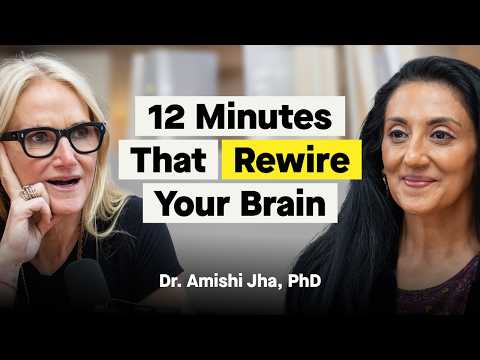
12 Minutes to a Better Brain: Neuroscientist Reveals the #1 Habit for Clarity & Focus
Mel Robbins (host), Dr. Amishi Jha (guest), Narrator
In this episode of The Mel Robbins Podcast, featuring Mel Robbins and Dr. Amishi Jha, 12 Minutes to a Better Brain: Neuroscientist Reveals the #1 Habit for Clarity & Focus explores neuroscientist’s 12‑Minute Habit Dramatically Strengthens Focus, Clarity, Attention Neuroscientist Dr. Amishi Jha explains how attention is a powerful yet fragile brain system that functions as the 'boss of the brain,' directing perception, thought, memory, and emotion.
Neuroscientist’s 12‑Minute Habit Dramatically Strengthens Focus, Clarity, Attention
Neuroscientist Dr. Amishi Jha explains how attention is a powerful yet fragile brain system that functions as the 'boss of the brain,' directing perception, thought, memory, and emotion.
She breaks attention into three systems—selective focus (flashlight), broad alertness (floodlight), and executive control (juggler)—and shows how stress, overload, and chronic worry reliably degrade all three.
Drawing on decades of research with military, first responders, athletes, and students, she presents a minimum effective dose of mindfulness training: 12 minutes a day, four days a week, for at least four weeks to stabilize and even improve attention, mood, and stress levels.
Jha and Robbins emphasize that attention is trainable, that mindfulness is essentially 'push‑ups for the mind,' and that directing your attention deliberately is both a performance tool and the highest form of love you can give yourself and others.
Key Takeaways
Attention is the 'boss of the brain' and fully trainable.
Wherever attention goes, perception, memory, emotion, and decision‑making follow. ...
Get the full analysis with uListen AI
You only have one flashlight—multitasking is really rapid task‑switching.
We cannot attend to multiple demanding tasks at once; we just flip our single 'flashlight' back and forth. ...
Get the full analysis with uListen AI
Use all three attention systems deliberately: flashlight, floodlight, juggler.
The flashlight focuses narrowly, the floodlight stays broadly alert to the present moment, and the juggler keeps your actions aligned with your goals. ...
Get the full analysis with uListen AI
Chronic stress and 'pre‑living' stressors quietly erode attention.
High‑demand periods (deployments, semesters, seasons, launches, caregiving) reliably degrade attention, mood, and stress regulation over weeks. ...
Get the full analysis with uListen AI
The research‑backed minimum effective dose is 12 minutes, four days a week.
Across multiple studies, people who practiced mindfulness at least 12 minutes per session, four days per week, for four weeks showed stable or improved attention, mood, and stress compared to controls whose attention declined. ...
Get the full analysis with uListen AI
Start smaller than you think and habit‑stack to make it stick.
Begin with about three minutes, tied to an existing habit (e. ...
Get the full analysis with uListen AI
Mindfulness is not about feeling blissful; it’s about noticing.
The goal is to pay attention to the present moment without layering stories or reactions on top—simply noticing mind‑wandering and gently returning. ...
Get the full analysis with uListen AI
Notable Quotes
“Your attention is an extremely powerful capacity that you hold, but it's incredibly fragile.”
— Dr. Amishi Jha
“It is, in some sense, the boss of the brain. Wherever attention goes, the rest of the brain's computational functions are aligned with whatever it is that you pay attention to.”
— Dr. Amishi Jha
“Focusing, noticing, refocusing, repeat. That's the push‑up for the mind.”
— Dr. Amishi Jha
“Don't deploy before you deploy.”
— Cynthia (military spouse), as quoted by Dr. Amishi Jha
“Attention is a form of love. It's the most you can give of yourself.”
— Dr. Amishi Jha
Questions Answered in This Episode
How could I redesign my daily routines to reduce unnecessary task‑switching and protect my 'one flashlight' of attention?
Neuroscientist Dr. ...
Get the full analysis with uListen AI
In what situations do I most often 'deploy before I deploy'—mentally living in future stress—and how is that draining my present‑moment life?
She breaks attention into three systems—selective focus (flashlight), broad alertness (floodlight), and executive control (juggler)—and shows how stress, overload, and chronic worry reliably degrade all three.
Get the full analysis with uListen AI
If I started with just three minutes of mindfulness after an existing habit, what specific cue and time of day would make it nearly impossible to skip?
Drawing on decades of research with military, first responders, athletes, and students, she presents a minimum effective dose of mindfulness training: 12 minutes a day, four days a week, for at least four weeks to stabilize and even improve attention, mood, and stress levels.
Get the full analysis with uListen AI
How might my closest relationships change if I treated my undivided attention as my highest form of love and gave it more intentionally?
Jha and Robbins emphasize that attention is trainable, that mindfulness is essentially 'push‑ups for the mind,' and that directing your attention deliberately is both a performance tool and the highest form of love you can give yourself and others.
Get the full analysis with uListen AI
When my mind wanders during practice, what stories do I tend to spin (self‑criticism, worry, planning), and what do those patterns reveal about how I relate to myself?
Get the full analysis with uListen AI
Transcript Preview
You said attention is something that you hold.
Your attention is an extremely powerful capacity that you hold, but it's incredibly fragile. The very hopeful news, and we'll talk about how to do this, is that it is trainable.
Hey, it's Mel. Today on The Mel Robbins Podcast, you're gonna learn how to build a better brain in just 12 minutes a day. This is one habit for clarity and focus that's researched back from neuroscientist Dr. Amishi Jha.
Attention is an incredibly powerful brain system, that's the first thing. We already know that. It is, in some sense, the boss of the brain. Wherever attention goes, the rest of the brain's computational functions are aligned with whatever it is that you pay attention to. That's why it's so powerful. The metaphor I like to use is that it's like a flashlight. Wherever it is that that flashlight is directed toward, you get crisper, clearer information.
What do you think the most important thing to do is?
The biggest call to action, and it's a very simple one, is pay attention to your attention. Focusing, noticing, refocusing, repeat. That's the push-up for the mind.
What happens if you do this 12 minutes a day, four days a week for four weeks?
Really good news, you're gonna get better than where you started. The best time to do it is that, when you're gonna do it.
Hey, it's your friend Mel, and welcome to The Mel Robbins Podcast. Dr. Amishi Jha, thank you, thank you, thank you for hopping on a plane and being here with us in our Boston studios. Welcome to The Mel Robbins Podcast.
Thank you. It's so great to be here.
I am so excited because I gotta be honest with you. Is it common when people interview you for them to feel like (laughs) they are unfocused? You know, as I was preparing for this, I was like, "Wait a minute, why am I suddenly feeling all scattered before Dr. Amishi walks in here?"
(laughs)
Is that like a thing that happens with people?
I certainly don't want it to feel like some kind of, like, test of your attentional capabilities at all. Because frankly, all the work that I do comes from my own journey with attention.
Mm.
It doesn't matter how much expertise I have, it doesn't matter how much I study this, the notion of having a crisis of attention or feeling scattered every now and then is part of the human experience. So, please don't feel that. (laughs)
Thank you for saying that, 'cause I think when you, when you think about attention and focus and training your mind to be a peak mind, you all of a sudden sit up and lean in and you're like, "Okay, we got stuff to do." And so there was something very, I think, optimistic and accessible to this idea that you are gonna have a scattered mind at times.
Install uListen to search the full transcript and get AI-powered insights
Get Full TranscriptGet more from every podcast
AI summaries, searchable transcripts, and fact-checking. Free forever.
Add to Chrome