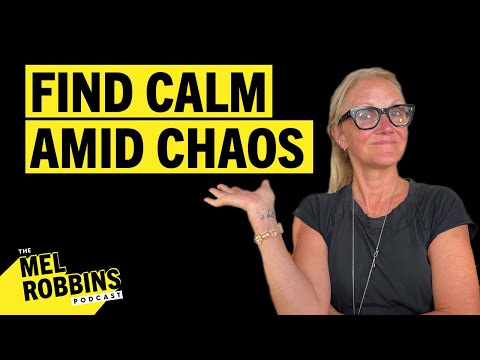
10 Genius Hacks To Keep Your Home Organized (When Getting Out Of Bed Is Hard) | Mel Robbins Podcast
Mel Robbins (host), KC Davis (guest)
In this episode of The Mel Robbins Podcast, featuring Mel Robbins and KC Davis, 10 Genius Hacks To Keep Your Home Organized (When Getting Out Of Bed Is Hard) | Mel Robbins Podcast explores transform Overwhelm Into Action: Compassionate Hacks For Real-Life Home Care Mel Robbins and therapist/author KC Davis discuss how to manage household tasks and self-care when you’re burned out, depressed, or going through major life stress like layoffs, breakups, or postpartum struggles.
Transform Overwhelm Into Action: Compassionate Hacks For Real-Life Home Care
Mel Robbins and therapist/author KC Davis discuss how to manage household tasks and self-care when you’re burned out, depressed, or going through major life stress like layoffs, breakups, or postpartum struggles.
KC reframes messy homes and unfinished tasks as morally neutral, often signs that your mental health is functioning properly by prioritizing emotional processing over productivity.
They differentiate motivation from task initiation and offer practical, “good-enough” hacks—like 5% efforts, paper plates, hygiene kits, and environment tweaks—to make home care more accessible when energy is low.
The conversation also introduces the concepts of self-compassion over shame, rest as a right (not a reward), and “fair rest” as a healthier framework for division of labor in relationships.
Key Takeaways
Start with 5% momentum instead of waiting for 100% motivation.
When you feel frozen, aim to do a tiny, concrete piece of a task—fold one item, wash two dishes, clean for five minutes—so action creates momentum instead of waiting to feel fully motivated.
Get the full analysis with uListen AI
Treat task struggles as morally neutral and resource-based, not character flaws.
If you’re processing grief, trauma, or stress, your cognitive and emotional resources are already heavily taxed; undone laundry or dishes usually mean your brain is prioritizing survival, not that you’re lazy or broken.
Get the full analysis with uListen AI
Use self-compassion to unstick yourself; shame keeps you paralyzed.
Shame (“I’m a failure”) arrests action, while self-compassion (“I’m allowed to be human, I’m processing a lot”) is linked to better psychological functioning and makes it easier to take small, doable steps like washing one outfit.
Get the full analysis with uListen AI
Redesign your environment so tasks are easier and more accessible.
Introduce practical supports like grabbers, wheelie stools, larger trash cans, paper plates, toy rotation, hygiene kits, and laundry baskets and trash cans in every room to reduce the number of steps and barriers required to function.
Get the full analysis with uListen AI
You don’t have to like yourself to start caring for yourself.
Self-esteem isn’t a prerequisite; begin with small, tender actions—such as making hygiene easier, removing triggering mirrors, or pre-setting coffee or slippers for morning comfort—and let consistent self-compassion gradually build genuine self-regard.
Get the full analysis with uListen AI
Prioritize fair rest over equal labor in relationships and households.
Instead of tallying who works more, ask whether each person has real off-duty time (e. ...
Get the full analysis with uListen AI
Rest is a right, not a reward for perfect productivity.
Because adult to-do lists are endless, waiting to finish everything before resting guarantees burnout; normalize shortcuts (pizza nights, movie nights, relaxed bedtimes, paper plates) as legitimate ways to build rest into ordinary life.
Get the full analysis with uListen AI
Notable Quotes
“We can use 5% momentum to do 5% of the task instead of just waiting around for 100% momentum to do everything.”
— KC Davis
“Shame is arresting; self-compassion is motivating.”
— KC Davis
“Your body is not meant to fit into clothes. Clothes are meant to fit your body.”
— KC Davis
“You do not have to care about yourself in order to begin how to learn to tenderly care for yourself.”
— KC Davis
“Rest should be a right and not a reward.”
— KC Davis
Questions Answered in This Episode
How can I tell in real time whether I’m facing a motivation issue or a task initiation problem, and what’s the first step for each?
Mel Robbins and therapist/author KC Davis discuss how to manage household tasks and self-care when you’re burned out, depressed, or going through major life stress like layoffs, breakups, or postpartum struggles.
Get the full analysis with uListen AI
What small environmental changes in my home would immediately reduce the number of steps it takes for me to complete everyday tasks?
KC reframes messy homes and unfinished tasks as morally neutral, often signs that your mental health is functioning properly by prioritizing emotional processing over productivity.
Get the full analysis with uListen AI
Where in my life am I treating rest as something I must earn, and how could I redesign my week so rest becomes a non-negotiable right?
They differentiate motivation from task initiation and offer practical, “good-enough” hacks—like 5% efforts, paper plates, hygiene kits, and environment tweaks—to make home care more accessible when energy is low.
Get the full analysis with uListen AI
If I’m the default caregiver or first-call parent, what would a fair-rest conversation with my partner or co-parent realistically look like?
The conversation also introduces the concepts of self-compassion over shame, rest as a right (not a reward), and “fair rest” as a healthier framework for division of labor in relationships.
Get the full analysis with uListen AI
What is one tiny, seemingly ‘inconsequential’ comfort I could set up for myself tonight that would make tomorrow morning feel kinder and more supportive?
Get the full analysis with uListen AI
Transcript Preview
I keep getting DMs and forms submitted at melrobbins.com/podcast where people are writing and feeling overwhelmed, and they're making themselves wrong for not feeling motivated. They're looking for motivation. And today, we are picking up this life-changing conversation with questions from your fellow listeners. And I am just so excited that you get to experience more of KC Davis. (instrumental music) Hey, it's your friend Mel, and welcome to the Mel Robbins podcast. I'm so glad you're here. Thank you so much. Um, we got something really exciting to talk about. In the last episode of the Mel Robbins podcast, you and I were talking about laundry, dishes, taking care of yourself, and how to find the motivation to get the little things done without beating the shit out of yourself, and we learned how to do that from our extraordinary expert, therapist and best-selling author, KC Davis. Now, KC blew you and me away. I mean, if I was wearing wind pants, they would have been blown right off my body blown away. Honestly, I personally think it was worth more than a ticket to Taylor Swift's tour. And if you have not heard that conversation, don't you worry. After this one, you can go back one episode and you can hear KC teach you how to imp- remove the shame, the guilt, the judgment that you and I put on ourselves about the little things that we need to get done. But I want you to stay with me right now. Why? Because my mission with this part of the conversation with KC is to prove to you that if you didn't get the dishes done, or you didn't get the kids on the bus on time, or if you got dirty dishes piled high in the sink, you're not broken. You're doing just fine. In fact, you're doing better than fine, and KC and I will prove it to you. Her hacks are genius. Her advice is a game changer. And today, we are picking up this life-changing conversation with questions from your fellow listeners. And I am just so excited that you get to experience more of KC Davis. So, you ready to jump in, KC?
I'm ready.
Let's just start with your concept that when it comes to getting things done, momentum is way more important than motivation.
So, research shows us that momentum builds once we start going. So, in a lot of ways, we sit around waiting for motivation to do something, when in reality, sometimes motivation precedes the action. Like, you do something and then you feel that motivation. And the problem with motivation is twofold. You know, we talked last time about how if you're looking at your laundry and going, "I don't want to do that. I don't understand why it's important. I don't care. I don't deserve clean laundry," that's a motivation problem. But if you're going, "I wish I could get that laundry done, but I just feel frozen to my seat," that's a task initiation problem, and that's when you really want to focus on building momentum.
Install uListen to search the full transcript and get AI-powered insights
Get Full TranscriptGet more from every podcast
AI summaries, searchable transcripts, and fact-checking. Free forever.
Add to Chrome