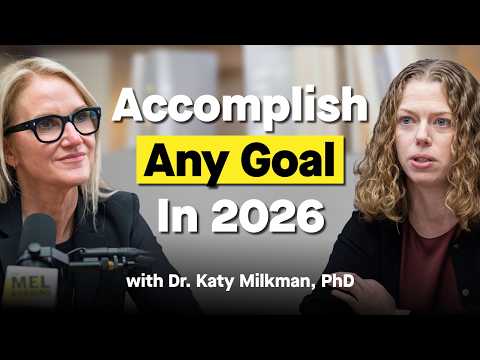
Change Your Life This Year: How to Get From Where You Are to Where You Want to Be
Katy Milkman (guest), Mel Robbins (host)
In this episode of The Mel Robbins Podcast, featuring Katy Milkman and Mel Robbins, Change Your Life This Year: How to Get From Where You Are to Where You Want to Be explores scientist Reveals Seven Hidden Barriers Sabotaging Your Life Changes Mel Robbins interviews behavioral scientist Professor Katy Milkman about why most attempts at change fail and how to do it differently using evidence-based strategies. Milkman explains that change is a learnable skill, not a willpower problem, and outlines seven universal internal barriers: getting started, impulsivity, procrastination, forgetfulness, laziness, low confidence, and conformity. For each barrier, she shares concrete tools such as fresh starts, making goals fun, temptation bundling, commitment devices, cue-based planning, habit design, social support, and copying successful peers. The episode emphasizes designing strategies and environments that make good behaviors enjoyable and easy, while giving yourself grace for inevitable setbacks.
Scientist Reveals Seven Hidden Barriers Sabotaging Your Life Changes
Mel Robbins interviews behavioral scientist Professor Katy Milkman about why most attempts at change fail and how to do it differently using evidence-based strategies. Milkman explains that change is a learnable skill, not a willpower problem, and outlines seven universal internal barriers: getting started, impulsivity, procrastination, forgetfulness, laziness, low confidence, and conformity. For each barrier, she shares concrete tools such as fresh starts, making goals fun, temptation bundling, commitment devices, cue-based planning, habit design, social support, and copying successful peers. The episode emphasizes designing strategies and environments that make good behaviors enjoyable and easy, while giving yourself grace for inevitable setbacks.
Key Takeaways
Stop relying on willpower; treat change as a skill that needs strategy.
Milkman argues that failing to change usually reflects poor systems and support, not a broken character, so you must learn and apply evidence-based tools rather than just “try harder.”
Get the full analysis with uListen AI
Use fresh starts to launch change, but always pair them with a concrete plan.
Moments like New Year’s, birthdays, Mondays, and life transitions create powerful psychological chapter breaks; commit specific goals, times, and places to those moments instead of relying on motivation alone.
Get the full analysis with uListen AI
Make the hard thing fun or instantly rewarding to beat impulsivity.
Choosing enjoyable versions of a behavior (e. ...
Get the full analysis with uListen AI
Combat procrastination with self-imposed consequences and friction.
Create “sticks” like financial stakes, public commitments, accountability partners, or making bad options harder (e. ...
Get the full analysis with uListen AI
Use cue-based plans and systems to outsmart forgetfulness.
Specify exactly when, where, and how you’ll act (“If it’s noon at my desk, then I meditate for 5 minutes”), use checklists, and set reminders, because intentions without cues and structure are almost always displaced by daily life.
Get the full analysis with uListen AI
Design habits and default settings so the ‘lazy’ choice is the right one.
Reduce friction for good behaviors (e. ...
Get the full analysis with uListen AI
Boost confidence and results through growth mindset, coaching others, and better peers.
Seeing yourself as a work in progress, seeking supportive high-achieving role models, and even giving advice to those slightly behind you can increase belief, crystallize your own strategies, and improve performance through “saying-is-believing” effects.
Get the full analysis with uListen AI
Notable Quotes
“Learning how to change is a skill, just like using an Excel spreadsheet is a skill.”
— Katy Milkman
“I think the biggest lie is that you should just work harder, or use your willpower, and that there's something wrong with you if you can't push through the pain.”
— Katy Milkman
“If it is painful to pursue your goal, you will quit.”
— Katy Milkman
“Most people and organizations that are trying to create change, they approach it with a one-size-fits-all mentality.”
— Katy Milkman
“You don't fail because you don't care, you fail because you forget.”
— Katy Milkman, paraphrased by Mel Robbins
Questions Answered in This Episode
Which of the seven barriers is currently blocking my most important goal, and what specific tool from this episode can I test against it this week?
Mel Robbins interviews behavioral scientist Professor Katy Milkman about why most attempts at change fail and how to do it differently using evidence-based strategies. ...
Get the full analysis with uListen AI
How can I redesign my environment so that the easiest, laziest option is actually the one that moves me toward my objective?
Get the full analysis with uListen AI
What meaningful fresh start point in my upcoming calendar (birthday, new quarter, move, job change) could I deliberately use to launch a new behavior with a detailed plan?
Get the full analysis with uListen AI
Where could I apply temptation bundling in my daily routines so that tasks I typically avoid become things I almost look forward to?
Get the full analysis with uListen AI
Who in my life could I both learn from (by copying their strategies) and also coach (to strengthen my own confidence and commitment to change)?
Get the full analysis with uListen AI
Transcript Preview
Most people that are trying to create change, they approach it with a one-size-fits-all mentality. A lot of people aren't thinking intentionally about engineering when they have a goal. That is the number one most important thing that all of us get wrong. Learning how to change is a skill, just like using an Excel spreadsheet is a skill. It doesn't just take willpower, or grit, or fortitude. It takes strategy.
Professor Milkman is an award-winning behavioral scientist and an endowed professor at the Wharton School of Business at the University of Pennsylvania, and today she's here to help you remove the seven hidden barriers that are currently keeping you from getting what you want.
We all have the same barriers.
What are they?
Well, the first is ... It almost seems crazy that all of us have the wrong mental model, but, but almost all of us have the wrong mental model of thinking. "No, no, no, no. There's something wrong with me if I can't do hard things. I just have to push through." I think the biggest lie is that you should just work harder, or use your willpower, and that there's something wrong with you if you can't push through the pain and achieve this challenging goal. And the truth is ...
Professor Katy Milkman, welcome to the Mel Robbins Podcast.
Thanks for having me.
Um, I really appreciate you making the time. I've been a fan of your work for over a decade, and I lo- love that we're gonna get this chance to dig into research that helps you change your life. It's informed some of the biggest books on habits on the planet, and now we have the OG with us in person. I wanna start, uh, Professor Milkman, by talking about, how could my life be different if I take everything you're about to teach us, the research you're about to explain, and I apply it to my life? What's gonna change?
Every single person has a goal. You have a goal that you want to achieve right now. Even if you haven't articulated it, there's some aspect of your life that you want to improve, you wanna get better. And there's also probably people you care about who you wanna help improve. And there's a lot of science that you can use to get there faster and with higher probability. But most of us, when we have that goal, we, and when we have someone we care about who we wanna help achieve a goal, we're just shooting from our head. We are not basing our strategies on evidence. And what I hope to share today is a set of tools you can use immediately to make it easier to achieve whatever it is you want to achieve, and to help other people do the same, whether that's getting in shape, whether that's getting your finances in order, whether it's getting a promotion at work. Whatever that goal is you're trying to tackle, we actually have evidence-based tools to help. So, hopefully by the end of this episode, you'll have learned and grown a lot in ways that will allow you to be a stronger version as you approach a new goal.
Install uListen to search the full transcript and get AI-powered insights
Get Full TranscriptGet more from every podcast
AI summaries, searchable transcripts, and fact-checking. Free forever.
Add to Chrome