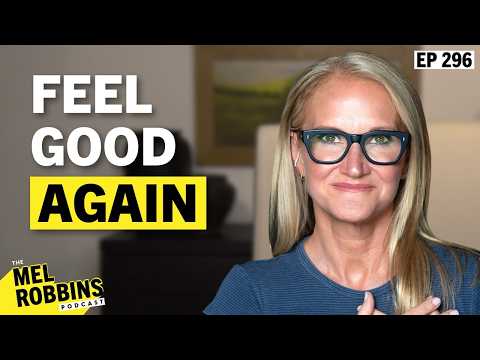
Finally Feel Good in Your Body: 4 Expert Steps to Feeling More Confident Today
Mel Robbins (host), Jake Shane (guest), Dr. Judith (guest), Dr. Ash (guest)
In this episode of The Mel Robbins Podcast, featuring Mel Robbins and Jake Shane, Finally Feel Good in Your Body: 4 Expert Steps to Feeling More Confident Today explores stop Hating Your Body: Four Science-Backed Steps To Real Confidence Mel Robbins explores why so many people secretly hate how they look, using comedian Jake Shane’s raw confession about body shame and dating fears as a starting point.
Stop Hating Your Body: Four Science-Backed Steps To Real Confidence
Mel Robbins explores why so many people secretly hate how they look, using comedian Jake Shane’s raw confession about body shame and dating fears as a starting point.
Two psychiatrists, Dr. Judith Joseph and Dr. Ashwini Nadkarni, explain how modern life, constant self-viewing (Zoom, selfies), early-life comments, and cultural beauty standards create a painful gap between our real and idealized selves.
They introduce the concept of autoscopic phenomenon and show how this nonstop self-surveillance fuels anxiety, self-criticism, and an endless pursuit of cosmetic fixes that never resolve underlying wounds.
The episode culminates in four practical, research-based steps to shift from self-rejection to self-acceptance: recognize the cultural problem, trace the roots of your body shame, rewire core beliefs with believable mantras, and stop waiting to live fully until you “look better.”
Key Takeaways
You are not the problem; the modern environment is.
Humans weren’t designed to see themselves all day on screens and in reflections. ...
Get the full analysis with uListen AI
Body hatred usually starts with a specific early experience.
Comments about weight, skin, height, or other features in childhood or adolescence can imprint as deep shame. ...
Get the full analysis with uListen AI
Fixing your appearance doesn’t fix the wound underneath.
Many people chase cosmetic procedures or physical changes believing, “I’ll be happy when…”, but psychiatrists see over and over that the shame simply shifts to another body part. ...
Get the full analysis with uListen AI
Identify and challenge your core beliefs with believable mantras.
Underneath constant self-criticism sit core beliefs like “I am unlovable” or “I am unworthy. ...
Get the full analysis with uListen AI
Stop delaying life until you ‘look better’; exposure heals faster than hiding.
Avoiding photos, beaches, dates, or speaking up at work is self-rejection. ...
Get the full analysis with uListen AI
Self-acceptance, not appearance, is the strongest predictor of happiness.
Research shows happiness is more tightly linked to how kind you are to yourself than to weight, looks, or achievement. ...
Get the full analysis with uListen AI
If self-hatred was learned, it can be unlearned.
You weren’t born criticizing your body; you absorbed other people’s judgments and cultural standards. ...
Get the full analysis with uListen AI
Notable Quotes
“You only get to do life with one person, from the moment you're born till the moment that you die. You have one person to take care of. It's you.”
— Mel Robbins
“We were never made to look at ourselves all the time.”
— Dr. Judith Joseph
“The three most common core beliefs are: ‘I am unlovable. I am unworthy. I am helpless.’”
— Dr. Ashwini Nadkarni (Dr. Ash)
“When you're that young, being accepted is so important… that adolescent brain views rejection as being like physically stabbed.”
— Dr. Judith Joseph
“If you had five more minutes on this earth, you're not thinking, ‘Man, if I had five more minutes, I'd like to have less acne.’”
— Dr. Judith Joseph
Questions Answered in This Episode
What specific childhood memory or comment first made me feel there was something ‘wrong’ with my body, and how might that still be shaping my self-image today?
Mel Robbins explores why so many people secretly hate how they look, using comedian Jake Shane’s raw confession about body shame and dating fears as a starting point.
Get the full analysis with uListen AI
If I stopped waiting to ‘fix’ my appearance, what part of life would I start participating in more fully right now?
Two psychiatrists, Dr. ...
Get the full analysis with uListen AI
Which core belief—‘I am unlovable,’ ‘I am unworthy,’ or ‘I am helpless’—sounds most like my inner critic, and what is one believable mantra I can use to challenge it?
They introduce the concept of autoscopic phenomenon and show how this nonstop self-surveillance fuels anxiety, self-criticism, and an endless pursuit of cosmetic fixes that never resolve underlying wounds.
Get the full analysis with uListen AI
How might my relationship with mirrors, selfies, and video calls change if I accepted that humans aren’t designed to constantly look at themselves?
The episode culminates in four practical, research-based steps to shift from self-rejection to self-acceptance: recognize the cultural problem, trace the roots of your body shame, rewire core beliefs with believable mantras, and stop waiting to live fully until you “look better.”
Get the full analysis with uListen AI
What small, practical ‘exposure’ (e.g., wearing the swimsuit, standing in the front of the photo, going on the date) can I commit to this week to start desensitizing my fear of being seen?
Get the full analysis with uListen AI
Transcript Preview
What do you do when you don't like how you look?
I do not like how I feel about my body. Like, I'll look in the mirror and I'll, like, take my sides and I'll, like, pull them back. I don't like my chin. I feel like I have a bump in my nose. I hate how short I am.
That was Jake Shane. Now, he's a comedian that's blowing up, and when I sat down with him, he opened up about things that his millions of followers were shocked to hear him say.
I just feel unhappy. Like, when I go to bed, like, I don't feel happy in my body.
It's not just Jake. It's all of us. If only I was a different height, had better complexion, better hair, better teeth, lost the weight. Why are we so hard on ourselves? Turns out, there's a name for it. It's called autoscopic phenomenon, and today on The Mel Robbins Podcast, two world-renowned psychiatrists are here to help you feel more confident today.
We were never made to look at ourselves all the time. It affects women and men equally, boys and girls equally. We focus on, "Oh, my legs are short. Oh, my toes are gross. My ears are big. My chin sticks out." They're things that we can see as, oh, that's the problem. If I just fix this one thing, it'll be better. And I can tell you-
This is a conversation I wish I had had years ago, because what you're about to learn will change the way you see and speak to yourself forever. Hey, it's your friend Mel, and welcome to The Mel Robbins Podcast. I am so excited that you're here. I cannot wait for today's conversation. And first of all, it's always such an honor to spend time together and to be with you. And if you're new to the podcast, I also wanted to take a moment and personally welcome you to the Mel Robbins Podcast family. I'm excited that you're here for the conversation today. And because you made the time to listen to this particular episode, here's what I know about you. I know that you not only value your time, but you also want to feel more confident, and you want to know how to accept yourself and learn how to love who you are as you are. And if you're here right now because somebody shared this episode with you, I want to point something out. It means that they care deeply about you, and they want you to hear something and learn from some experts some unbelievable information that is going to help you value yourself and be even more confident, and you deserve that. And I think it's awesome that you have people in your life that care about you like that, because today's conversation that we're going to have, it's a really important one. And I was inspired to do this because I sat down with a person by the name of Jake Shane. If you don't know Jake, trust me, every single 20-something and every high schooler in your life knows exactly who Jake Shane is. He is a comedian who is blowing up everywhere. In fact, he just won a Webby Award for Best Comedic Creator. He is on a sold-out tour right now all across the United States. He has a hit podcast called Therapuss, huge YouTube and TikTok following. And I had the honor of sitting down with Jake and being on his podcast, and when we sat down together, he opened up in a way that he's never opened up before. He got so real. He said that he thinks he's ugly. He hates how he looks. He just hates that he's short. He obsesses over his body, and then he shared this painful story about when all of these feelings of self-hatred and body image started, and I thought to myself, "How many of us have a story like this?" You know, this moment when somebody said something to you or you walked in a room and suddenly, you felt like you were the tallest or the shortest, or you didn't look like anybody else in there, and you felt like you didn't belong, and you started believing there was something wrong with you? Your height, your skin, your stomach, your face, the acne, hair, lack of hair. I mean, who hasn't looked in the mirror and thought, "I hate this. I hate how I look. Why do I look like this? I wish I could look like that." Now, it's normal to have a thought like that every once in a while, but when those thoughts become the soundtrack in your mind, when they stop you from showing up, or from wearing a bathing suit, or jumping in the photo with your friends, or going to the beach, or going out on a date, or putting yourself out there, when the thoughts about your body or your acne steal your confidence, and they make you believe that you're not smart enough or worthy of love and happiness because of how you look, that's a problem. And I know you would agree, even though we know it's a problem, nobody really knows how to fix this, right? Well, that conversation that I had with Jake Shane on his podcast about body image, it got me thinking about the fact that he said out loud what so many people, including you, feel privately. So I thought, "I want to go deeper into this topic," and that's what you and I are going to do today, and that's why I'm excited that you're here and I'm excited that you're going to take the time to listen to this, and that you're also going to take the time to share this with people in your life where you're like, "Gosh, I wish they could just really see what I see. Why don't they see how beautiful they are? Why are they constantly hating on themselves?" And I wanted you to understand, like I wanted to understand, why do so many of us feel this way? And more importantly, what do you do about it? So for today's episode, I'm doing something really special. I want to explain what you're about to hear. After my conversation with Jake Shane, I reached out to not one, but two world-renowned psychiatrists, Columbia University's Dr. Judith Joseph and Harvard Medical School's Dr. Ashwini Nadkarni. These two experts are gonna walk you through the topics of body image, self-acceptance, and confidence, and it is so important for you to hear from the very start. If you don't like how you look, if you think you're ugly, if you think if only you could change certain aspects of your appearance, your chin, your nose, your this, your that, oh, well, then you'd be happier, our experts will tell you, this is normal.And you are also going to learn how life in the modern world is impacting your body image and your self-confidence so much more than you even realize. You're going to learn about the connection between constantly seeing yourself on Zoom and selfies online, how that is negatively affecting your self-image and your mental health. And most importantly, you know this is the Mel Robbins podcast, so you're not leaving here without simple things that you can do backed by research, and there are, in fact, four steps that our world-renowned experts are going to walk you through that you can start to do as you're listening to our experts explain them. These are the steps that will help you learn how to accept and love yourself, particularly if you hate how you look, because I want you to hear something loud and clear from your friend, Mel. You're not broken. In fact, you are beautiful. You may not see it, but I do, and so do the people that love you. And my mission with our conversation today is to get you to stop picking yourself apart and to stop caring so much about what other people may think and learn how to be kinder, more compassionate, and more confident in seeing and celebrating your unique, beautiful self. And one more thing, Jake, if you're listening, I love you, I am so proud of you, and thank you. Thank you for being brave enough to share your story and for giving us all permission to listen and to talk about this. So, let me set up how we're going to dive into the topic. First, you're going to hear Jake Shane talk about how much he hates his looks and how it is impacting him and dating, because one of the things that he really wants is to be in a relationship. And you're also going to hear Jake open up about how his height and deep insecurities make him feel like a real relationship, not going to happen. But let me be very clear, this is not a dating episode. This is a deeper conversation. It's about something most of us carry quietly and constantly in the background. It's about the thing you hate about yourself, and so I want you to stop and think about that one thing. Is it your complexion, your body, your teeth, your thighs, your voice, your face, the way it looks in photos, your hair? That thing that you constantly zero in on and rip apart, that thing that makes you want to hide or not smile or not speak up at work, because we can be honest with one another. Most of us are not walking around thinking, "Oh my God, I'm just so beautiful today." You're walking around thinking, "I look hideous. I'm this, I'm that, I'm not enough. My outfit blows. I wish I looked like this." But what's really going on underneath all this criticism is deep down, you're afraid that what you look like is going to get in the way of the life you want. You've convinced yourself that you're the problem, and when that belief takes root, when you think you're too ugly, too different, too short, too much acne, too far gone, too old, too this, too saggy, too baggy, it doesn't just keep you from love. It keeps you from life. That craving for connection, whether it's with a romantic partner or friends or being seen at work or just being somebody who gets you, it often masks something even more powerful, a deeper need to feel worthy. You deserve that. You deserve to feel like you're allowed to take up space, to be seen and to be celebrated and to stop apologizing for your body. So that's where we're going today, because here's what I believe. You are not ugly. You're not unlovable. And if you ever felt like you don't deserve the things you want, whether it's a relationship or intimacy or just someone to hold your hand, I want you to stay with me. We're talking about the relationship you have with yourself and how to finally stop being the bully in your own head. So let's begin where the conversation with Jake Shane began. See, Jake admitted something to me. Jake said the thing that he wants most in life is a relationship. And so then I asked him to describe what would the relationship that he has in his mind, what would that feel like? He paused and he said, "I don't know. I- I want the relationship to make me feel confident, and I would like it to, like, give me more life experience. I want to be able to lay down with someone and watch TV, but also to feel romantic with them." He knows what he wants, but he's not sure how it would feel, because here's the truth. It's really hard to ask for what you want when deep down you don't believe you deserve it, and if you ever felt like that, if you ever avoided the mirror, stood in the back of a photo, or laughed off a compliment because you just couldn't believe it was true, keep listening. You have to believe that you're worthy of being fully seen, and that being seen, this isn't insecurity that's stopping you. It's self-protection. You're afraid if somebody sees you naked or they see you without your makeup on or they see that you're actually bald and not the guy in the photo that you posted online that they're going to reject you. I mean, it makes total sense. When you carry shame or judgment about your body, your past, your face, or the one thing you hate about yourself, it feels safer to keep people at arm's length, right? Because then you don't have to risk rejection. But that same armor that's protecting you as you act cool and you cross your arms and you put on the makeup and the perfect outfit and you always have a towel around you 'cause you don't want them to see you naked, it also keeps love out. And that's why this moment with Jake hit me so hard. See, I asked Jake, "Well, if you know what you want, Jake, what's the biggest issue when it comes to dating?" This is what Jake Shane had to say.
Install uListen to search the full transcript and get AI-powered insights
Get Full TranscriptGet more from every podcast
AI summaries, searchable transcripts, and fact-checking. Free forever.
Add to Chrome