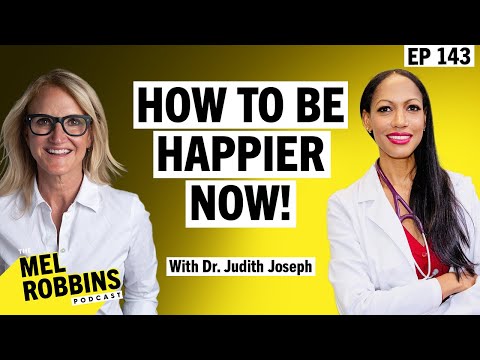
Want to Be Happier Right Now? Don’t Make This Mistake (New Surprising Science)
Mel Robbins (host), Dr. Judith Joseph (guest)
In this episode of The Mel Robbins Podcast, featuring Mel Robbins and Dr. Judith Joseph, Want to Be Happier Right Now? Don’t Make This Mistake (New Surprising Science) explores redefining Happiness: Healing Post-Pandemic Numbness With Small Joys Mel Robbins interviews psychiatrist and researcher Dr. Judith Joseph about why so many high-functioning people feel empty, numb, and “meh” despite outward success. Dr. Joseph argues that our cultural idea of constant, peak “happiness” is unrealistic and actually fuels dissatisfaction, especially after years of unprocessed collective trauma from the pandemic and social upheaval. She introduces anhedonia—a clinical term for lack of joy—as a widespread, under-acknowledged condition now affecting many otherwise functioning adults. Together, they explore a science-backed shift from chasing big happiness milestones to deliberately creating small, daily “points of joy” through presence, sensory awareness, and emotional validation to slowly bring feelings back online and become happier overall.
Redefining Happiness: Healing Post-Pandemic Numbness With Small Joys
Mel Robbins interviews psychiatrist and researcher Dr. Judith Joseph about why so many high-functioning people feel empty, numb, and “meh” despite outward success. Dr. Joseph argues that our cultural idea of constant, peak “happiness” is unrealistic and actually fuels dissatisfaction, especially after years of unprocessed collective trauma from the pandemic and social upheaval. She introduces anhedonia—a clinical term for lack of joy—as a widespread, under-acknowledged condition now affecting many otherwise functioning adults. Together, they explore a science-backed shift from chasing big happiness milestones to deliberately creating small, daily “points of joy” through presence, sensory awareness, and emotional validation to slowly bring feelings back online and become happier overall.
Key Takeaways
Stop chasing a fixed state of ‘being happy’; aim to become happier through daily moments of joy.
Dr. ...
Get the full analysis with uListen AI
Recognize anhedonia—feeling blah, numb, or joyless—even if you’re still ‘high-functioning.’
Anhedonia is a clinical term for lack of pleasure, and many people experience it as feeling on autopilot, empty, or disconnected while still working, parenting, and performing. ...
Get the full analysis with uListen AI
Unprocessed collective trauma from recent years is silently driving widespread numbness and burnout.
Using a biopsychosocial lens, Dr. ...
Get the full analysis with uListen AI
Your environment and leaders can spread numbness—or joy—throughout systems and families.
Corporate and family cultures that reward nonstop productivity and emotional suppression make anhedonia ‘contagious. ...
Get the full analysis with uListen AI
Use structured sensory grounding to bring feelings back online safely.
Practices like the 5-4-3-2-1 grounding method—slowly noticing five things you see, four you feel, three you hear, two you smell, and one you taste—interrupt autopilot, anchor you in the present, and gently retrain your nervous system to feel again.
Get the full analysis with uListen AI
Micro-joys in ordinary activities are powerful: savoring water, food, touch, or a sunset matters.
Deliberately savoring a sip of water, one minute of a meal, a brief hug, or a moment of play with a child or pet engages your senses, validates your inner experience, and incrementally counters the dullness of anhedonia without requiring big life changes.
Get the full analysis with uListen AI
Simple, consistent self-care beats elaborate, performative ‘wellness’ routines.
Meeting basic needs (eating when hungry, resting when tired, pausing when stuck) and protecting small pockets of time—like actually taking a lunch break or five undistracted minutes with a child—are more healing than rushed spa-like activities done on overload.
Get the full analysis with uListen AI
Notable Quotes
“Happiness is not a state. It’s about increasing the points, the moments of joy.”
— Dr. Judith Joseph
“People are walking around feeling blah or meh or just feeling numb, and then to give them this impossible idea of happiness to obtain, it’s just not right.”
— Dr. Judith Joseph
“If we don’t know how we feel, how can we identify what to do with this feeling?”
— Dr. Judith Joseph
“If you are not true with yourself, how can you fix things? How can things get better?”
— Dr. Judith Joseph
“Tomorrow is not promised. How do we improve the points of joy today?”
— Dr. Judith Joseph
Questions Answered in This Episode
How can I distinguish between clinical depression and the kind of anhedonia Dr. Joseph describes in high-functioning people?
Mel Robbins interviews psychiatrist and researcher Dr. ...
Get the full analysis with uListen AI
What are some concrete ways to process the unprocessed trauma of the pandemic years without becoming overwhelmed?
Get the full analysis with uListen AI
How can leaders or managers change workplace culture so that joy and rest are supported instead of subtly punished?
Get the full analysis with uListen AI
If I feel resistant or cynical about ‘savoring small moments,’ how can I start in a way that feels authentic rather than forced?
Get the full analysis with uListen AI
How can I use the anhedonia rating scale over time to track whether my daily ‘points of joy’ practices are actually helping?
Get the full analysis with uListen AI
Transcript Preview
(ticking sound) You're about to hear one of the most validating, important, and impactful interviews I've ever done on this podcast, period. Dr. Judith Joseph.
This idea of what we thought happiness was is just not possible. It's not attainable. That's why people feel unsatisfied. That's why they feel like they can't reach it. How do we increase the points of joy today?
Here we go. Let's take the quiz. There's a different way to live, and you're here to say there is? (ticking sound) Hey, it's your friend Mel, and welcome to the Mel Robbins podcast. I am so excited that you're hanging out with me today, and I also want to thank you for taking the time to choose to listen to something that could help you improve your life. I think that is super cool. Whether you're a longtime listener or you are brand new, I wanna welcome you. You are now part of the Mel Robbins podcast family. We are a super cool, smart, and empowered group of people, and you are a huge part of it, so thank you. I'm Mel Robbins. I'm a New York Times best-selling author and one of the world's leading experts on confidence and motivation. I am on a mission to inspire you, to empower you, and to give you tools and the expert resources that you need and deserve to help you create a better life. Now, over the past month, we have been talking non-stop about different ways that you can make this year the best year of your life, and I know you've been loving these episodes because we've been covering everything from how do you get clear on what you actually want and why you want it? How do you create a plan to go for it and to actually achieve what you want? And a big part of this being one of the best years of your life is you allowing it to be, you letting happiness in, because I really do want you to not only crush it in life and achieve your big goals, but I don't want you to do that as an empty person. I want you to be able to experience joy and to feel fulfilled as you're going for it. Just a couple weeks ago, you and I talked all about how you are blocking your happiness. I talked and shared about how I had been doing it, how I've stopped doing it, and I'll put a link in the show notes to that episode in case you missed it, because everybody that listened to it gobbled that up. I mean, you shared that. You wrote in, "I'm so glad it made a huge difference." And so today, this was my plan. I was planning that we were going to go even deeper on the topic of happiness and talk all about the research and science with this renowned researcher. Well, I sat down, and we were starting the conversation, and I'm gonna warn you, holy smokes, I- we were, like, two minutes in and (whoosh) the conversation went in a direction that I was not expecting. And I'm gonna tell you something, I am so happy it did because you're about to hear one of the most validating, important, and impactful interviews I've ever done on this podcast, period. You are gonna feel so seen and understood. You're gonna understand why feeling fulfilled and just happy, happy, happy has eluded you, and most importantly, you will be left in action. I cannot wait for you to spend time with the incredible Dr. Judith Joseph. Let me tell you about her. She is a renowned double board-certified psychiatrist. She earned her medical degree, her MBA, and did her residency all at Columbia, where she is also the chairwoman of the Women in Medicine Board. She also did a medical fellowship at NYU, where she's been a professor for the last decade. Just recently, she received a US Congress and House of Representatives Proclamation Award for her social media advocacy and mental health research. And here's the thing that I find to be so cool about Dr. Judith Joseph. She's a pioneering researcher. She's the founder and principal investigator of a research institute that she created, Manhattan Behavioral Medicine, where she has conducted over 60 clinical research trials with her all-female medical team. Dr. Judith is here with not only the research, but the recommendations, the simple things that you can start doing literally in the middle of this podcast with me and with Dr. Judith to start feeling like yourself again. So thank you for being here. Thank you for sharing this. Let's jump right in. Hey, we're gonna get to this episode in just a second. I cannot wait to introduce you to Dr. Judith Joseph. This is amazing. But first, please, have you subscribed to our channel? It makes a huge difference. It allows me to bring you a brand-new video every single day. You're gonna love this one, so just take a moment and subscribe. Did you do it? Awesome. Thank you so much. Now let's jump into the episode. Dr. Judith Joseph, I am so happy you are here. Thank you, thank you, thank you for coming and spending time with me.
Install uListen to search the full transcript and get AI-powered insights
Get Full TranscriptGet more from every podcast
AI summaries, searchable transcripts, and fact-checking. Free forever.
Add to Chrome