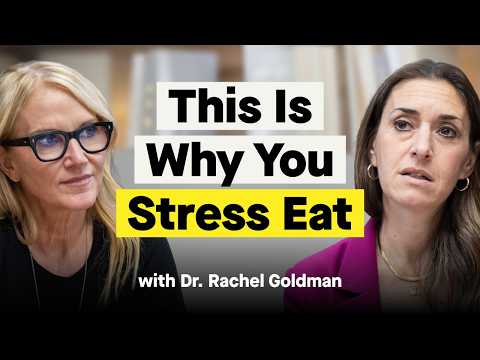
The Mind-Body Reset: The Truth About Stress Eating, Dieting, & How to Feel Better Now
Dr. Rachel Goldman (guest), Mel Robbins (host)
In this episode of The Mel Robbins Podcast, featuring Dr. Rachel Goldman and Mel Robbins, The Mind-Body Reset: The Truth About Stress Eating, Dieting, & How to Feel Better Now explores stress eating decoded: pause, reframe, and rebuild body trust today Dr. Rachel Goldman breaks down how diet culture and chronic stress shape body image, “food noise,” and reactive eating, emphasizing that emotional eating is common and not a willpower failure. She teaches a “pause” practice (diaphragmatic breathing plus grounding statements) to create space between emotion and behavior, then outlines a coping toolbox and a 10-minute buffer to interrupt impulsive eating.
Stress eating decoded: pause, reframe, and rebuild body trust today
Dr. Rachel Goldman breaks down how diet culture and chronic stress shape body image, “food noise,” and reactive eating, emphasizing that emotional eating is common and not a willpower failure. She teaches a “pause” practice (diaphragmatic breathing plus grounding statements) to create space between emotion and behavior, then outlines a coping toolbox and a 10-minute buffer to interrupt impulsive eating.
The conversation clarifies key distinctions: physiological vs emotional hunger, overeating vs binge eating, disordered eating vs diagnosable eating disorders, and health-conscious habits vs orthorexia. Goldman highlights how restriction often fuels the binge–restrict cycle and how consistent nourishment (including breakfast and protein) reduces cravings, shame, and preoccupation with food.
Finally, she offers compassionate communication strategies for helping someone with disordered eating and a stigma-reducing framework for GLP-1s as medical treatments for obesity/diabetes—effective for quieting food noise but not a substitute for mindset and habit change.
Key Takeaways
Emotional eating is a regulation strategy, not a character flaw.
Goldman defines emotional eating as using food to soothe any emotion (stress, boredom, sadness, even happiness). ...
Get the full analysis with uListen AI
The “pause” is the foundational reset button.
Diaphragmatic breathing (belly expands on inhale, slow exhale) plus grounding statements (“I am in control/confident/I can do this”) helps shift from reacting to responding. ...
Get the full analysis with uListen AI
You can spot emotional hunger by urgency and searching.
Physiological hunger builds gradually and is satisfied by available food; emotional hunger feels immediate (“I need something right now”) and often involves opening/closing cabinets looking for a specific comfort item. ...
Get the full analysis with uListen AI
Restriction often fuels overeating and binge patterns.
Skipping meals and rigid rules increase preoccupation (“food noise”), intensify cravings, and make impulsive eating more likely—especially at night when stress drops and hunger finally registers. ...
Get the full analysis with uListen AI
Mindful eating reduces ‘automatic’ intake and post-eating shame.
Tools include putting the utensil down between bites, chewing until the bite is fully broken down, and the “raisin exercise” (noticing texture/flavor before chewing). ...
Get the full analysis with uListen AI
Health-focused habits become problematic when they create distress and rigidity.
Goldman flags orthorexia—when “healthy” eating turns obsessive—as crossing the line when it impairs daily life (skipping events, constant anxiety) or becomes rule-bound (“I can’t eat X,” “I must work out daily”). ...
Get the full analysis with uListen AI
GLP-1s can help quiet food noise, but they don’t change mindset.
She frames GLP-1s as treatments for obesity/diabetes rather than “weight-loss meds,” helping reduce cravings and fullness thresholds. ...
Get the full analysis with uListen AI
Notable Quotes
“Emotional eating… is turning to food as a way to soothe yourself when you are having an emotion.”
— Dr. Rachel Goldman
“In a way it’s a distraction, but not a solution.”
— Dr. Rachel Goldman
“It’s not the behavior itself that matters, it’s the thought that follows the behavior.”
— Dr. Rachel Goldman
“The key is to actually eat… Get rid of the restricting. So it could be something small.”
— Dr. Rachel Goldman
“It’s scary when we feel like we lost control, but we can hit the reset button right here, right now.”
— Dr. Rachel Goldman
Questions Answered in This Episode
In your cabinet-checking moment, what does Goldman mean by “searching for something specific,” and how can you identify what you’re actually needing (comfort, rest, connection, relief)?
Dr. ...
Get the full analysis with uListen AI
Goldman says physiological hunger is gradual while emotional hunger is urgent—what are concrete bodily cues (beyond stomach growling) that help distinguish them in real time?
The conversation clarifies key distinctions: physiological vs emotional hunger, overeating vs binge eating, disordered eating vs diagnosable eating disorders, and health-conscious habits vs orthorexia. ...
Get the full analysis with uListen AI
How would you build a personal “coping toolbox” with at least three options if you can’t leave the situation (e.g., at work, in the car, with kids)?
Finally, she offers compassionate communication strategies for helping someone with disordered eating and a stigma-reducing framework for GLP-1s as medical treatments for obesity/diabetes—effective for quieting food noise but not a substitute for mindset and habit change.
Get the full analysis with uListen AI
Goldman argues restriction can keep weight from moving via stress/survival mode—what’s the best evidence-based way to explain that without oversimplifying metabolism?
Get the full analysis with uListen AI
What’s the most practical way to apply the “10-minute rule” at night when you’re exhausted and your willpower is low?
Get the full analysis with uListen AI
Transcript Preview
Thanks to diet culture and the society we live in, we have all been told messages telling us that we should be thin or we shouldn't be hungry or we shouldn't be eating this. And because of that, we have all internalized those messages and we have learned to tie our worth to our body shape, size, food behaviors, eating behaviors, et cetera.
Today, you and I are sitting down with Dr. Rachel Goldman, a renowned clinical psychologist and professor at NYU who's worked with thousands of patients dealing with emotional eating, stress, obesity, and body image. It feels like the core issue is that our emotions are really driving our eating patterns and our health habits.
Emotional eating, first of all, is so common. It is turning to food as a way to soothe yourself when you are having an emotion.
Huh. I think a lot of us make the mistake of thinking it's about willpower.
It's not at all.
What is this about?
It's about...
What is your take on how to be body positive and not shame yourself and use the tools like GLP-1 for weight loss?
This is a hot topic. So I think a lot of people think if you're body positive, you can't be doing something to, quote, "change your body." It's scary when we feel like we lost control, but we can hit the reset button right here, right now.
Dr. Rachel Goldman, welcome to The Mel Robbins Podcast.
Thank you so much. I'm so excited to be here with you today.
I am so excited to unpack all that you are going to teach us today, and I wanna start by asking you, how is my life going to change for the better if I take everything to heart that you are about to share with us and teach us and all the very tactical things you're going to give us as resources and we use it in our life? How is my life gonna change?
So actually, I wanna give you kind of a glimpse of what that's gonna feel like.
Ooh.
So let's just take a moment and take a breath right here, right now. Just pausing is what many of us need. We just have to pause and tune in. So I always like to start by just taking a breath-
Okay
... to, like, ground ourselves and reset.
Okay.
So can we do that together?
Absolutely, 'cause I have a feeling that this is gonna come full circle by the end of this, and it has a huge connection to our relationship to our bodies and eating and our health-
You're absolutely correct
... and resetting. Okay.
Yeah.
I'm in.
Okay, let's do it.
Okay. What do I do? [laughs]
So let's take a breath in through our nose.
Okay.
And out through our mouth. Let's do another one. Breath in and out. Before I ask you how you feel, I want you now to repeat three things.
Install uListen to search the full transcript and get AI-powered insights
Get Full TranscriptGet more from every podcast
AI summaries, searchable transcripts, and fact-checking. Free forever.
Add to Chrome