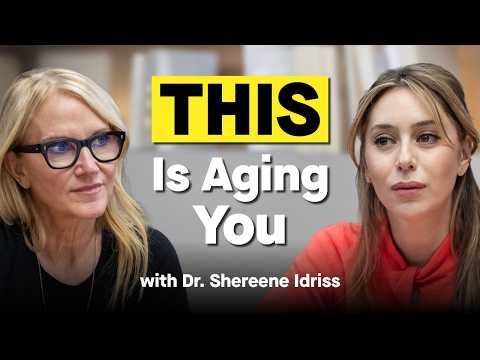
#1 Dermatologist: The Ultimate Skincare Routine for Amazing Skin
Mel Robbins (host), Dr. Shereene Idriss (guest)
In this episode of The Mel Robbins Podcast, featuring Mel Robbins and Dr. Shereene Idriss, #1 Dermatologist: The Ultimate Skincare Routine for Amazing Skin explores dermatologist simplifies skincare: essentials, actives, aging, and confident choices Dr. Shereene Idriss reframes skincare as health (skin is the body’s largest organ) and emphasizes that daily habits—especially sun exposure—drive most visible aging more than genetics.
Dermatologist simplifies skincare: essentials, actives, aging, and confident choices
Dr. Shereene Idriss reframes skincare as health (skin is the body’s largest organ) and emphasizes that daily habits—especially sun exposure—drive most visible aging more than genetics.
She argues that most people are over-marketed into complicated routines, and that consistency with a simple foundation (gentle cleanse, moisturize, daily broad-spectrum SPF) beats trendy “12-step” regimens.
The conversation breaks down how to properly wash your face, how to interpret SPF, what “sensitive skin” usually really means, and how to use actives like vitamin C and retinoids without damaging your barrier.
They also cover adult acne, melasma, collagen myths, and realistic options for aging concerns (like jowls), while repeatedly returning to the mindset shift: skin isn’t a problem to solve, it’s a relationship to build.
Key Takeaways
Most people need fewer products, not more.
Idriss says nobody needs a 12-step routine; overly complex routines reduce consistency and increase irritation, making outcomes worse over time.
Get the full analysis with uListen AI
Build your routine around three categories: cleanse, moisturize, protect.
Her baseline is a gentle cleanser, a basic moisturizer (no actives), and daily sunscreen—chosen for your skin type and environment so you’ll actually use them.
Get the full analysis with uListen AI
Wash smarter: cleanse mainly at night, consider water-only mornings.
For many people, morning cleansing plus hot water over-strips protective oils—especially in drier, menopausal, or dehydrated skin—so warm water may be enough unless you’re very oily/acne-prone.
Get the full analysis with uListen AI
Water temperature matters more than people realize.
Hot water acts like it does on a greasy pan—removing protective oils and worsening dehydration/barrier dysfunction—so use warm (not hot) water.
Get the full analysis with uListen AI
Sunscreen success is about texture adherence, not “the perfect brand.”
The best sunscreen is the one you’ll wear; many skip SPF because they hate the feel, so trial-and-error is normal until you find one you like.
Get the full analysis with uListen AI
Broad-spectrum SPF is non-negotiable, and SPF is a time multiplier.
Broad spectrum protects from UVA (collagen breakdown) and UVB (burn); SPF roughly indicates how much longer you can stay in sun without burning compared to no sunscreen.
Get the full analysis with uListen AI
There is no safe tan—pigment is a DNA-damage signal.
She frames tanning, freckles, and sun-induced pigment as evidence of UV injury; you can fade visible signs, but you can’t “undo” DNA damage—so get yearly skin checks if you’ve had heavy exposure.
Get the full analysis with uListen AI
Avoid ‘instant gratification’ skincare that damages the barrier.
She flags items like retinol sheet masks (wrong format), face loofahs (too abrasive/bacterial), daily makeup wipes (smear into pores), and pore strips (temporary payoff, potential pore stretching).
Get the full analysis with uListen AI
Retinoids work best with ‘consistency over intensity.’
Stronger isn’t better if it causes inflammation and quitting; start low/slow and prioritize a frequency you can tolerate long term rather than burning your skin with high-strength tretinoin.
Get the full analysis with uListen AI
Most ‘sensitive skin’ is actually reactive, inflamed skin state.
She notes many self-diagnose sensitivity, but true allergy-like sensitivity is rarer; when stinging/burning appears, stop actives, reset, then rebuild barrier stepwise (moisturizer → cleanser → additions).
Get the full analysis with uListen AI
Adult acne often reflects hormones plus slower cell turnover.
She distinguishes hormonal jawline cysts from inflammatory, cystic, and comedonal acne, and highlights triggers like hair products, dirty phones/glasses, unwashed brushes, heat/sweat, and diet.
Get the full analysis with uListen AI
Jowls aren’t a skincare failure—they’re structural aging.
Jowls come from bone remodeling, fat pad shifting/shrinking, skin laxity, and sometimes muscle patterns; creams won’t fix structure, while options range from lymphatic massage (temporary) to devices, injectables, or surgery.
Get the full analysis with uListen AI
Collagen marketing is often oversold; focus on proven levers.
Balanced diet supports collagen but supplements aren’t magic; topicals like retinoids plus sunscreen help over time, while in-office procedures (e. ...
Get the full analysis with uListen AI
Injectables should match a problem, not a fear.
She frames Botox as strategic “pauses,” not freezing, and criticizes “preventative Botox” when no lines exist because it’s often fear-driven rather than goal-driven.
Get the full analysis with uListen AI
Confidence improves fastest by changing your relationship to your skin.
Her practical mindset tools: simplify your routine, throw out the magnifying mirror, and do one confidence-boosting act (mascara/red lip/great jeans) while your skin changes gradually.
Get the full analysis with uListen AI
Notable Quotes
“Skin is not just vanity. It’s not just cosmetic. It’s not just superficial.”
— Dr. Shereene Idriss
“Nobody needs a 12-step skincare routine. Nobody.”
— Dr. Shereene Idriss
“There is no safe tan…. a tan… is a sign of DNA damage.”
— Dr. Shereene Idriss
“It’s not a skincare failure. It’s a structural issue.”
— Dr. Shereene Idriss
“Consistency over intensity.”
— Dr. Shereene Idriss
Questions Answered in This Episode
If you had to design a morning routine for three different skin types (dry/dehydrated, oily/acne-prone, rosacea-prone), what would change from your “water-only” guideline?
Dr. ...
Get the full analysis with uListen AI
Can you explain, in practical terms, how to tell whether your barrier is damaged versus you having a true ingredient sensitivity—and what signs should prompt patch testing?
She argues that most people are over-marketed into complicated routines, and that consistency with a simple foundation (gentle cleanse, moisturize, daily broad-spectrum SPF) beats trendy “12-step” regimens.
Get the full analysis with uListen AI
You recommend using a cleanser twice instead of relying on wipes—how exactly should someone ‘double cleanse’ if they wear waterproof sunscreen and makeup daily?
The conversation breaks down how to properly wash your face, how to interpret SPF, what “sensitive skin” usually really means, and how to use actives like vitamin C and retinoids without damaging your barrier.
Get the full analysis with uListen AI
Which specific sunscreen textures/filters tend to be best tolerated for people who ‘hate the feel’ of SPF (e.g., gel, fluid, mineral), and what should they look for on labels?
They also cover adult acne, melasma, collagen myths, and realistic options for aging concerns (like jowls), while repeatedly returning to the mindset shift: skin isn’t a problem to solve, it’s a relationship to build.
Get the full analysis with uListen AI
You mention SPF is a time multiplier—how should people translate that into real-world reapplication advice when sweating, swimming, or sitting by windows?
Get the full analysis with uListen AI
Transcript Preview
We have received thousands and thousands and thousands of questions on the topic of skincare. Today, Dr. Shereene Idriss, one of the most trusted board-certified dermatologist in the world, is here with the science, three specific steps, and the no BS truth on what works and what doesn't.
Skin is not just vanity. It's not just cosmetic. It's not just superficial. Once you start to shift that perspective, you realize, "Holy cow, this is my biggest organ, and yet I put it through the wringer!"
What do we do about these sagging jowls?
It's not a skincare failure. Your structural bone changes.
Now, let's talk about the things that you should skip because they are a waste of money.
There are moments when it can be useful, but this is not something I recommend every day.
[gasps] Uh-oh, uh-oh.
Makeup remover wipes. [laughs]
She's coming after the makeup wipes, everybody.
I... But I, I prefaced it.
Not every day.
Not most days.
Let's talk about injectables. Who are they for?
The goal of Botox is not to freeze you in perpetuity. [chuckles] And side note, that's why I think I personally have an issue with, like, the preventative Botox aspects of life, because what are we preventing? Your confidence is not gonna come from changing your skin first. It's gonna come by changing your relationship to your skin first. Your skin is not a problem to solve. It is a relationship to build.
Hey, it's Mel, and before we get into this episode, my team was showing me 57% of you who watch The Mel Robbins Podcast here on YouTube are not subscribed yet. Could you do me a quick favor? Just hit subscribe so that you don't miss any of the episodes that we post here on YouTube. It lets me know you're enjoying the guests and the content that we're bringing you, because I wanna make sure you don't miss a thing, and I'm so glad you're here for this episode 'cause this is a really good one. All right, let's dive in. [whoosh] Dr. Shereene Idriss, welcome to The Mel Robbins Podcast.
I cannot believe I'm here, but thank you so much for having me.
Well, I'm really glad you're here, and there's two things I wanna say before we jump in. Number one, you know, as you're listening or watching on YouTube, I just wanna tell you, you have picked a winner, and I can already tell because you have about 40 pages of notes-
[laughs]
... in front of you. I know that we are in for something that is gonna be world-class, so thank you for really showing up in a way for me and for the person who's spending time with us today, uh, to make an impact. Second thing is when I posted on social all about the fact that you were coming, just asked people for their questions, I don't know that we've ever gotten more questions on a topic, and so we are gonna go deep. I'm so excited. Where I wanna start, Dr. Idriss, is what is going to change about my life if I take everything to heart that you are about to teach us, and I apply it?
Install uListen to search the full transcript and get AI-powered insights
Get Full TranscriptGet more from every podcast
AI summaries, searchable transcripts, and fact-checking. Free forever.
Add to Chrome