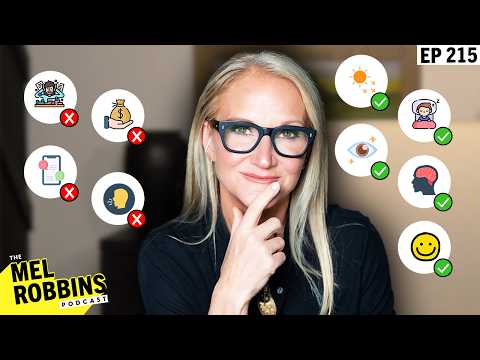
9 Small Things That Will Make a Surprisingly Big Difference
Mel Robbins (host), Narrator
In this episode of The Mel Robbins Podcast, featuring Mel Robbins and Narrator, 9 Small Things That Will Make a Surprisingly Big Difference explores nine Tiny Daily Habits That Quietly Transform Your Entire Life Mel Robbins shares nine simple, memorable behavior shifts designed to create outsized improvements in mindset, sleep, productivity, relationships, money, and emotional regulation.
Nine Tiny Daily Habits That Quietly Transform Your Entire Life
Mel Robbins shares nine simple, memorable behavior shifts designed to create outsized improvements in mindset, sleep, productivity, relationships, money, and emotional regulation.
Each "little change" is framed as an easy rule of thumb or mantra, grounded in current research but translated into practical, everyday actions you can start immediately.
Topics range from cultivating a can-do mindset and improving sleep hygiene to using walking as an emotional reset, curbing impulse spending, and strengthening social connection through eye contact.
Robbins emphasizes that these small, repeatable actions compound over time, changing how you think, feel, and respond to problems far more than big, occasional efforts.
Key Takeaways
Adopt the mindset: “Whether you think you can or you can’t, you’re right.”
Your belief about what’s possible determines whether you even try; telling yourself “I can do that” opens the door to action, learning, and opportunity, while “I can’t” stops you before you start.
Get the full analysis with uListen AI
If you want eight hours of sleep, spend nine hours in bed.
Because it takes most people 15–20 minutes (or more) to fall asleep and you may wake briefly at night, scheduling nine hours in bed is a practical way to actually achieve eight hours of sleep.
Get the full analysis with uListen AI
Use the 5-10-20 rule to “bank” morning light for better sleep.
Get outside (or by a bright window) first thing: 5 minutes if it’s sunny, 10 if it’s cloudy, 20 if it’s rainy or you’re indoors by a window to help reset your circadian rhythm and improve nighttime sleep quality.
Get the full analysis with uListen AI
Take a short walk as a default response to emotional or mental overload.
A 10–15 minute walk can reduce cravings, lift mood, clear mental fog, and create emotional distance from stressful situations, helping you return with more clarity and control instead of reacting impulsively.
Get the full analysis with uListen AI
“Stop talking” so you can learn more and protect your peace.
Intentionally speaking less—especially in tense conversations—creates space to listen, learn, avoid unnecessary conflict, and resist the urge to always have the last word or an opinion on everything.
Get the full analysis with uListen AI
Put things where they belong the moment you notice they’re out of place.
Taking the extra 10–30 seconds to return items to their true home (not just where you found them) prevents clutter from accumulating and gradually transforms your environment into an organized, calmer space.
Get the full analysis with uListen AI
Curb impulse spending with a “wait a week” rule for nonessential purchases.
If something costs more than around $100 and you don’t truly need it, wait seven days; the initial emotional high of buying usually fades, revealing whether it’s actually worth your money or just an algorithm-fueled impulse.
Get the full analysis with uListen AI
Improve connection by noticing the color of people’s eyes.
Training yourself to really see and even compliment someone’s eye color naturally holds your gaze longer, strengthens eye contact, signals confidence and presence, and deepens interpersonal connection.
Get the full analysis with uListen AI
Intentionally smile throughout the day to gently lift your mood.
Research shows that even a “fake” smile—pulling the corners of your mouth toward your ears—can produce a small but real increase in happiness through facial feedback, signaling to your brain that you’re okay.
Get the full analysis with uListen AI
Notable Quotes
“Whether you think you can or you think you can’t, you’re right.”
— Mel Robbins (quoting her grandmother / common saying)
“If you wanna get eight hours of sleep, spend nine hours in bed.”
— Mel Robbins
“A little walk is a solution to 93% of your problems.”
— Mel Robbins
“Not everything deserves a response. Not everyone deserves an explanation. Stop talking.”
— Mel Robbins
“Don’t put things back where you found them. Put them where they belong.”
— Mel Robbins
Questions Answered in This Episode
Which of these nine small changes would make the biggest difference in my life right now, and what’s blocking me from starting it today?
Mel Robbins shares nine simple, memorable behavior shifts designed to create outsized improvements in mindset, sleep, productivity, relationships, money, and emotional regulation.
Get the full analysis with uListen AI
How does my self-talk—especially around “I can” vs. “I can’t”—show up in my career, health, and relationships, and where is it quietly limiting me?
Each "little change" is framed as an easy rule of thumb or mantra, grounded in current research but translated into practical, everyday actions you can start immediately.
Get the full analysis with uListen AI
What would my evenings and mornings look like if I truly prioritized nine hours in bed and the 5-10-20 light rule for 30 days?
Topics range from cultivating a can-do mindset and improving sleep hygiene to using walking as an emotional reset, curbing impulse spending, and strengthening social connection through eye contact.
Get the full analysis with uListen AI
In what situations do I habitually react instead of taking a “little walk,” and how might choosing to walk first change my typical outcomes?
Robbins emphasizes that these small, repeatable actions compound over time, changing how you think, feel, and respond to problems far more than big, occasional efforts.
Get the full analysis with uListen AI
If I applied the “wait a week” rule to all nonessential purchases, what patterns in my emotions, triggers, and spending habits might I uncover?
Get the full analysis with uListen AI
Transcript Preview
(instrumental music plays) I have nine simple changes that I'm gonna share with you today that are gonna make a surprisingly big difference in your life. They're super easy to remember. It's almost like these are little life hacks that sit on top of the latest and most amazing research on how you can improve various aspects of your life, and I guarantee you, you'll be able to do most of 'em today. (clock ticks) Hey, it's your friend Mel, and I'm so glad you're here. Welcome to The Mel Robbins Podcast. I am always so excited to be able to spend time together with you, and I wanna start by thanking you for taking the time to listen to something that could help you be happier. Today's conversation is absolutely going to do that. And if you're brand new, I also wanna personally welcome you to The Mel Robbins Podcast family and say you are listening to the perfect episode, because I have nine simple changes that I'm gonna share with you today that are gonna make a surprisingly big difference in your life. And what I love about each one of these nine simple changes is that each one of them has its own kinda little fun way to remember it, and I'm gonna teach you the little tricks to remembering these things. And what's also really awesome about these nine simple changes is that each one is a way that you can apply the latest research in an easy way to your life. And the fact is, there are lots of episodes that you and I do together where we get to sit with the world-renowned leading experts on topics ranging from neuroscience and habits and health and happiness and relationships, and they go so deep on a specific topic, and there are a lot more of those kinda episodes coming up that you're gonna be able to listen to. But one of the things that I often struggle with is what to do with all that knowledge. Like, it's so exciting to learn this stuff, but oftentimes, I'm left wondering, "Well, how do I remember this study? And more importantly, how do I apply it for maximum benefit in my life?" And that's my mission with the conversation today. We're gonna address that, because today is all about these nine simple changes. These are simple sayings, kinda like a rule of thumb. They're super easy to remember. It's almost like these are little life hacks that sit on top of the latest and most amazing research on how you can improve various aspects of your life, and I guarantee you, the second you hear me explain each one, you're gonna be like, "Oh, my gosh, that makes so much sense. Why did I not think about it that way?" And you're also gonna go, "Thank you, Mel, because the way that you just explained it and that simple little saying that you gave me, now I can remember it. And if I can remember it, I can apply it." And not only can you apply it, you wanna know how simple these nine changes are? You'll be able to do most of 'em while you're listening. And the ones that you can't do while you're listening, you'll be able to do 'em today. That's how easy and impactful this is gonna be. So let's just start with the very first little change that you're gonna make. I want you to start repeating that phrase that my grandma used to say to me to yourself. "Whether you think you can or can't, you're right." And let's unpack that, because there is so much power packed into that one little sentence. "Whether you think you can or you can't, you're right." And I'm gonna give you an example. Let's say that you're in a situation where you would really love to get a better job. I mean, who doesn't wanna get paid more? Who doesn't wanna work somewhere where they feel valued and they're having fun and they're making a difference? If you think you can't get a better job, are you gonna apply? Nope. Are you gonna do the work on your resume if you think, "Well, I can't get a better job"? Nope, you're not. Are you gonna network with your parents' friends or reach out to college friends so that you can get a better job? Not if you think you can't. Are you gonna update your LinkedIn profile? Nope. Why? Because you think you can't. That mindset of thinking "I can't do that" stops you from taking action, and if you stop yourself from taking action because you think you can't do that, you're right. You can't do that. The mindset itself is what's stopping you from taking the actions that are gonna get the result that you want. Now, let's flip it, okay? If you think you can get a better job, now what happens? Now, you're opening the door to optimism, to hope. If you think you can get a better job by trying, you're going to want to try. You have a reason to try. You're gonna feel more resilient. And that's an example of a simple saying that packs so much research around mindset and psychology into something that you can say to yourself over and over and over again, because if you say to yourself, "If I think I can or I think I can't, I'll be right," one thing that you say, "If I think I can," creates a mindset where you try. And when you try, that's what matters, because it's all in the trying that you create the results. And so here's how you apply this first little change so that you create surprisingly big results in your life. Just start telling yourself, "I can do that. I can try that. I think I can change my attitude. I, I can improve my relationship with my spouse. I can get in better shape. I can learn this AI coding thing if I wanted to." Because if you think you can, you'll be right, because you're gonna be more likely to try. You're gonna open up the door to all kinds of opportunities, because now, just through that small, little, tiny shift in your mindset, "I think I can," you will make the effort. So remember, the first tiny, little change that creates a surprisingly big difference, we're talking domino effect here. "Whether you think you can or you think you can't, you're right."So, by gosh, you better tell yourself you can. Now, let's go right into the second little change that I want you to make. And honestly, I can't believe I didn't stumble into this one sooner, and I don't even know who to give credit to for this, but we're just gonna take it and run with it. So, the little change number two is this, if you wanna get eight hours of sleep, spend nine hours in bed. What the heck? That is so obvious. If you wanna get eight hours of sleep, spend nine hours in bed. Do you know, I've spent my entire life thinking about getting eight hours of sleep? I have been missing the obvious the entire time, and I bet you have too. Why did I not think about this? I mean, this is so kind of like one of those things that's like, duh. You know, I'm the kind of person that if I think, "Okay, I want to get eight hours of sleep tonight," I literally climb in bed at 10 o'clock at night, and then I set my alarm at 6:00 AM. That's eight hours. Do I get eight hours of sleep? No, because it takes time to fall asleep. In fact, one of the world's most renowned researchers in the science of sleep is none other than Dr. Rebecca Robbins at Brigham and Women's Hospital right here in Boston, Massachusetts. It's one of Harvard's many hospitals in the Boston area. This is what she told me about the average time that it takes for someone to fall asleep.
Install uListen to search the full transcript and get AI-powered insights
Get Full TranscriptGet more from every podcast
AI summaries, searchable transcripts, and fact-checking. Free forever.
Add to Chrome