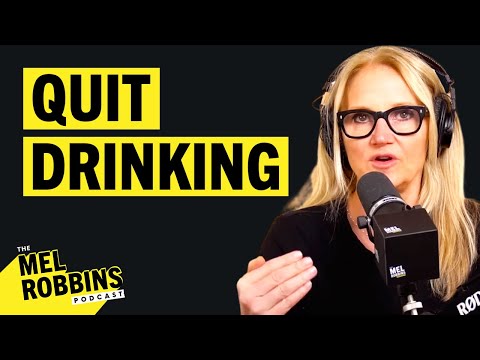
Mindset Flip: Getting Real About Your Relationship With Alcohol | The Mel Robbins Podcast
Mel Robbins (host), Rachel Hart (guest), Narrator
In this episode of The Mel Robbins Podcast, featuring Mel Robbins and Rachel Hart, Mindset Flip: Getting Real About Your Relationship With Alcohol | The Mel Robbins Podcast explores rewriting Drinking Habits: Understanding Urges, Desire, And Inner Conflict Mel Robbins and coach Rachel Hart unpack Mel’s conflicted relationship with alcohol as a doorway into understanding urges, desire, and self-judgment. They reframe drinking not as a simple willpower issue, but as a learned response to deeper needs like belonging, relief, boundaries, and celebration. Rachel explains the roles of the “lower brain” (immediate gratification) and “higher brain” (long-term values) and how internal conflict between them often drives us to drink just to stop the argument in our heads. The conversation offers a practical, non-shaming approach—using a 30‑day ‘tools-first’ experiment—to change your relationship with alcohol or any other compulsive behavior by learning to feel and interpret urges instead of obeying or fighting them.
Rewriting Drinking Habits: Understanding Urges, Desire, And Inner Conflict
Mel Robbins and coach Rachel Hart unpack Mel’s conflicted relationship with alcohol as a doorway into understanding urges, desire, and self-judgment. They reframe drinking not as a simple willpower issue, but as a learned response to deeper needs like belonging, relief, boundaries, and celebration. Rachel explains the roles of the “lower brain” (immediate gratification) and “higher brain” (long-term values) and how internal conflict between them often drives us to drink just to stop the argument in our heads. The conversation offers a practical, non-shaming approach—using a 30‑day ‘tools-first’ experiment—to change your relationship with alcohol or any other compulsive behavior by learning to feel and interpret urges instead of obeying or fighting them.
Key Takeaways
Treat urges as data, not evidence that you’re broken.
Instead of panicking when you want a drink, notice the urge and name it—“I’m having an urge right now”—so your higher brain comes online. ...
Get the full analysis with uListen AI
Look beneath the drink to the deeper need it represents.
Alcohol often stands in for things like connection (the red Solo cup at age 14), a boundary (“I’m off the clock now”), celebration, or a dopamine hit. ...
Get the full analysis with uListen AI
Understand your “lower brain” so you can use your “higher brain.”
The lower brain wants immediate pleasure, comfort, and efficiency; it remembers, “Sunset = cocktail” or “bad news = numbing. ...
Get the full analysis with uListen AI
Internal conflict, not alcohol itself, often drives the behavior.
Many people drink not just for the buzz, but to silence the war in their heads—“I said I wouldn’t,” versus “I deserve it. ...
Get the full analysis with uListen AI
Shift from “I can’t have it” to “I’m choosing not to.”
Telling yourself you “can’t” triggers rebellion and resentment, especially if you hate being told what to do. ...
Get the full analysis with uListen AI
Redefine commitment: progress comes from learning, not perfect streaks.
In Rachel’s 30-day experiment, the goal is to use the tools—observe urges, question excuses, review lapses—not to have 30 flawless dry days. ...
Get the full analysis with uListen AI
The skills you build with alcohol generalize to every habit.
Learning to identify feelings, ride out unmet desire, and respond with your higher brain applies just as well to overeating, overspending, doom-scrolling, or procrastinating. ...
Get the full analysis with uListen AI
Notable Quotes
“I don’t know why I’m so conflicted about it. I literally argue for it and against it every single time I use it.”
— Mel Robbins
“Maybe this urge actually is kind of trying to tell me something useful… something that you need, something that you want, that maybe has nothing to do with alcohol.”
— Rachel Hart
“Alcohol becomes a boundary. ‘I’ve poured the drink, I am off the clock.’”
— Rachel Hart
“You can’t get awareness just by being perfect.”
— Rachel Hart
“I really profoundly believe I do not have an issue with alcohol. I believe I have a major issue with the desire that’s driven by a boundary between work and relaxing and the desire to join in and belong.”
— Mel Robbins
Questions Answered in This Episode
If I removed alcohol from the picture, what deeper need or feeling would still be left in the situations where I most want to drink?
Mel Robbins and coach Rachel Hart unpack Mel’s conflicted relationship with alcohol as a doorway into understanding urges, desire, and self-judgment. ...
Get the full analysis with uListen AI
How would my relationship with myself change if I stopped treating every urge or lapse as evidence that something is wrong with me?
Get the full analysis with uListen AI
In what ways do I use other behaviors—like food, shopping, or social media—the same way Mel uses a cocktail: to set a boundary, belong, or turn my brain off?
Get the full analysis with uListen AI
What stories am I telling myself about a life with less (or no) alcohol—especially around fun, sex, celebration, and social acceptance—and are those stories actually true?
Get the full analysis with uListen AI
If I approached a 30-day ‘tools-first’ experiment, how could I commit to learning from every day—including the hard ones—without slipping into all-or-nothing shame about perfection?
Get the full analysis with uListen AI
Transcript Preview
We're just gonna jump in with a confessional. Is that okay? I have been thinking a lot about my relationship, and it sounds weird to even say my relationship with alcohol. I've been thinking a lot about drinking. Should I drink? Should I not drink? Is it bad if I'm drinking? And I feel like I have a split personality because I'm, I'm, I literally argue for it and against it every single time I use it. I don't know why I'm so conflicted about it. Help me. Help all of us. (upbeat music) Hey, it's your friend Mel, and welcome to the Mel Robbins Podcast. Okay, I'm so glad you're here today because today is one of those conversations where I need you to put your arm around me. You know how I always say that the Mel Robbins Podcast is like you and I going on a walk together and sorting out life and all kinds of topics together? Well, today, I wanna talk about something that's been on my mind for a long time, and that is my relationship with alcohol, and if I'm being honest, I've resisted having this conversation on the podcast because I'm not ready to remove alcohol from my life entirely, but I am so conflicted about drinking. I know it's bad for my health. I have so many other healthy habits, and yet I still love to have a cocktail. I still love to have a glass of wine, and maybe it's because Chris doesn't really drink that much, and so I often am confronted with, "Do I have a glass of wine alone? Do I not?" And this isn't just a conversation about alcohol. You may not have any issue with alcohol. You may be sober. You may not really drink at all. You may be able to have one beer or one glass of wine and never think about it, but you probably have something else in your life that you're conflicted about. Maybe it's how much money you spend. Maybe it's an addiction to sugar. Maybe you play way too many video games, or you spend too much time scrolling on social media. You know it's a problem, or maybe you wonder if it's a problem, and you keep going back and forth. "I should stop, but I don't stop. Should I stop? I don't know. What should I do?" Well, a friend of mine told me about this incredible woman named Rachel Hart. Rachel is a podcaster, and she is an expert at helping people understand their urges and create healthier and normal relationships with the things in life that you crave. Her work focuses on creating, quote, "a normal relationship with alcohol," whatever that might mean for you, but everything that we're gonna talk about today is gonna help you take control of any area of your life where you feel this conflict, or you feel out of control, or you wonder if you have a problem, and you just can't seem to get to the bottom of it. Here we go. Put your arm around me 'cause this is gonna be one of those (laughs) episodes where I'm processing my feelings in real time live in our conversation as you and I are walking and talking. So, let's do this. Rachel, welcome to the Mel Robbins Podcast.
Install uListen to search the full transcript and get AI-powered insights
Get Full TranscriptGet more from every podcast
AI summaries, searchable transcripts, and fact-checking. Free forever.
Add to Chrome