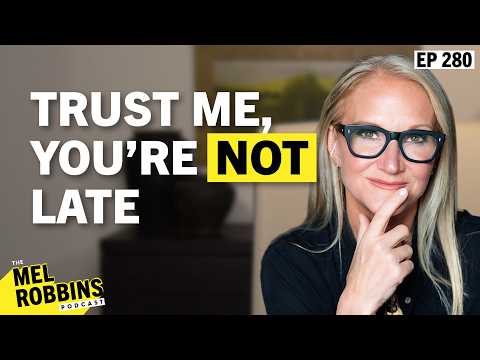
If You’re Feeling Behind in Life, Watch This
Mel Robbins (host), Narrator, Narrator, Narrator
In this episode of The Mel Robbins Podcast, featuring Mel Robbins and Narrator, If You’re Feeling Behind in Life, Watch This explores mel Robbins Destroys Life Timelines: Why You’re Right On Time Mel Robbins unpacks the concept of the “social clock” — the invisible, culturally inherited checklist of when we’re supposed to hit life milestones like career success, marriage, kids, homeownership, and retirement.
Mel Robbins Destroys Life Timelines: Why You’re Right On Time
Mel Robbins unpacks the concept of the “social clock” — the invisible, culturally inherited checklist of when we’re supposed to hit life milestones like career success, marriage, kids, homeownership, and retirement.
Drawing on psychological and longevity research, she shows that most of these timelines were created decades ago under very different life expectancies, economies, and social realities, and are now largely irrelevant or harmful.
She reframes each decade — 20s through 70s+ — with a new purpose (possibility, clarity, launchpad, reinvention, reignition, and connection), arguing that feeling “behind” is a symptom of misplaced expectations, not personal failure.
Throughout, she offers practical mindset shifts and examples to help listeners drop comparison, align with current reality, and make age-appropriate but open‑ended decisions about career, relationships, money, and meaning.
Key Takeaways
The feeling of being ‘behind’ is manufactured by social clocks, not facts.
Research on the ‘social clock’ shows that our stress comes from comparing ourselves to arbitrary, inherited timelines (graduation, marriage, kids, retirement) set in very different eras — not from any real deadline on our potential.
Get the full analysis with uListen AI
Your 20s are for exploration, not for having everything figured out.
Given economic instability, hybrid work, tech disruption, and new career paths, it’s normal to feel lost in your 20s; Robbins urges treating this decade as a ‘decade of possibility’ focused on trying jobs, locations, and interests to learn who you are.
Get the full analysis with uListen AI
In your 30s, get honest about what you want, not what’s ‘due’.
Instead of bowing to pressure to marry, have kids, and buy a house “on time,” Robbins says to confront real constraints (like fertility data) while rejecting fake ones, taking concrete steps such as freezing eggs or leaving partners who don’t share your vision.
Get the full analysis with uListen AI
Your 40s are a launchpad, not a verdict on your past choices.
Even after many pivots and financial setbacks, accumulated skills, networks, and urgency make your 40s a prime decade to start or relaunch a career, business, or major life change; high-profile examples and research on successful founders support this.
Get the full analysis with uListen AI
Midlife is a powerful time for reinvention, not inevitable crisis.
In your 50s, with kids older and priorities clearer, you can go back to school, start retreats, write books, or redesign your marriage and work life; Robbins reframes this decade as one of deliberate reinvention and deepened contribution.
Get the full analysis with uListen AI
Retirement should be a choice driven by passion and reality, not age.
The age-65 retirement norm comes from a 1935 policy, not biology or meaning; given longer lives and economic shifts, many people benefit from continuing to work, volunteer, or pivot roles to preserve purpose, structure, finances, and mental health.
Get the full analysis with uListen AI
It is never too late to strengthen your body, mind, and relationships.
Longevity research shows we can build strength, mobility, and cognitive vitality well into old age; Robbins emphasizes doubling down on friendships, family healing, fun, and new experiences in your 60s, 70s, and beyond as core to a ‘good life’.
Get the full analysis with uListen AI
Notable Quotes
“You’re not behind. You’re not late. You are right on time.”
— Mel Robbins
“The pressure to be ‘on time’ in life isn’t the truth; it’s social conditioning.”
— Mel Robbins
“Your 20s are not the decade of figuring things out. Your 20s are the decade of possibility.”
— Mel Robbins
“Your 40s aren’t a finish line. Your 40s are the launchpad for the next decade of your life.”
— Mel Robbins
“You weren’t put on the Earth to be somebody’s wife or husband. You’re here to fulfill your dream, share your story, and create a big, beautiful, amazing life.”
— Mel Robbins
Questions Answered in This Episode
Which parts of my current ‘life checklist’ actually come from me, and which were inherited from family, culture, or outdated norms?
Mel Robbins unpacks the concept of the “social clock” — the invisible, culturally inherited checklist of when we’re supposed to hit life milestones like career success, marriage, kids, homeownership, and retirement.
Get the full analysis with uListen AI
If I stopped trying to be ‘on time,’ what would I choose to explore or change in this decade of my life?
Drawing on psychological and longevity research, she shows that most of these timelines were created decades ago under very different life expectancies, economies, and social realities, and are now largely irrelevant or harmful.
Get the full analysis with uListen AI
How can I practically balance real constraints (like fertility or finances) with rejecting arbitrary age-based pressure?
She reframes each decade — 20s through 70s+ — with a new purpose (possibility, clarity, launchpad, reinvention, reignition, and connection), arguing that feeling “behind” is a symptom of misplaced expectations, not personal failure.
Get the full analysis with uListen AI
What skills, experiences, and relationships have I already built that I could repurpose into a new direction or reinvention?
Throughout, she offers practical mindset shifts and examples to help listeners drop comparison, align with current reality, and make age-appropriate but open‑ended decisions about career, relationships, money, and meaning.
Get the full analysis with uListen AI
In what specific ways could I strengthen my social connections and sense of purpose to make the next decade my most fulfilling yet?
Get the full analysis with uListen AI
Transcript Preview
Every single society has this invisible checklist for life milestones. You gotta graduate from college by 22, you gotta be married by 30, you gotta have kids by 35, you're gonna have your mid-life crisis when you turn 50, you gotta retire by 65. Where do these numbers come from? If you haven't had kids by the time you're 30, if you haven't met the one by the time you're in your late 20s, that you're off-time, you're falling behind. Says who? You're not behind. You're not late. You are in the exact same boat as almost every other human being on the planet right now who has this sense that they're behind in life, that there's some sort of checklist that you're supposed to be checking off in your 20s, your 30s, your 40s, your 50s, your 60s, and beyond. The pressure to be, quote, "on time" in life isn't the truth, it's social conditioning, and it ends today. Hey, it's your friend Mel, and welcome to the Mel Robbins Podcast. I'm absolutely thrilled that you're here. I am thrilled that you're here because first of all, it's always such an honor to spend time with you, to be together. But I'm also thrilled because the topic today is fantastic. It is so interesting. I'm so excited to share everything that I wanna share with you today. I also wanna say if you're a new listener, I just wanna take a moment and personally welcome you to the Mel Robbins Podcast family. I'm thrilled that you're here today. And because you made the time to hit play and listen to this particular episode, the title of which is If You're Feeling Behind in Life, here's what I know about you. First of all, you're the type of person who does value your time, and you also wanna make sure that your experience of where you are in your life right now, you want it to be different, and you deserve to be enjoying your life. And after today's conversation, let me tell you something, in particular, when you hear the research that I have uncovered, when you hear the strategies that I'm gonna share with you, based on the age that you are right now, you are gonna feel different in your life. How you see where you are right now, based on your age, it's going to be different, because the fact is, you're not behind. You're not late. You are in the exact same boat as almost every other human being on the planet right now who has this sense that they're behind in life, that there's some sort of checklist that you're supposed to be checking off in your 20s, your 30s, your 40s, your 50s, your 60s, and beyond. And that if you're not checking off these things on the list, that, oh, I should be doing this by then, I should be engaged, I should be having kids, I should be buying a house, I should be doing this, that if you're not checking these things off, that you're losing in life, that you're behind, that somehow you're the only person on the planet that hasn't figured this out. And the reason why I know that you're struggling with this is first of all, this is a universal experience in life. I have felt this in my life. My kids who are in their 20s have felt this in their life. My husband has felt this at various ages. But more importantly, I'm seeing your messages that are flooding into the inbox at melrobbins.com. I'm seeing what you're writing in the comments on social media, and the number of you who are writing in right now. And you may be thinking, "Wait, Mel's reading my comments?" Of course I'm reading your comments. Of course I'm reading your inbox. And it's kind of startling the number of you that are writing in, saying, "I just feel lost. I feel behind in my life." And I so relate to that sentiment, but I didn't realize how many of you are feeling this right now. And so I'm like, we gotta dig into this. And we gotta not just kind of talk about it as a thematic thing. Let's do the research. Let's find the experts. Let's figure out what this sense of being behind in your life actually is. And this is such a common experience in life, it's so common in fact, that there's a word for it. It's called the social clock. That is the technical name based on research for this sense that there's some invisible checklist that you're supposed to mark your success in life by. And the research is incredible. I mean, if you're watching me on YouTube right now, you see that I have a stack of paper here. I have 21 pages of research to share with you today. This is such a cool topic, and it's going to completely transform how you feel about where you are in life. So let's talk about this concept of social clock. And once I unpack that and how it creates pressure and expectations that are just simply unfair and not accurate for where the world is at right now, once you see this, and then we go decade by decade, you're gonna be liberated by how you're gonna look at your life and yourself differently. And so in the 1960s, there was a psychologist by the name of Bernice Neugarten, and she found that every single society has this invisible checklist for life milestones. You gotta graduate from college by 22. You gotta be married by 30. You gotta have kids by 35. You're gonna have your mid-life crisis when you turn 50. You gotta retire by 65. And here's an interesting note about 65 and retiring. Where do these numbers come from? Like, why do we all think we're supposed to do certain things by a certain time? Well, they come from societal norms. And what you're about to discover, this blew my mind when I dug into the research, is so many of the societal norms were determined, like, 50 to 100 years ago when life was different. In fact, life expectancy was completely different. So that kind of general notion that you should retire at the age of 65, check this out. You wanna know when that became, quote, "the social clock" or the invisible checklist? 1935. Mm-hmm. 1935 was when the Social Security Act happened, and it created this moment in time at the age of 65 where social security was a thing.... that's when you were supposed to retire. And we all were just like, "Okay." And then we set the social clock at 65, and then we all live our lives as if we're supposed to retire at 65. Says who? I guess everybody, since 1935. Isn't that kinda dumb that we have this stupid age we're supposed to do something by? You know, my son, Oakley... I'm thinking about something else. My son, Oakley, he had a lot of challenges going through school. He bounced from public elementary school to a school for kids with language-based learning disabilities 'cause of dyslexia. Then he had to go to another smaller school, because that school stopped at the age of eighth grade, and he had to repeat a grade. So now he's ending his freshman year of college, and he just turned 20, and he's like, "I feel weird because I'm older. Aren't you supposed to be like 18 when you're a freshman?" Says who? I guess we did. That's what this concept of social clock is. That if you follow the clock, and you're a freshman at 18 and not 20, you're quote, "on time." But if you're not following the clock and you retire at 75, you're off time. If you haven't had kids by the time you're 30, if you haven't met the one by the time you're in your late 20s, that you're off time, you're falling behind. That's where the sense that you're falling behind comes from. It's these weird societal norms that we set way back when, for when somebody is supposed to be doing something. And what I'm going to prove to you today is that the timeline that is in place, that your parents live by, that your grandparents live by, that your friends are all following, that you are feeling all this pressure around, it's completely made up. And it was also made up when life was totally different. I mean, wait till I just unpack all this for you. It's crazy when you hear this. And, you know, I wanna bring in another researcher that I absolutely love. This is research from Dr. Robert Waldinger's book, The Good Life: Lessons from the World's Longest Scientific Study on Happiness. Now, Dr. Robert Waldinger, he has been on this podcast, he's absolutely fantastic. He is a professor at Harvard Medical School. He is also the fourth director of the Harvard Study of Adult Development, which is the longest study that has ever been done on what it means to live a happy and meaningful life. This thing's been in existence for 86 years. And the data is very conclusive, and he actually writes about this idea of a social clock and how it screws us all up. It makes us unhappy. It makes us feel like we're falling behind or we're losing in life. So Dr. Waldinger takes Bernice Neugarten's research about the social clock even a step further, because he says it's not just society, and things like we gotta retire at 65, or we gotta graduate by the time we're 18, that put pressure on us. But there's also social clocks that you may feel based on your upbringing, or based on influences like your friends, or news, or social media, or movies. They create this sense that, "Oh my gosh, okay, that's what other people are doing right now, so that's what I need to be doing right now." Whether it's, "Oh, my friends are now all leaving big cities and moving out to where the mountains are, and maybe I need to be doing that." Or, "Oh my gosh, my best friend just got engaged and I'm sing- still single. Maybe I need to be doing that right now." And they also differ from culture to culture, generation to generation, which we're about to get into. Like, when I unfold how different life was one or two human beings ago, and how we still live by some of the same social clocks as people had 50 years ago, you're gonna think to yourself, "This is ridiculous. Why am I doing this to myself?" And Dr. Waldinger writes about the fact that there are these key events in everybody's life, like when do you leave a childhood home? When are you going to enter into a committed long-term relationship? Are you having kids? And if so, at what age? When are you buying a house? That these can also have a cultural value based on where you were raised, based on where you grew up, based on your religion, based on your grandparents and your parents' personal history. That is what creates the sense that you're off time, because you're not quote "on time" based on your parents' expectations, or based on what your friends are doing, or based on what is sort of valued in the culture that you grew up in. And this is where it gets really important and interesting to me, is that it's not that being off time is stressful in and of itself. What makes it stressful is the fact that you don't think you're meeting the expectations that society or your parents or your friends have for you. That's what makes this so challenging. See, the sense of falling behind is based on falling behind to whom? Falling behind based on what? Falling behind based on whose expectations? That's what's at the heart of this, and that's why I think this is so commonplace in terms of an experience that you're feeling right now, that there is this crazy expectation that society has for where you're supposed to be in your life based on your 20s, 30s, 40s, 50s, and you've just adopted it. When is the exact age that you should go to nursing school? When is the time limit for when you could apply to go back to school? What, where's the time limit to you reinventing your career? Where's the time limit for where you can no longer get good with money? There isn't one. And that's why this whole notion that you're behind in life is a freaking joke, and it's time to stop playing into it. At the beginning of the 1800s...Can you guess what the average life expectancy was here in the United States? So it's the 1800s. What do you think the average life expectancy is? Just take a guess. 29 years old (laughs) 20, 29 years old? Of course you're getting married at the age of 20. I mean, you're almost dead for crying out loud. You gotta hurry up. But that's not your life today. No wonder people were trying to get it all done, because if your average life expectancy is 29, uh, you gotta hurry up. Every second counts, for crying out loud. Like think about your grandparents. Life in the '50s was completely different. D- Have you ever turned on a movie from the '50s? It looks like a different planet, from the cars, to the clothes, to the way the saturation of the film looks, to the social norms. And so the reason why your grandparents and sometimes even your parents don't understand what you're doing in your 20s is because they literally lived in a different reality. Their friends were dying in their 50s. That's why they hurried up and had certain expectations about things. You live in a completely different moment of time, which means you have to have completely different expectations for yourself and what's possible, and a lot of those expectations that need to change about where you're supposed to be in your life are so exciting and so full of possibility. And this stupid social clock and this checklist from the 1950s, "Oh, I gotta be this by this. I gotta figure it out by my 20s. I gotta be married by this certain time. I gotta..." (babbles) It's so dumb because that's not the world you live in. And it's not only dumb, it can make you miserable, because you may be making a major life decision right now because of approval, not based on what's gonna make you happy. You may be torturing yourself, telling yourself that you have to have everything figured out right now in your 20s or your 30s, or that it's too late to reinvent yourself because of the mistakes that you've made and now you're in your 50s. Complete BS, it's not the truth, and yet you're making yourself miserable because of these stupid checklists that we're all adhering to. The pressure to be, quote, "on time" in life isn't the truth, it's social conditioning, and it ends today. So let's start with our 20s and the lies you're telling yourself and the lies that the social clock has been telling you. And when I share with you the reality of what it's like to be in your 20s today, I think you're gonna feel very validated. And if you're listening right now and you're not in your 20s, but you have somebody in your life who is, this is going to be so eye-opening, because being in your 20s right now is a very different experience than being in your 20s even five years ago. The amount of change that has happened when it comes to careers, when it comes to the cost of living, when it comes to the way that people work now is mesmerizing. And so the expectation that you should, quote, "have it figured out in your 20s" is not only a joke, it's dangerous. And so as you hear me share the reality of what you're facing in your 20s and why the 20s is not when you're supposed to figure your life out, no. If you're feeling lost in your 20s, you're doing your 20s correctly, because your 20s is not the decade of figuring things out, especially in your career. The 20s is a decade of possibility. That's what the 20s are. I wanna read to you a message from Mimi, who is a listener of this podcast, and she wrote in to MelRobbins.com: "Hey Mel, I'm 25, lost, jobless, and I regret the degree I spent four years on. It feels too late to pursue something meaningful like med or law school. How do I break out of this rut and stop comparing myself to those who had a clear path from a young age?" First of all, this notion that you're too late to apply to med school is a lie. You can apply to med school at the age of 80. There is no age limit for applying to medical school. Even if you didn't do a pre-med major, you can do a post-bac pre-med program and then apply to law school. There are people right now that are listening around the world that applied to law school in their 40s, 50s, and 60s. It's a joke. So stop putting that pressure on yourself that there was some time that you were supposed to do it and now you're, quote, "late." No you're not. You're figuring your life out. Your 20s is a time that is full of possibility. So before I talk about how I want you to reframe your mindset to possibility and really embrace that in your 20s I don't want you to have things figured out. In your 20s I want you to be exploring and figuring out who you are and what you like, and if by the age of 25 you have woken up and realized, "Oh my gosh, I really do feel this call to become a doctor," great. Go explore. Great. Check out the possibility. And for those of you who are listening who are not in your 20s, I really need you to understand something. Being a 20-year-old today is not the experience that you had in your 20s. The statistics that I'm about to read to you are so sobering, and it's important for all of us, whether you're the parent or the aunt or the uncle of a 20-something, or whether you're the older brother or sister of a 20-something, or if you're a 20-something and you're beating yourself up or you're thinking you gotta have it all figured out, I really want you to hear this, because it's gonna validate this sense of feeling lost. The average 20-year-old today is under so much stress and pressure and chaos right now, and it's not pressure and stress and chaos that existed five or six years ago. It's just changed. And, you know, we sit here and we look at 20-somethings and we're like, "Oh, they're weak or addicted to social media or all anxious," or this or the other thing. Uh-Have you stopped to consider what it's like to be a 20-something today? That, first of all, five or six years ago, you went into an office, work was very predictable, you kinda knew what it was gonna look like when you graduated from high school or college and you started, like, going into a company and commuting. That's not what work is today. Nothing is stable, it's all hybrid, it's 24/7. In fact, uh, Dell did some research. Did you know that 85% of jobs that are gonna be around in the next 10 years haven't been created yet? Home ownership is out of reach, the generational wealth gap is absolutely massive. Nearly 10 million people right now are falling behind on their student loans. That's $250 billion worth of debt that is past due. The world is in chaos, and most 20-somethings have parents that lived in a very predictable, stable economy. They went to a corporate job, they reported to the office, they had a network of friends at work. That's not the typical 20-year-old experience. They're now in the middle of a recession, in hybrid work. The world is shifting, the landscape is shifting. People are all over the place and scattered. Nothing is as it was, even six years ago. And it's time to wake up and recognize that if you feel lost, I'm not surprised. I would too. In fact, I felt lost in my 20s 'cause I didn't know what I wanted to do yet. I bounced from one thing to the other, and I wasn't dealing with half the stuff that you're dealing with: not going into work consistently, not having, like, a really core group of friends at work, not feeling like there's something that you can count on in terms of predictability, not quite knowing what industry to go into because AI is here and things are changing. This is exactly how you should feel. And so, if you're feeling lost right now, if you have not figured out your career, good. You're doing your 20s correctly. There's nothing wrong with you. It's a perfectly normal response to the decade that you're in based on the moment in history that you're in. And for those of us that have 20-somethings that we wanna support, I think showing up with a bit more compassion based on the facts, on how difficult this is to navigate, and none of us have experience with this so we can't exactly help them based on our own life experience 'cause we're in the middle of this too, feeling lost is to be expected. Which is why shifting your mindset from this ridiculous social clock expectation that you should have it all figured out yet, to shifting your mind to, "Oh, I'm basically in a decade of possibility. I'm not supposed to have it figured out. I'm supposed to be exploring." And one thing that you do have on your side that I wanna point out is that because you're digitally native, and because all of the jobs that are coming are gonna have to do with being online, in technology, in AI, one of the best things that you can do is double down on learning AI, on leaning into tech, on embracing the fact that it is a skill to be digitally native, it is a skill to be able to communicate the way that you do. This is not a deficit, it's an asset. Embracing that because it's gonna be a part of any single career path that you choose. But hear me loud and clear. Get rid of the checklist that you have to have your career figured out in your 20s. In fact, think about your friend Mel Robbins. In my 20s, I had approximately 11 job changes. Uh-huh. I graduated from law school. I hated law school. I then went and was a public defender. I liked that job. I did that for a couple years, then I bounced to a large law firm. Hated that job. Then I quit that job after a year. Then I went not to one startup, not to two startups, I went to three startups in three years. Then I studied to be a life coach, then I invested in a little tiny paint-your-own-pottery business, then I tried a little radio. Like, I bounced from one thing to the other. So the idea that you're supposed to have it figured out, complete garbage. In fact, you may be the kind of person like me that actually needs to explore and you need to bounce from one thing to another to figure out what you like, because it's how something feels that tells you whether you like it or not. And every one of the things that you're gonna try in your 20s brings experience, experience that you're gonna build on, skills that you're going to build. And so embracing this idea that I don't have to figure it all out, I'm exploring, this is a decade of possibility and I'm gonna embrace it. Have you ever shown up at a beach on a wave day? Aren't wave days the best? The big rollers come in and you grab the boogie board and you jump in the waves and you ride 'em up and down. That's what I think the 20s are. Figuring out what you like. Learning how to ride the waves. That's what you're gonna do. And look, I wanna acknowledge something. It's easy for me to sit here and say, "Oh, it's a decade of possibility. You're gonna figure it all out." I understand that there are gonna be moments in your 20s where you do feel desperate. In fact, there are gonna be moments in every decade of your life where you're gonna think like you've made a major mistake, you're gonna feel like you're not quite sure if you can go on. And I can really relate to this feeling because our daughter, Sawyer, who is now 26 years old, she's the exact opposite of me in terms of how she goes about her life, how she thinks, and she just, like, has everything all mapped out, okay? Gonna go to high school, then I'm gonna go to college. During college, she got herself an internship at this huge cybersecurity firm. During the internship, she gets herself the offer to get the job. After college, the pandemic hits, a lot of plans go sideways. In three years of working for this massive cybersecurity firm, never went into work. Three years, never went into work. Even though she loved her boss, even though she was engaged in her work, she hated never going into work.She never left her apartment. She would literally sit in Southie (00:02:00) in Boston and work all day. And if you're in your 20s, that may be your experience. Hybrid work has done a number of things. Yes, it's wonderful to have the flexibility, but it has imploded people's networks at work, it has imploded a sense of structure and rhythm to your day, it has destroyed the separation between your home space and your work space, which is why people feel lonely and isolated, and that's what she started to feel. And so, she saved her money and she went on this lifelong dream to go on a four-month-long solo backpacking trip, and that was a highlight of her life, something she had been planning for seven years. She quits her job, and one of the reasons why she didn't want to quit her job is because, check this out, she was worried about what future employers would think and what it would look like on a resume. Why? Because of the social clock. Because of this expectation, "I gotta, as-y-y-the checklist in my 20s, I gotta make sure that I stay at a job for a certain amount of time, that I stay in an industry for a certain amount of time, that I don't quit too soon or I don't stay too long so that it looks a certain way to other..." This is all the same thing, not wanting to look behind other people, not wanting to look bad to other people based on what the expectations are of other people in society. Well, thankfully, she finally decided, "I'm gonna go on this trip." She spends four months solo backpacking. Great. Because in your 20s, decade of possibility. You don't have kids. You don't have obligations. You don't have the massive amount of things that pile up in your life when you're in your 30s, 40s and 50s. That's the time to do it. That's the time to move to a different city. That's the time to explore new things. That's the time to jump from one thing to the other. Because it is the decade of possibility. But then, she came home, completely broke, and having no idea what to do with her life. And if you don't have somebody in your life who is lost or feels behind, I wanna play a little selfie video for you that she took of herself in her bedroom upstairs while she was living here at home with her parents at the age of 25, feeling broken, lost, and not knowing what to do with her life. This is what it feels like to be behind in your 20s.
Install uListen to search the full transcript and get AI-powered insights
Get Full TranscriptGet more from every podcast
AI summaries, searchable transcripts, and fact-checking. Free forever.
Add to Chrome