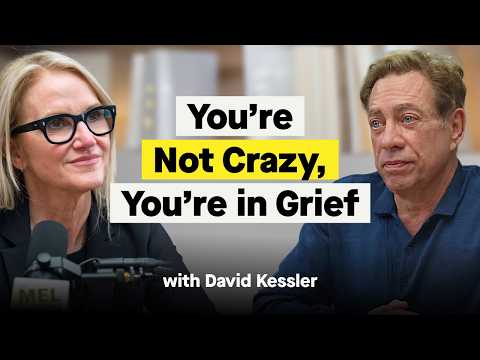
Your Grief & Heartbreak Will Get Better the Moment You Watch This
David Kessler (guest), Mel Robbins (host)
In this episode of The Mel Robbins Podcast, featuring David Kessler and Mel Robbins, Your Grief & Heartbreak Will Get Better the Moment You Watch This explores grief Expert Reveals How Fully Grieving Lets You Fully Live Again Mel Robbins interviews grief expert David Kessler about the realities of grief, emphasizing that real healing comes from feeling grief fully rather than rushing to “move on.”
Grief Expert Reveals How Fully Grieving Lets You Fully Live Again
Mel Robbins interviews grief expert David Kessler about the realities of grief, emphasizing that real healing comes from feeling grief fully rather than rushing to “move on.”
Kessler explains different grieving styles, why timelines and comparisons are harmful, and how judgment and guilt often block healing more than grief itself.
They discuss concepts like grief bursts, anticipatory grief, denial as a healthy defense, complicated grief, and how meaning is found after pain—not in the loss itself.
The conversation offers practical tools for grievers and supporters: how to show up, what (not) to say, dealing with guilt and anger, handling belongings, and slowly shifting from pain to remembering with more love than pain.
Key Takeaways
There is no right way or timeline to grieve.
Grief is as unique as a fingerprint; early grief often lasts at least two years, and many people only seek help around the five-year mark. ...
Get the full analysis with uListen AI
Judgment—internal and external—is one of the biggest blockers of healing.
Comments like “it’s time to move on” translate to “you’re doing grief wrong,” which people then internalize. ...
Get the full analysis with uListen AI
Grieving styles differ, and “practical grievers” are not broken—just different.
Some people process loss pragmatically and move on quickly; they often don’t seek therapy and may not feel lingering grief. ...
Get the full analysis with uListen AI
Grief often appears as ‘grief bursts’ and mixed emotions, not just constant sadness.
Sudden waves of tears or love years later are normal. ...
Get the full analysis with uListen AI
Guilt and “if only” thoughts are usually attempts to avoid feeling helpless.
The mind prefers guilt (which feels like control) over helplessness. ...
Get the full analysis with uListen AI
Support is more about presence and listening than perfect words or advice.
The most healing act is to witness grief: show up at 3 days, 3 weeks, 3 months; bring food; help with logistics; and say things like “I don’t know what to say, but I’m here,” rather than platitudes like “they’re in a better place.”
Get the full analysis with uListen AI
Meaning comes after pain is faced, and it lives in how you continue.
There is no inherent meaning in a tragic death; meaning emerges over time in who you become, the rituals you create, the love you deepen, or the ways you live differently. ...
Get the full analysis with uListen AI
Notable Quotes
“If people can find a way to grieve fully, they will live fully.”
— David Kessler
“The goal of grief work is to eventually remember with more love than pain.”
— David Kessler
“Our life was with them then; our life is with us now, and we have to continue to live it.”
— David Kessler
“What we run from pursues us, and what we face transforms us.”
— David Kessler
“Don’t give death any more power than it has. Death can take your loved one’s body; it cannot end your love.”
— David Kessler
Questions Answered in This Episode
How do I tell whether I’m in “complicated grief” versus a normal, painful but healthy grief process?
Mel Robbins interviews grief expert David Kessler about the realities of grief, emphasizing that real healing comes from feeling grief fully rather than rushing to “move on.”
Get the full analysis with uListen AI
If the people closest to me are practical grievers, how can I build a new support system that truly understands my way of grieving?
Kessler explains different grieving styles, why timelines and comparisons are harmful, and how judgment and guilt often block healing more than grief itself.
Get the full analysis with uListen AI
What might it look like, in concrete day-to-day terms, to start remembering my person with more love than pain?
They discuss concepts like grief bursts, anticipatory grief, denial as a healthy defense, complicated grief, and how meaning is found after pain—not in the loss itself.
Get the full analysis with uListen AI
How can I gently address long-held guilt or “if only” beliefs with a friend or family member without triggering more shame?
The conversation offers practical tools for grievers and supporters: how to show up, what (not) to say, dealing with guilt and anger, handling belongings, and slowly shifting from pain to remembering with more love than pain.
Get the full analysis with uListen AI
In what small, ordinary moments could I begin to find meaning after my loss, without feeling like I’m betraying the person who died?
Get the full analysis with uListen AI
Transcript Preview
(instrumental music plays) I know it, you know it, no one's talking about this topic. No one wants to talk about it. It is the most needed, requested topic that no one wants to talk about.
What nobody tells you about grief and loss. I needed the right person to guide you and me through this topic, and that person is David Kessler. David has over 30 years of experience helping people through unimaginable loss. He's lived it, he's studied it, he's taught it, and today, he is here in our Boston studios for you and the people that you care about. How is my life gonna be different?
Your life is gonna be fuller and bigger. Today, if people can find a way to grieve fully, they will live fully. Loss in our life pushes our bandwidth for pain, but it also pushes our bandwidth for happiness and joy and laughter. You know, to me, the goal of grief work is to eventually remember with more love than pain. When you release the pain, in your own way, in your own time, you will be connected only in love. Our life was with them then, our life is with us now, and we have to continue to live it. No feeling is final. It is going to change. Take the next step. Wake up.
It can be done?
It can be done.
Please help me welcome David Kessler to the Mel Robbins Podcast. It is so great to see you. Thank you, thank you, thank you for making the trip here to Boston to be on the Mel Robbins Podcast.
I am thrilled to be here.
How does it feel to know that this is the topic that is one of the most requested topics that we have received from listeners around the world?
I know it, you know it. It is the most needed, requested topic that no one wants to talk about.
I wanna start by having you talk about how is my life gonna be different if I take everything to heart that you're about to share with us, and I apply it to my life? How will my life be different, David?
This is gonna sound strange, but I can almost guarantee it, if you were to do this work, listen to this, share it, your life is gonna be fuller and bigger, and it's gonna be richer. And I'm evidence of that. You know, loss is about subtraction. We need to find ways to bring addition into this.
Hmm.
And so I'm gonna throw every tool I can think of at everyone, at everyone, to really help folks have ways to find their inner wholeness.
Well, what's interesting as I listen to you already is nobody can go through life without experiencing some kind of devastating loss.
I have been studying the statistics. Here they are. It's a trend. Death rate, 100%.
Install uListen to search the full transcript and get AI-powered insights
Get Full TranscriptGet more from every podcast
AI summaries, searchable transcripts, and fact-checking. Free forever.
Add to Chrome