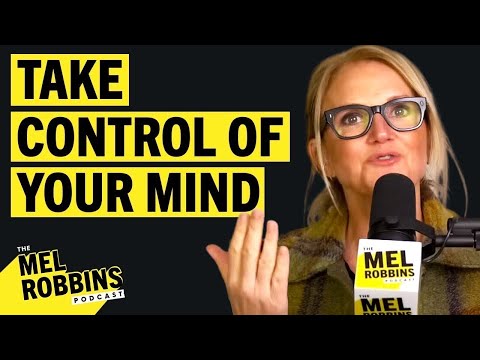
Mindset Reset: Take Control of Your Mental Habits | The Mel Robbins Podcast
Mel Robbins (host), Brandy (guest), Peter (guest)
In this episode of The Mel Robbins Podcast, featuring Mel Robbins and Brandy, Mindset Reset: Take Control of Your Mental Habits | The Mel Robbins Podcast explores reprogram Your Brain: Mel Robbins’ Practical Guide To Mindset Reset Mel Robbins explains how your mindset functions like a pair of sunglasses, tinting how you see yourself, others, and your possibilities in life. She introduces the brain’s Reticular Activating System (RAS) as a flexible “filter” or mental bouncer that decides what information you consciously notice based on what it thinks is important to you. By intentionally directing your focus and practicing simple tools—like searching for heart shapes and swapping negative “what if” thoughts for empowering ones—you can train this filter to work for you instead of against you. The episode emphasizes that while you can’t instantly change external realities, you can reshape your internal narrative to take more courageous, constructive action.
Reprogram Your Brain: Mel Robbins’ Practical Guide To Mindset Reset
Mel Robbins explains how your mindset functions like a pair of sunglasses, tinting how you see yourself, others, and your possibilities in life. She introduces the brain’s Reticular Activating System (RAS) as a flexible “filter” or mental bouncer that decides what information you consciously notice based on what it thinks is important to you. By intentionally directing your focus and practicing simple tools—like searching for heart shapes and swapping negative “what if” thoughts for empowering ones—you can train this filter to work for you instead of against you. The episode emphasizes that while you can’t instantly change external realities, you can reshape your internal narrative to take more courageous, constructive action.
Key Takeaways
Your mindset colors everything you experience, so you must choose the tint deliberately.
Seeing your mindset as a pair of sunglasses makes it obvious that pessimistic lenses will filter for what’s wrong, while more optimistic, empowered lenses help you notice options, resources, and reasons to act.
Get the full analysis with uListen AI
Your brain’s RAS shows you what it believes is important to you.
Just as you suddenly notice a specific car, shoes, or pregnancies everywhere once you care about them, your RAS is constantly reprogramming itself to spotlight whatever you repeatedly focus on—good or bad.
Get the full analysis with uListen AI
Self-doubt trains your brain to highlight your flaws and failures.
When you obsess over mistakes and criticize yourself, your RAS interprets that as your priority, filtering out your wins and magnifying anything that confirms “I’m not good enough,” which then suppresses action.
Get the full analysis with uListen AI
You can consciously retrain your focus using simple daily exercises.
The “Looking for Hearts” game—deliberately finding naturally occurring heart shapes each day—proves to you in real time that your filter can be instructed to notice new things, building trust that your brain will respond to intentional direction.
Get the full analysis with uListen AI
Thought substitution disrupts negative mental habits and builds new biases.
Catching catastrophic questions like “What if it doesn’t work? ...
Get the full analysis with uListen AI
You’re not stuck with inherited or childhood narratives about your worth.
Many of the harsh internal voices originated from parents, caregivers, or adolescent social sorting; recognizing them as old programming allows you to consciously reject them and write new, self-supportive narratives.
Get the full analysis with uListen AI
Changing your mindset doesn’t erase real-world hardship, but it changes how you face it.
Robbins stresses this is not toxic positivity: a trained, resilient mindset can’t stop discrimination, war, or poverty, but it can empower you to cope, persist, and make better choices for yourself and your community.
Get the full analysis with uListen AI
Notable Quotes
“Your mind is either working for you or against you.”
— Mel Robbins
“Your mindset is like a pair of sunglasses—it tints how you see the world.”
— Mel Robbins
“The Reticular Activating System is the bouncer in your brain deciding what gets in.”
— Mel Robbins
“You are not stuck with the thoughts that you think.”
— Mel Robbins
“If you can make up bad thoughts, you can make up good ones.”
— Mel Robbins
Questions Answered in This Episode
What specific recurring thoughts or narratives might be programming my RAS to filter for limitation instead of opportunity?
Mel Robbins explains how your mindset functions like a pair of sunglasses, tinting how you see yourself, others, and your possibilities in life. ...
Get the full analysis with uListen AI
How would my daily behavior change if I truly believed, “What if it all works out?” in one area I currently feel stuck?
Get the full analysis with uListen AI
Which social media accounts, environments, or relationships are reinforcing a negative mindset that I should consciously unfollow or step back from?
Get the full analysis with uListen AI
What evidence from my own life already proves that my brain can adapt and notice new possibilities when I shift my focus?
Get the full analysis with uListen AI
If I stopped believing “I’m not good enough,” what actions would I finally allow myself to take in the next 90 days?
Get the full analysis with uListen AI
Transcript Preview
(ticking clock) (upbeat music) Today, we've got a crazy cool topic. We are talking about mindset. Your mind is either working for you or against you. That's what it's doing. So whether you're listening to this episode because you struggle right now with overthinking or feeling unworthy, or maybe you have a really positive outlook, but you just want to level up. You want to play a bigger game. That's where I am right now. So today, you and I are going to get serious about making your mind work for you. (upbeat music) Hey, it's your friend Mel, and welcome to a mind-bending and really cool episode of the Mel Robbins Podcast. Okay, I wanted to just start today by saying thank you. Thank you, thank you, thank you to you. I often say that the Mel Robbins Podcast is not my podcast, it's our podcast, because this is a conversation between you and me, and I wanted to start off by saying thank you, because about 90 seconds ago, I got word that you have voted the Mel Robbins Podcast as the most inspirational podcast of 2022, and we have won the Listener's Choice Award for the most inspiring podcast of 2022. That is a huge deal, because we just launched two and a half months ago. So from the bottom of my heart, on behalf of my team, I just wanted to thank you. I wanted to thank you for showing up, for listening, for sharing these episodes with friends and family members, for giving us feedback, for asking questions, for submitting topic ideas. This podcast is changing people's lives, and it is inspiring and empowering people around the world because of you. So thank you. And if you're brand new to the Mel Robbins Podcast and this amazing, energizing group of people that listen to this podcast, I want to say welcome. I'm Mel Robbins. I'm a New York Times bestselling author, and I'm one of the most trusted experts in the world on behavior change and motivation. And today, we've got a crazy cool topic. We are talking about mindset, and before we jump into the science and the cool tactics that you're going to be able to apply to your life to change your mindset, I want to just remind you that this episode is part of a month-long series that we are doing here on the Mel Robbins Podcast about the building blocks and the research that you need to know in order to create a better life. Here's the simple truth about your mindset. Your mind is either working for you or against you. That's what it's doing. And so by the end of today's episode, there's going to be a couple things that go down. First of all, you are going to understand that you have the power to reprogram your mind. That's right. You can take simple steps and you can practice them every day to train your mind to work for you. And I'm also going to prove to you today, using very simple science, that your mind is trying to help you. It doesn't know any better if it's working against you. And when you can identify the way that you want to feel or what you want to do with your life, you can change your mindset to help you. And when you do that, here's what's super cool. It improves the day-to-day experience of your life, and it changes what it's like to be in your head. So whether you're listening to this episode because you struggle right now with overthinking or feeling unworthy, or maybe you have a really positive outlook, but you just want to level up. You want to play a bigger game. That's where I am right now. I am so ready to take a bigger swing to knock it out of the park this year, and the mindset and creating a more powerful mindset, that is a tool in your arsenal to help you achieve anything that you want. So today, you and I are going to get serious about making your mind work for you. And I want to start us off with a question from a listener named Brandy.
Install uListen to search the full transcript and get AI-powered insights
Get Full TranscriptGet more from every podcast
AI summaries, searchable transcripts, and fact-checking. Free forever.
Add to Chrome