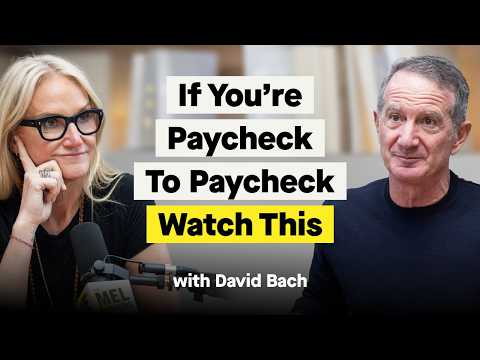
The #1 Money Habit That Sets You Up for Financial Freedom
David Bach (guest), Mel Robbins (host)
In this episode of The Mel Robbins Podcast, featuring David Bach and Mel Robbins, The #1 Money Habit That Sets You Up for Financial Freedom explores automate saving one hour daily to build wealth and freedom David Bach argues most people are trapped in a paycheck-to-paycheck “automatic economy” designed to extract money via subscriptions, credit, and convenience spending, unless you intentionally automate wealth-building.
Automate saving one hour daily to build wealth and freedom
David Bach argues most people are trapped in a paycheck-to-paycheck “automatic economy” designed to extract money via subscriptions, credit, and convenience spending, unless you intentionally automate wealth-building.
His core prescription is “pay yourself first” by automatically saving roughly 12.5% (one hour/day) of gross income into retirement vehicles (401(k) or IRA/Roth IRA), plus separate emergency and “dream” accounts.
He recommends simple, diversified investing (target-date funds in 401(k)s; low-cost index funds/ETFs like Vanguard Total Stock Market) and warns young people against high-risk meme/speculation that derails long-term compounding.
The conversation also covers a practical credit-card payoff method (DOLP), the importance of “money dates” to get organized, and an estate/household preparedness checklist so divorce, widowhood, or illness doesn’t become financial catastrophe.
Key Takeaways
Automate your wealth-building or the economy will automate your spending.
Bach’s “automatic economy” framing says phones, subscriptions, and frictionless payments siphon money by default; your counter-move is automatic transfers into retirement, emergency, and goal accounts so progress happens without willpower.
Get the full analysis with uListen AI
Save “one hour a day” of income (≈12.5% of gross) into retirement, ideally immediately.
He recommends setting 401(k) contributions to about 12–14% and letting it run for decades; he cites Fidelity data showing “401(k) millionaires” averaged ~14% saved over ~26 years, ending around age 59 with ~$1.4M.
Get the full analysis with uListen AI
Use the tax advantages: pre-tax 401(k) contributions reduce taxable income now.
Putting retirement money in before taxes means you may feel less “pain” than saving the same amount after-tax, and investments compound tax-deferred (or tax-free in Roth structures).
Get the full analysis with uListen AI
For most people, the best 401(k) investment is a target-date fund.
Target-date mutual funds automatically allocate between stocks/bonds and rebalance over time, reducing decision fatigue and the odds of tinkering mistakes.
Get the full analysis with uListen AI
Rollover retirement accounts carefully—contribution rate and investment selection can silently reset.
He warns that job changes often drop savings rates (e. ...
Get the full analysis with uListen AI
If you don’t have a 401(k), build your own automation with a Roth IRA.
Open a Roth IRA at a brokerage and schedule transfers from checking right after pay hits; even small, consistent contributions matter, and he suggests young people generally benefit more from Roth’s tax-free growth/withdrawals in retirement.
Get the full analysis with uListen AI
Separate accounts create clarity: retirement, emergency, and dreams are different jobs.
He recommends an emergency “security” account (often 3–5% of income) in a liquid money market, and a dream account for medium-term goals, invested based on time horizon (cash-like for 1–2 years; balanced for ~5; mostly stocks for longer).
Get the full analysis with uListen AI
Avoid speculative “high-risk investing” narratives—especially for young people.
Bach argues meme stocks/coins/NFT chasing creates boom-bust cycles that make people quit investing entirely; steady index investing keeps you in the game long enough for compounding to work.
Get the full analysis with uListen AI
Index funds simplify everything; one fund can be a complete start.
He highlights low-cost, diversified indexing (e. ...
Get the full analysis with uListen AI
Use compounding math to find hidden money: $27.40/day becomes millions over time.
He illustrates that $10,000/year (about $27. ...
Get the full analysis with uListen AI
Start tiny if needed—1% today beats 0% forever.
For people living paycheck to paycheck, he suggests beginning at 1% and stepping it up gradually; the key is getting the system running so increases are incremental and sustainable.
Get the full analysis with uListen AI
Debt payoff works better when progress is visible: pay smallest balances first (DOLP).
His DOLP method prioritizes the smallest credit-card balance (not highest APR) to eliminate cards quickly, reduce late-fee risk, and create momentum; automate minimum payments to prevent penalties while attacking balances.
Get the full analysis with uListen AI
A “money date” is the missing productivity block for most households.
He advises scheduling dedicated sessions (solo or with a partner) to inventory accounts, align spending to values, adjust bill due dates, and confirm automation—because avoidance keeps stress chronic even before debt is gone.
Get the full analysis with uListen AI
Homeownership is a major driver of generational wealth, but the first home isn’t the dream.
He argues owners build inheritable net worth while renters often don’t; his strategy is buying the smallest/most affordable entry point (studio, farther out) and treating it as a stepping-stone.
Get the full analysis with uListen AI
Plan for widowhood/divorce/illness now: knowing where everything is can determine outcomes.
He stresses a household “drill” (accounts, passwords, old 401(k)s, insurance, will location) and notes many people lack or hide outdated wills; in divorce, not knowing assets can mean not receiving your fair share.
Get the full analysis with uListen AI
Notable Quotes
“Either you have a plan for your money, or someone else has a plan for your money.”
— David Bach
“We’re living in what I call now an automatic economy—either makes you rich, or it keeps you poor.”
— David Bach
“Pay yourself first one hour a day of your income, automatically… for life.”
— David Bach
“It actually doesn’t take you being debt-free to feel better. It just takes you starting the process.”
— David Bach
“Absolutely freaking not.”
— David Bach
Questions Answered in This Episode
The “one hour a day” rule equals ~12.5% of gross—how should someone calculate this if their income is irregular (gig work, commissions, seasonal)?
David Bach argues most people are trapped in a paycheck-to-paycheck “automatic economy” designed to extract money via subscriptions, credit, and convenience spending, unless you intentionally automate wealth-building.
Get the full analysis with uListen AI
You recommend target-date funds for 99% of 401(k) investors—what are the red flags that mean someone should NOT choose the target-date option in their plan?
His core prescription is “pay yourself first” by automatically saving roughly 12. ...
Get the full analysis with uListen AI
When rolling over an old 401(k), what exact steps ensure the funds don’t sit in cash and the contribution percentage doesn’t quietly reset to 3%?
He recommends simple, diversified investing (target-date funds in 401(k)s; low-cost index funds/ETFs like Vanguard Total Stock Market) and warns young people against high-risk meme/speculation that derails long-term compounding.
Get the full analysis with uListen AI
Your DOLP method prioritizes smallest balance first, not highest APR—how do you respond to critics who say that’s mathematically suboptimal, and when (if ever) would you switch strategies?
The conversation also covers a practical credit-card payoff method (DOLP), the importance of “money dates” to get organized, and an estate/household preparedness checklist so divorce, widowhood, or illness doesn’t become financial catastrophe.
Get the full analysis with uListen AI
You cite the stock market’s long-term ~10% average—what assumptions should viewers adjust for inflation, fees, and sequence-of-returns risk as they near retirement?
Get the full analysis with uListen AI
Transcript Preview
Seven out of 10 people are being left behind because they're living paycheck to paycheck.
Wait, seven out of 10 people in the United States live paycheck to paycheck?
So if you are living paycheck to paycheck, you are not alone. But what I know, because I've done this for 30 years, is that's a very hard way to live. I've been teaching people how to be smarter with money for 30 years, and my belief is no one should be left behind. And what's happening in our country right now is people are being left behind.
Our guest today is David Bach. He's one of the most respected voices in personal finance for over 30 years. His books have sold over seven million copies. He's taught millions of regular people just like you how to build wealth, starting exactly where you are right now.
Either you have a plan for your money, or someone else has a plan for your money. I want you to reduce the amount of credit cards you have as fast as you can. Stop taking credit cards out, okay? They're traps.
And this includes not just, like, Mastercard, and Visa, and Amex. This is, like, also store cards.
Oh, God! Don't... Please, please, please, please, please, please say no to these people for those cards. Do not do those cards. There's two escalators to wealth in America, 'cause the system's rigged. You need to hear this, especially young people. Two things get people typically to make a decision around money.
What are they?
One is [beep] people don't know. It c- it actually can make me cry sometimes because people just don't know. When you start the process of digging out, you start to feel better.
It's so true.
It actually doesn't take you being debt-free to feel better. It just takes you starting the process of working on getting debt-free. It's, it's never too late unless you give up. Let me tell you what's really going on in this economy, 'cause this is probably the most important thing you're gonna hear in this podcast.
David Bach, welcome to The Mel Robbins Podcast.
Mel, thank you for being here. It's fabulous to see you.
It is fabulous to see you, too. I love you as a friend.
Thank you.
I love your energy, and I love your work, and I am very excited about the conversation today, because so many of us are concerned about money. We're concerned about our future. We're concerned about how to support the people in our lives around their financial future. And where I wanna start is this: if I take everything to heart that you're about to teach us, how will my life be different if I apply what I learn from you today?
Well, first and foremost-
Yeah
... I'm gonna give you hope.
Oh.
A lot of people right now are missing hope when it comes to their money, which is impacting their life.
Mm.
So I believe that nobody should be left behind when it comes to money. That's why I've spent 30 years of my life teaching people about money, and so the challenge right now in this country, honestly, Mel, we're leaving people behind.
Install uListen to search the full transcript and get AI-powered insights
Get Full TranscriptGet more from every podcast
AI summaries, searchable transcripts, and fact-checking. Free forever.
Add to Chrome