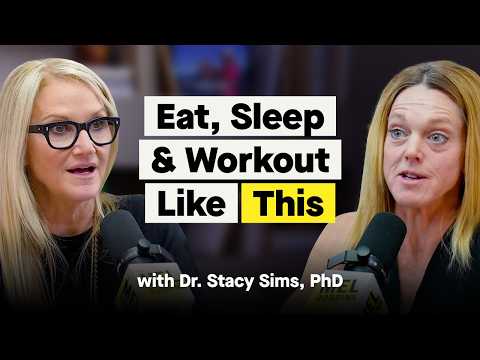
The Menopause Guide: What Every Woman Needs to Know to Feel Amazing Again
Dr. Stacy Sims (guest), Mel Robbins (host)
In this episode of The Mel Robbins Podcast, featuring Dr. Stacy Sims and Mel Robbins, The Menopause Guide: What Every Woman Needs to Know to Feel Amazing Again explores menopause demystified: body changes, strength training, and actionable protocols explained Menopause is defined as a single day on the calendar—12 months after your last period—while perimenopause is the often-symptom-heavy transition leading up to it.
Menopause demystified: body changes, strength training, and actionable protocols explained
Menopause is defined as a single day on the calendar—12 months after your last period—while perimenopause is the often-symptom-heavy transition leading up to it.
Sims frames menopause as “reverse puberty”: as estrogen and progesterone decline, multiple systems are affected—brain neurotransmitters and metabolism, inflammation, fat distribution (visceral “menopot”), muscle and tendon integrity, and gut microbiome diversity.
Her primary intervention is high-quality strength training (nervous-system driven heavy lifting) to build muscle, bone, cognitive resilience, and better body composition—even later in life.
She warns that common midlife fitness approaches (long, moderate-intensity “smash” workouts) often backfire, and she outlines targeted cardio (true HIIT/sprints), higher protein plus fiber-rich carbs, and parasympathetic-focused stress/sleep tools and supplements.
Key Takeaways
Menopause is a date; the transition is where most symptoms occur.
Sims defines menopause as one day after 12 months without a period; perimenopause (often ~6 years) is when hormone fluctuations drive many of the disruptive symptoms and body changes.
Get the full analysis with uListen AI
Think of menopause as “reverse puberty,” not a personal failure.
Declining estrogen/progesterone changes epigenetic “lock-and-key” signaling across the body, similar to how rising hormones reshape the body in puberty—normalizing why things can feel suddenly unfamiliar.
Get the full analysis with uListen AI
Low estrogen shifts the brain’s chemistry and fuel use—driving mood swings and brain fog.
Estrogen supports serotonin and dopamine; as hormones fluctuate and drop, neurotransmitters become “askew. ...
Get the full analysis with uListen AI
The ‘menopot’ is largely visceral fat with higher cardiometabolic risk.
Structural changes in circulating fats (linked to inflammation and low estrogen) are interpreted by the liver as “store this,” increasing deep, organ-surrounding visceral fat that pushes the abdomen outward.
Get the full analysis with uListen AI
Strength training is the cornerstone because it rewires the nervous system.
Heavy lifting trains neural recruitment and compensatory pathways (e. ...
Get the full analysis with uListen AI
Start small, then progress to heavy, full-body lifting three days/week.
Begin with ~10 minutes, 3x/week of loaded movements (bodyweight/light dumbbells) to build skill and neural adaptation. ...
Get the full analysis with uListen AI
Most midlife cardio mistakes come from living in ‘moderate’ intensity too long.
She criticizes interval-style group classes that keep women in a middle zone—“too easy to be hard, too hard to be easy”—which can elevate stress, impair sleep, stall belly-fat loss, and increase injury risk.
Get the full analysis with uListen AI
Use sprint interval training for maximum return with minimal time.
Sprint intervals are ~30 seconds all-out followed by 90–120 seconds recovery; stop when intensity drops. ...
Get the full analysis with uListen AI
Eat more strategically—especially more protein—and don’t fear carbs; choose better carbs.
A common pattern is cutting calories while increasing training, which backfires under stress. ...
Get the full analysis with uListen AI
Sleep and stress improve when you train and recover like it matters—and build parasympathetic tone.
Perimenopause can increase sympathetic drive, making deep sleep harder. ...
Get the full analysis with uListen AI
Targeted supplements may help anxiety, sleep, and brain metabolism support.
She mentions L-theanine and apigenin for parasympathetic activation/relaxation and highlights creatine monohydrate (3–5g/day; “Creapure” as a purity standard) as potentially aiding mood and recovery from depressive/anxious episodes by supporting brain metabolism.
Get the full analysis with uListen AI
Notable Quotes
“Menopause isn't happening to you, it's something that you can face and have control over.”
— Dr. Stacy Sims
“When we talk about menopause… it’s one day on the calendar.”
— Dr. Stacy Sims
“If we're taking it to the other side of things… every system in the body takes a hit.”
— Dr. Stacy Sims
“You’re literally rewiring your body to work with what you have in it? Yes.”
— Mel Robbins / Dr. Stacy Sims
“The one overarching theme… it’s not about volume, it’s about the quality of the work that you are doing.”
— Dr. Stacy Sims
Questions Answered in This Episode
You distinguish menopause hormone therapy (MHT) from “HRT.” How should a listener talk about this with their clinician, and what practical differences does the distinction imply?
Menopause is defined as a single day on the calendar—12 months after your last period—while perimenopause is the often-symptom-heavy transition leading up to it.
Get the full analysis with uListen AI
You say MHT “slows the rate of change but doesn’t stop it.” Which outcomes (lean mass, visceral fat, bone) change the most even with MHT, and what metrics should women track?
Sims frames menopause as “reverse puberty”: as estrogen and progesterone decline, multiple systems are affected—brain neurotransmitters and metabolism, inflammation, fat distribution (visceral “menopot”), muscle and tendon integrity, and gut microbiome diversity.
Get the full analysis with uListen AI
In your ‘ideal’ lifting plan (3x/week heavy, long rests), what are the 3–5 best foundational lifts for beginners who don’t have barbell access or coaching?
Her primary intervention is high-quality strength training (nervous-system driven heavy lifting) to build muscle, bone, cognitive resilience, and better body composition—even later in life.
Get the full analysis with uListen AI
You recommend sprint intervals with full recovery and stopping when intensity drops. What are safe options for women with joint pain, plantar fascia, or frozen shoulder risk?
She warns that common midlife fitness approaches (long, moderate-intensity “smash” workouts) often backfire, and she outlines targeted cardio (true HIIT/sprints), higher protein plus fiber-rich carbs, and parasympathetic-focused stress/sleep tools and supplements.
Get the full analysis with uListen AI
You call out OrangeTheory/F45-style programming for perimenopause onward. Are there specific class modifications (rest ratios, session length, weekly frequency) that could make them appropriate?
Get the full analysis with uListen AI
Transcript Preview
Take control and acknowledge the fact that menopause isn't happening to you, it's something that you can face and have control over.
I can have control when my body is going through such crazy changes?
Yep, and the more we know, the more we control.
The most popular guest of all time on The Mel Robbins Podcast, I'm talking about Stanford University's Dr. Stacy Sims, is back for an incredible episode about menopause and hormones.
So if we think about puberty and all the things that are happening from the perspective of a young girl's body, if we're taking it to the other side of things, where we start to unpack everything, and we're not having estrogen, and we're not having progesterone, every system in the body takes a hit.
No, it makes so much sense, that, like, if you really think about your own experience of what happened to your body in puberty, when you hit perimenopause and menopause, it's like you're going through a reverse puberty.
Right. I'll say there are a lot of tools on the table. Taking control of your body through strength training. So if you are creating a new pathway or a stronger pathway to be able to lift that load, it improves the neuroplasticity of the brain.
You're literally rewiring your body to work with what you have in it?
Yes.
Oh, my God!
It's never too late to start, and you can always become stronger and build muscle. When you have the education, and you put the steps into play, then you understand what's happening to your body, and you can adapt and change and modify things to counter what's happening. I want women to go away not being afraid, 'cause it's such an amazing, powerful tool to have, to have that education, and to be able to invoke change to improve how you're feeling in the moment, and also how you're feeling five, 10, 15 years down the line.
Where do you start?
So we wanna-
Dr. Stacy Sims, all the way from New Zealand, I am so excited to sit down with you and learn from you today. Thank you for being here.
Thanks for having me. I'm looking forward to having a bit of a chat, a bit of fun.
Oh, we're gonna, uh, have more than fun, 'cause I know it's gonna be a life-changing conversation-
Awesome
... for so many people that listen and then share this. So I'd love to start by having you just talk directly to the person listening.
Mm-hmm.
What could they experience in their life that's different if they take everything that you're about to share today, about the science of menopause and women's health and exercise, to heart, and they just put it to use in their life? Like, what's gonna be different?
I think it's going to be the education component, of actually understanding why and what is happening.
Mm.
'Cause we have not talked about that. Like, I think we're the first generation of women that is trying to push and understand what is going on, and that we're not siloed. So if you, as a listener, understand what's going on, and you start putting some of the practices that we'll discuss into play, you're gonna have more empowerment and more ability to take control, and acknowledge the fact that menopause isn't happening to you, it's something that you can face and have control over to improve parts of your life.
Install uListen to search the full transcript and get AI-powered insights
Get Full TranscriptGet more from every podcast
AI summaries, searchable transcripts, and fact-checking. Free forever.
Add to Chrome