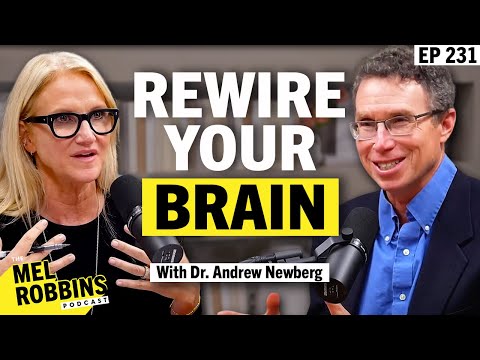
The Science Of Spiritual Experiences: How To Rewire Your Brain For More Happiness & Purpose
Dr. Andrew Newberg (guest), Mel Robbins (host)
In this episode of The Mel Robbins Podcast, featuring Dr. Andrew Newberg and Mel Robbins, The Science Of Spiritual Experiences: How To Rewire Your Brain For More Happiness & Purpose explores neuroscience Reveals How Spiritual Practices Rewire Your Brain For Joy Mel Robbins interviews neuroscientist Dr. Andrew Newberg about how spiritual and religious experiences show up in the brain and how anyone can cultivate them. Newberg explains that spirituality—broadly defined as connection to something greater than oneself—activates and reshapes key brain regions related to self, emotion, and meaning. His research on meditation, prayer, speaking in tongues, and retreats shows common neural patterns behind diverse experiences people label as God, energy, love, or oneness. They discuss how intentionally engaging in spiritual practices can reduce stress, improve health, increase purpose, and help people feel less stuck in life.
Neuroscience Reveals How Spiritual Practices Rewire Your Brain For Joy
Mel Robbins interviews neuroscientist Dr. Andrew Newberg about how spiritual and religious experiences show up in the brain and how anyone can cultivate them. Newberg explains that spirituality—broadly defined as connection to something greater than oneself—activates and reshapes key brain regions related to self, emotion, and meaning. His research on meditation, prayer, speaking in tongues, and retreats shows common neural patterns behind diverse experiences people label as God, energy, love, or oneness. They discuss how intentionally engaging in spiritual practices can reduce stress, improve health, increase purpose, and help people feel less stuck in life.
Key Takeaways
Spirituality is about connection to something greater than the self.
Newberg defines spiritual experiences broadly—as connecting to God, nature, music, creativity, or humanity—so almost everyone already has spiritual moments even if they reject formal religion.
Get the full analysis with uListen AI
Diverse spiritual experiences share common brain patterns.
Brain scans of meditation, prayer, and speaking in tongues show recurring changes in areas like the parietal lobe (self–world boundaries), frontal lobes (effort vs. ...
Get the full analysis with uListen AI
Five core elements characterize most spiritual experiences.
Across thousands of narratives, people consistently report: unity/oneness, intensity, clarity/insight, surrender, and transformation—whether it’s a near-death vision, a church service, a concert, or a walk in nature.
Get the full analysis with uListen AI
Regular spiritual practice can literally rewire your brain.
Retreat and meditation studies show increased sensitivity to serotonin and dopamine and functional changes in key brain regions, which can enhance mood, optimism, and the feeling that life is meaningful—even in older adults.
Get the full analysis with uListen AI
“Small” daily spiritual moments are powerful and accessible.
You don’t need a dramatic mystical vision; simple rituals like hiking, music, holding a grandchild, lighting incense, or attending a service can evoke the same core elements in milder form and cumulatively deepen purpose and connection.
Get the full analysis with uListen AI
Feeling stuck often reflects rigid neural patterns that can be disrupted.
When life feels purposeless, the brain is looping the same thoughts, routines, and emotional responses; deliberately adopting new rituals or practices aligned with what has felt meaningful in the past can break those patterns and form new connections.
Get the full analysis with uListen AI
Health and healing are multidimensional, and spirituality is a key component.
Newberg’s integrative model emphasizes biological, psychological, social, and spiritual dimensions; engaging the spiritual dimension improves stress, mental health, immune function, and even outcomes in chronic disease by boosting optimism and resilience.
Get the full analysis with uListen AI
Notable Quotes
“One of the most important things for people to learn is how to make their life more spiritual, and that doesn’t have to be supernatural.”
— Dr. Andrew Newberg
“If this area normally turns on to give us our sense of self, what’s going to happen when it shuts down? We lose our sense of self and we don’t see the boundary between our self and something that’s out there in the world.”
— Dr. Andrew Newberg
“People who have been enlightened realize that life is about the small experiences.”
— Dr. Andrew Newberg
“If you feel stuck, you are likely stuck in patterns of thinking, your commute, the same people, the same habit, the same way you move through your day.”
— Mel Robbins
“Within all of us, we have a brain that is capable of finding these paths. It doesn’t mean it’s going to be an easy pursuit, but it can happen to everyone.”
— Dr. Andrew Newberg
Questions Answered in This Episode
Are experiences people call God, energy, love, or oneness fundamentally the same in the brain, or do they represent truly different states of consciousness?
Mel Robbins interviews neuroscientist Dr. ...
Get the full analysis with uListen AI
How much can deliberate spiritual practice (like meditation or worship) reshape a person’s brain and personality compared to a single, sudden mystical experience?
Get the full analysis with uListen AI
If feeling stuck is linked to rigid neural patterns, what are the most effective first tiny rituals to begin loosening those patterns in everyday life?
Get the full analysis with uListen AI
Where is the line between psychological and spiritual experiences—are they distinct categories or just different interpretations of the same underlying brain activity?
Get the full analysis with uListen AI
Could future neurotheology research ever provide convincing evidence for consciousness existing beyond the brain, for example in near-death experiences?
Get the full analysis with uListen AI
Transcript Preview
What do you feel when you feel something spiritual? One of the questions that I have is, you know, if one person says, "I felt l- love," and somebody says, "I felt energy," and then somebody else s- "I felt a force," and somebody else says, "I felt God," well, are they the same, fundamentally s- the same experiences that then people just interpret differently because of our backgrounds and the way we think about things, or are they actually different experiences? Mm. It, it, it's hard.
How do you want us to think about it? 'Cause I'm sitting here grappling with it right now. Do you do brain scans on people when they're praying and when they're meditating? How does it work?
Um, some of them are deeply meditative, uh, like Buddhist meditation, and some of them are deeply spiritual. We've studied people speaking in tongues.
What do you see in someone's brain when you pray, meditate, or have a spiritual experience? What's happening?
Well... (suspenseful music)
Hey, it's Mel. I'm so excited that you're here. You know, it's always such an honor to be able to spend some time with you and to be together. If you're brand new, welcome to the Mel Robbins Podcast family. Thank you for choosing to listen to this podcast. It tells me that you're the type of person that's interested in deeper questions and having a deeper and richer experience in life, and I do too. And that's why I'm absolutely thrilled that Dr. Andrew Newberg is here in our Boston studios to talk to you and me today, and to share his groundbreaking research on the impact of spiritual and religious practices on your brain. Dr. Newberg is a renowned neuroscientist and medical doctor. He is the Director of Research for Integrative Health at Thomas Jefferson University Hospital and Medical College. He is listed as one of the 30 most influential neuroscientists alive today. He's published over 250 peer-reviewed articles and chapters. He is also the author of 14 books which share his cutting-edge research. And here's where this gets really interesting. Dr. Newberg has been scanning the brains of people during meditation, prayer, and countless religious and spiritual experiences, and what he has found will make you think very differently about the connection between your brain and spirituality. So please help me welcome Dr. Andrew Newberg to the Mel Robbins Podcast.
Thank you for having me on your program.
Oh, I'm so excited to just learn from you today, and I'd love to start by asking you, if you could speak to the person who's listening directly and tell them what they might expect to be different about their life based on what you're gonna share and teach us today, what are we gonna learn?
Well, I think one of the most important things for people to learn is how to make their life more spiritual, and that doesn't have to be supernatural. Uh, um, it could be being in nature. It could be connecting to something creative. And sometimes it is something truly spiritual. But what we're gonna be learning tob- today is about how our brain helps us to be spiritual, and through that process, we'll, we'll learn how to actually be more spiritual. And I think perhaps one of the most important take-homes messages of all of the work that I've done is that we all have a pretty similar kind of brain, so these experiences are available to everyone. It's not like there's somebody who could be excluded from this. Everyone who's listening has the potential to, to find their own paths towards enlightenment and to, to thinking about their life in a much deeper, more meaningful way.
Install uListen to search the full transcript and get AI-powered insights
Get Full TranscriptGet more from every podcast
AI summaries, searchable transcripts, and fact-checking. Free forever.
Add to Chrome