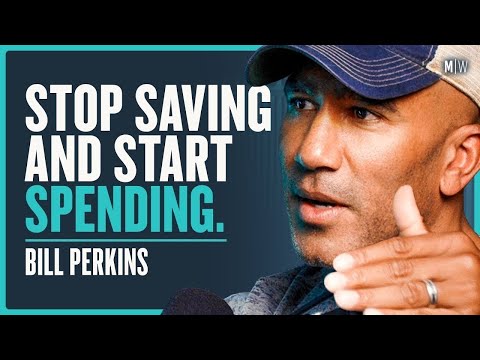
Why You Should Spend All Of Your Money Before You Die - Bill Perkins
Bill Perkins (guest), Chris Williamson (host), Narrator
In this episode of Modern Wisdom, featuring Bill Perkins and Chris Williamson, Why You Should Spend All Of Your Money Before You Die - Bill Perkins explores bill Perkins: Stop Hoarding Money And Start Maximizing Life Experiences Bill Perkins explains his ‘Die With Zero’ philosophy: life should be optimized for net fulfillment, not net worth, by consciously using time, health, and money to create meaningful experiences before it’s too late.
Bill Perkins: Stop Hoarding Money And Start Maximizing Life Experiences
Bill Perkins explains his ‘Die With Zero’ philosophy: life should be optimized for net fulfillment, not net worth, by consciously using time, health, and money to create meaningful experiences before it’s too late.
He argues most people over-save due to fear and conditioning, working for money they’ll never spend and effectively wasting life “skeeball tickets” and “Chuck E. Cheese tokens.”
Key ideas include investing in experiences early for their ‘memory dividends,’ smoothing consumption over a lifetime, planning by life seasons, giving money to kids and charities earlier, and taking big risks when young.
Throughout, he attacks “monk mode”/grind culture, autopilot living, and fear of judgment, urging people to deliberately design a non–cookie-cutter life and accept failure as part of a fully used life.
Key Takeaways
Optimize for net fulfillment, not net worth.
Perkins reframes life as an ‘optimization program’ where the goal is maximum positive life experiences, not the largest bank balance; money is a tool (a hammer and saw) to build the ‘house’ of happiness, not the end itself.
Get the full analysis with uListen AI
Invest in experiences early to capture memory dividends.
Experiences pay off twice: once when you do them and repeatedly as you recall and retell them; doing meaningful trips, adventures, and connections earlier in life creates decades of ‘memory dividends’ that compound like interest.
Get the full analysis with uListen AI
Use consumption smoothing instead of over-saving for old age.
Most people effectively ‘borrow from their poorer, younger self’ to give their richer, older self money they may not even be able to enjoy; projecting future earning and spending realistically lets you shift some resources to earlier, more vital years.
Get the full analysis with uListen AI
Plan life in seasons and get the order of experiences right.
Different activities belong in specific life phases (single years, young kids, physical peak, retirement); like Tetris, putting big experiences in the wrong slot (e. ...
Get the full analysis with uListen AI
Get off autopilot by interrogating what truly fulfills you.
Many preferences (career path, where you live, food, even relationship patterns) are cultural programming and inertia; regularly asking “Is this what I really want? ...
Get the full analysis with uListen AI
Give money to kids and charity earlier, not only at death.
If the point of inheritance or philanthropy is impact and experiences, waiting until you die often means giving to children in their 50s–60s (or too late) and to causes that needed help decades earlier; earlier, smaller gifts typically create greater real-world and emotional returns.
Get the full analysis with uListen AI
Take big life risks when young and ignore haters’ judgment.
Youth offers high recovery capacity and fewer obligations, making it the ideal time to change cities, start companies, pursue unconventional careers, or risk heartbreak; fear of social judgment, not actual downside, stops many from living the adventure they want.
Get the full analysis with uListen AI
Notable Quotes
“Most people fear running out of money. What you should really fear is wasting your life.”
— Bill Perkins
“You don’t want to be playing Skee-Ball, get a million tickets, and just walk out. Working for money you never spend is the same thing.”
— Bill Perkins
“Delaying gratification in the extreme means no gratification.”
— Bill Perkins
“This monk mode is just another version of ‘go to jail for money.’”
— Bill Perkins
“For the person out there who’s cookie cutting it but really yearns to strike out… don’t waste your life. Don’t let the judgment of the haters make you waste your life.”
— Bill Perkins
Questions Answered in This Episode
If I truly optimized my life for net fulfillment instead of net worth, what concrete changes would I make in the next 12 months?
Bill Perkins explains his ‘Die With Zero’ philosophy: life should be optimized for net fulfillment, not net worth, by consciously using time, health, and money to create meaningful experiences before it’s too late.
Get the full analysis with uListen AI
Which experiences clearly ‘belong’ in this current season of my life, and what will it cost me if I keep postponing them?
He argues most people over-save due to fear and conditioning, working for money they’ll never spend and effectively wasting life “skeeball tickets” and “Chuck E. ...
Get the full analysis with uListen AI
Where am I on financial autopilot—saving, working, or living in a certain place—because of fear or cultural conditioning rather than deliberate choice?
Key ideas include investing in experiences early for their ‘memory dividends,’ smoothing consumption over a lifetime, planning by life seasons, giving money to kids and charities earlier, and taking big risks when young.
Get the full analysis with uListen AI
How much earlier could I start giving money or support to my kids or causes I care about to maximize their impact and my own sense of meaning?
Throughout, he attacks “monk mode”/grind culture, autopilot living, and fear of judgment, urging people to deliberately design a non–cookie-cutter life and accept failure as part of a fully used life.
Get the full analysis with uListen AI
What is one big risk (career, relationship, location, adventure) I would take if I stopped worrying about other people’s judgment of failure?
Get the full analysis with uListen AI
Transcript Preview
For the person out there who's cookie cutting it, but really yearns to, like, strike out, try anything, move to a new city, chase the girl, say "I love you" first, get in shape, run the marathon, whatever it is, don't waste your (censored) life, dude. Don't do it. Don't let the (censored) judgment of the haters make you waste your (censored) life.
(wind blowing) You said that you wrote this book to save people's lives. What'd you mean?
Well, the first life I wanted to save was my own. Um, I have a, I have a deep fear of wasting my life, you know, and, and I, I was thinking about this earlier in life, like, kind of, what does it all mean type conversations that people have. And I was broke. I was trying to work my way up in Wall Street, commodities trading. And, you know, there's a lot of frustration trying to obtain wealth and, and get there. And I was like, "Well, what does it all mean? What is it gonna get me?" Right? "What is the extra money gonna get me?" Um, and I was thinking about, "Well, I don't wanna be rich when I'm old, because what am I gonna do with money when I'm old," right? "My life will have passed me by. And what's the money for? What am I gonna buy at different stages in my life, and what are the things that I really want?" And, you know, I was young, so, like, when you're young, you just think, "I just want a bunch of women and, and a guitar and a fast car," and, you know, whatever it is, right? All the dumb things that (laughs) young people think, right? I was kinda on this different advertised autopilot. But I really didn't wanna waste my life. I didn't wanna go to work and bust my butt and deal with the abuse, as clerks deal with trying to get, get rich, for nothing, right? To, to have a picket fence a- and a car and a bigger car and then, and, and drive my kids to school in a bigger car, right? So... And I also didn't wanna go to work for money that I was never gonna spend. I didn't wanna have Chuck e- unused Chuck E. Cheese tokens. I, I use Chuck E. Cheese, but I, I realize that internationally people are like, "What the hell is he talking about, Chuck E. Cheese tokens?" But I guess a lot of people know what Skee-Ball is, when they give you the tickets, and, and you go get the prize, right? You, you don't wanna be playing Skee-Ball, get, like, I don't know, a million tickets, and just walk out, right? And that, that was kinda the idea of, like, working for money that I never would spend or never use. And so, I was like, "I don't wanna waste my life. I don't wanna waste my life." Um, "What does that mean? How do I optimize l- my life? How do I get the most out of my life regardless... You know, h- if I'm gonna spend all my money, when? How does that curve work?" You know, so I looked at life as kind of, like, this optimization prog- program, um, and I tried to distill the variables, and the variables were your wealth, your health, and your time. And I was like, "I wanna get the absolute most out of this life, absolute most." And so that's the save my life. And so I know that's a long answer, maybe we should chop that up a little bit, but I'm gonna tell you, um, you know, something I usually tell people at the end, is that if, if you save somebody who's drowning, right? Let's, let's say y- you walk by and they're drowning, and you go in and you do the mouth-to-mouth and they cough up the water dramatically and you're like, "Oh my God, you saved my life," and I go, "Guess what? They're still gonna fucking die. They're just not gonna die that day." So what did you really do for them? You gave them more I love yous, more walks in the park, more trips, more experiences, basically. And so you've optimized their life for more experiences by pulling them out of the water that day. Um, and so when I write a book about optimizing your life, like, not wasting your time, being deliberate with your money, and getting the most out of it, I feel like I'm doing the same thing, to a certain extent. I'm giving you more I love yous, more walks in the park, more fulfillment, right? Just as you gave that person the opportunity for more fulfillment when you pulled them out of the water. And so I wrote the book to save my life so that I don't drown in the bullshit, right? And then hopefully you read the book, you apply the principles, and you don't drown in the bullshit and you get more life.
Install uListen to search the full transcript and get AI-powered insights
Get Full TranscriptGet more from every podcast
AI summaries, searchable transcripts, and fact-checking. Free forever.
Add to Chrome