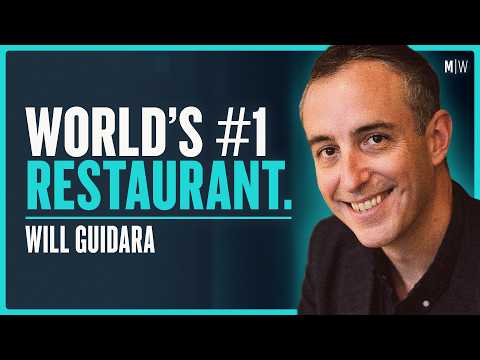
The Hotdog Effect: Secrets of the World’s #1 Restaurants - Will Guidara
Chris Williamson (host), Will Guidara (guest)
In this episode of Modern Wisdom, featuring Chris Williamson and Will Guidara, The Hotdog Effect: Secrets of the World’s #1 Restaurants - Will Guidara explores unreasonable hospitality: systemizing human connection to win loyalty forever Guidara argues that hospitality is about how people feel—connection, belonging, being seen—while service is the technical delivery of a product, and confusing the two limits long-term success.
Unreasonable hospitality: systemizing human connection to win loyalty forever
Guidara argues that hospitality is about how people feel—connection, belonging, being seen—while service is the technical delivery of a product, and confusing the two limits long-term success.
He credits his father, his mother’s illness, and mentor Danny Meyer for shaping a people-first philosophy, including ‘enlightened hospitality’ and the disciplined use of language to embed values into culture.
Eleven Madison Park’s climb from #50 to #1 came from choosing to be ‘unreasonable’ about people rather than only food, sparked by the ‘hot dog’ moment that revealed the power of one-size-fits-one gestures.
He outlines a practical operating system for hospitality: map every touch point, elevate overlooked moments, use pattern recognition for recurring situations, and invest resources so staff can reliably create magic.
The conversation also examines ambition and wellbeing: pursue finite wins for motivation while anchoring to an infinite game (an unwinnable mission), and avoid letting achievement substitute for self-acceptance.
Key Takeaways
Define hospitality as emotion, not execution.
Service is the correct, timely delivery of the product; hospitality is whether someone feels welcomed, seen, and connected—what they remember long after details fade.
Get the full analysis with uListen AI
Your ‘unfair advantage’ is relationships, not product features.
Better products and stronger brands are eventually copied, but loyalty built through consistent, generous relationship investment takes much longer to erode.
Get the full analysis with uListen AI
Map the full customer journey and elevate overlooked touch points.
Like chefs obsess over ingredients, teams can obsess over micro-interactions—greeting, transitions, farewells—because small neglected moments often shape the total memory most.
Get the full analysis with uListen AI
Earn informality to lower defenses and create connection faster.
Guests arrive guarded or intimidated; intentional warmth (names, familiarity, human greeting) helps people relax, which is the precondition for genuine hospitality.
Get the full analysis with uListen AI
Treat peak moments as data: ‘go to the tapes’ after wins.
The hot-dog story worked due to presence, courage to be ‘off-brand,’ and personalization; reviewing successes turns intuition into repeatable intention.
Get the full analysis with uListen AI
Systemize ‘magic’ with pattern recognition of recurring moments.
Identify events that happen sometimes (engagements, delays, complaints) and pre-build assets and responses so staff can deliver remarkable experiences reliably, not only when someone improvises.
Get the full analysis with uListen AI
Fund hospitality with disciplined finances: the 95/5 rule.
Obsessively manage costs 95% of the time to ‘earn the right’ to spend the last 5% on memorable gestures that create stories, word-of-mouth, and durable loyalty.
Get the full analysis with uListen AI
Notable Quotes
“Service is black and white. Hospitality is color.”
— Will Guidara
“We were gonna be unreasonable, but in pursuit of people… ‘unreasonable hospitality.’”
— Will Guidara
“People will forget what you say… but they will never forget how you made them feel.”
— Will Guidara (quoting Maya Angelou)
“Manage every single dollar like an absolute maniac 95% of the time… so that you earn the right to spend the last 5% foolishly.”
— Will Guidara
“Greatness doesn't cure pain, it just makes the pain more expensive.”
— Chris Williamson
Questions Answered in This Episode
In your ‘touch-point’ audit at Eleven Madison Park, which single overlooked moment produced the biggest measurable shift in guest satisfaction or referrals?
Guidara argues that hospitality is about how people feel—connection, belonging, being seen—while service is the technical delivery of a product, and confusing the two limits long-term success.
Get the full analysis with uListen AI
How did you train staff to ‘earn informality’ without crossing into forced friendliness or violating guest boundaries?
He credits his father, his mother’s illness, and mentor Danny Meyer for shaping a people-first philosophy, including ‘enlightened hospitality’ and the disciplined use of language to embed values into culture.
Get the full analysis with uListen AI
The hot-dog moment worked because you overheard a detail—what systems did you build to capture guest signals ethically and consistently (notes, research, pre-shift briefs)?
Eleven Madison Park’s climb from #50 to #1 came from choosing to be ‘unreasonable’ about people rather than only food, sparked by the ‘hot dog’ moment that revealed the power of one-size-fits-one gestures.
Get the full analysis with uListen AI
You say excellence (control) and hospitality (empowerment) aren’t friends—what specific practices helped you prevent empowerment from degrading standards?
He outlines a practical operating system for hospitality: map every touch point, elevate overlooked moments, use pattern recognition for recurring situations, and invest resources so staff can reliably create magic.
Get the full analysis with uListen AI
What are the best and worst ‘recurring moments’ you’d recommend a non-hospitality business start with first (e.g., SaaS onboarding, cancellations, support escalations), and why?
The conversation also examines ambition and wellbeing: pursue finite wins for motivation while anchoring to an infinite game (an unwinnable mission), and avoid letting achievement substitute for self-acceptance.
Get the full analysis with uListen AI
Transcript Preview
I started listening to emo music when I was 12 and 13, like everybody else. Uh, except I never grew out of it.
[laughing]
So I'm, I'm permanently in, uh, band T-shirts that 14-year-old me would think are sick. And, um, that's it.
But dude, isn't, isn't that like one of the greatest forms of, of success if 14-year-old you would be proud of you now?
14-year-old you thinks that you're cool?
Yeah.
That's-
14-year-old you is saying, "Gosh, he's like... He's done something with himself, but he's still wearing the Beartooth T-shirt."
Yeah. What do you think 14-year-old you would say about you?
I think 14-year-old me would be pretty psyched. I mean, man, I've... When I was 12, I wanted to be in restaurants. Um, it's literally the only thing I ever wanted to do when I was a kid. And so for 14-year-old me to see that I did that at the absolute highest level, and then somehow managed to find another life to carve out for myself afterwards, I think he'd be pretty, I think he'd be pretty impressed.
What a cool, what a cool concept of what would 14-year-old you think about adult you-
Mm
... as basically the ultimate gauge of whether or not your life's going well or not. What do the people in your industry think of you? Not even actually what your parents think of you, but what would, what would 14-year-old you think of you?
Or your spouse or your friends, or I'm... All of those things are important. Uh, uh, I think it's important to show up for the people that you care about and try to make sure that they're excited to have you in their lives. I mean, to this day, I wanna make my dad proud based on the relationship I have with him. But-
Mm
... and honestly, until I made the joke about your Beartooth T-shirt, I'm not sure I, I've actually gone down this road before, which is-
Me neither
... I mean, 14-year-old me, his opinion of me is as important as anyone's opinion of me. [both laughing]
Well, hey, with AI, you might be able to cement a 14-year-old version of you that you could just check in with as a performance coach every so often.
Just have a little hologram-
You're not playing enough Xbox
... of him over there. [laughing]
Yeah. Yeah, yeah, yeah. Yeah, yeah, yeah.
"Will, Will, what do you think? Was that a good... Was that good?"
Yeah. Yeah. Yeah. I, uh, I know exactly what you mean. That trajectory that we all end up on, and the way that we, we get captured by the opinions of people who in many ways we should. I think there's, there's kind of two categories of people with this. There's one who don't serve others enough-
Mm
... sort of don't care enough about the, uh, way that they're contributing to those around them, uh, the opinions of people. They're the egotists. They're the narcissists. They're the obsessives that don't take a, take outside, uh, input. But then there's another group of people-
Install uListen to search the full transcript and get AI-powered insights
Get Full TranscriptGet more from every podcast
AI summaries, searchable transcripts, and fact-checking. Free forever.
Add to Chrome