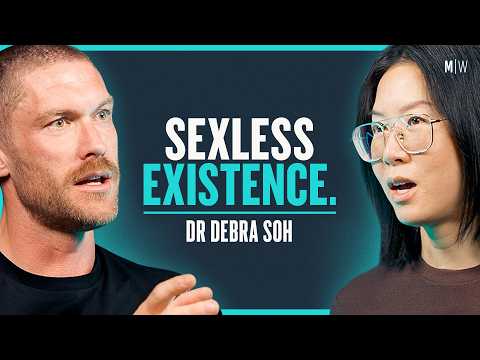
Why Nobody is Having Sex Anymore (& why it matters) - Dr Debra Soh
Chris Williamson (host), Dr. Debra Soh (guest)
In this episode of Modern Wisdom, featuring Chris Williamson and Dr. Debra Soh, Why Nobody is Having Sex Anymore (& why it matters) - Dr Debra Soh explores sex recession: technology, shifting markets, and intimacy’s new constraints worldwide Multiple datasets show a broad decline in sexual activity—partnered and solo—especially among young people, with roughly one in three men and one in five women reporting no sex in the past year.
Sex recession: technology, shifting markets, and intimacy’s new constraints worldwide
Multiple datasets show a broad decline in sexual activity—partnered and solo—especially among young people, with roughly one in three men and one in five women reporting no sex in the past year.
The discussion links sexlessness to a mix of forces: internet/smartphone life, rising anxiety and depression, porn and other “proxy” sexual outlets, and possible biological contributors like endocrine disruptors and testosterone decline.
They argue dating-market dynamics (hypergamy, widening education/earnings gaps, and skewed sex ratios in certain environments) make coupling harder and can incentivize non-commitment among highly sought-after men.
Porn and social media are framed as reshaping expectations and arousal—affecting motivation, partner satisfaction, body image, and norms around aggression—while also driving cosmetic surgery and “looksmaxxing” behaviors.
AI companions and sex robots/dolls are presented as fast-improving substitutes for connection that may further reduce real-world dating, sex, and ultimately fertility, unless people intentionally rebuild offline intimacy habits.
Key Takeaways
Sex is declining overall—not just shifting into solo or digital outlets.
Soh emphasizes that studies show decreases in partnered sex and even masturbation among adolescents, suggesting a broader drop in sexual drive/behavior beyond simple substitution.
Get the full analysis with uListen AI
The “sex recession” is strongly tied to modern convenience and avoidance of social risk.
Porn, apps, and AI reduce the need to face rejection, effort, and negotiation; for anxious or depressed people, low-friction substitutes can become default coping strategies.
Get the full analysis with uListen AI
Dating-market inequality may be a structural driver of sexlessness.
As women’s education/earnings rise relative to men’s, the pool of “acceptable” partners shrinks for many women, while high-status men gain leverage and commitment becomes less incentivized.
Get the full analysis with uListen AI
Hormonal contraception may change mate preferences and relationship stability for some couples.
They discuss evidence that suppressing ovulation can blunt sexual signaling and shift attraction priorities; coming off the pill later can reveal mismatches that were masked for years.
Get the full analysis with uListen AI
Porn is less about ‘instant addiction’ and more about habituated self-soothing—especially under anxiety.
Soh argues “porn problems” often correlate with anxiety, trauma, avoidance, and paraphilias; addressing root causes with therapy and lifestyle changes may be more effective than moral panic.
Get the full analysis with uListen AI
Early exposure to porn can distort sexual scripts and normalize risky behaviors.
They highlight concerns about porn-informed choking/rough-sex norms among Gen Z, noting safety risks and legal/ethical issues when harm is reframed as consensual ‘rough sex.’
Get the full analysis with uListen AI
Reversing the trend likely requires rebuilding offline connection rituals.
Practical suggestions include meeting in person, reducing phone ‘phubbing,’ cultivating flirtation/novelty in long-term relationships, improving health basics (sleep, exercise, diet), and experimenting with porn abstinence to restore motivation.
Get the full analysis with uListen AI
Notable Quotes
“We see consistently with multiple data sets that one in three men and one in five women have not had sex in the past 12 months.”
— Dr. Debra Soh
“So it’s not just that the pie of sexual activity has been redistributed… It’s that the overall size of the pie has gotten smaller too.”
— Chris Williamson
“If you hate the opposite sex, it’s gonna be very difficult to want to have a relationship with them or to date them.”
— Dr. Debra Soh
“Why is it… we’re not seeing the concordant amounts of antisocial behavior? …men are being sedated… through screens, video games, and porn.”
— Chris Williamson
“People f—do fall in love with their AI chatbots… They said, ‘My AI doesn’t remember me anymore.’”
— Dr. Debra Soh
Questions Answered in This Episode
You both claim the decline includes solo masturbation—what are the strongest studies showing that, and what are the main limitations of those datasets?
Multiple datasets show a broad decline in sexual activity—partnered and solo—especially among young people, with roughly one in three men and one in five women reporting no sex in the past year.
Get the full analysis with uListen AI
If hypergamy is partly ‘physics of the system,’ what concrete cultural or economic changes (if any) would actually relax that constraint without coercion?
The discussion links sexlessness to a mix of forces: internet/smartphone life, rising anxiety and depression, porn and other “proxy” sexual outlets, and possible biological contributors like endocrine disruptors and testosterone decline.
Get the full analysis with uListen AI
You argue porn problems correlate with anxiety and trauma more than ‘addiction’—what would a clean study design look like that could falsify your view?
They argue dating-market dynamics (hypergamy, widening education/earnings gaps, and skewed sex ratios in certain environments) make coupling harder and can incentivize non-commitment among highly sought-after men.
Get the full analysis with uListen AI
On hormonal contraception: how large are the mate-preference effects in real-world relationship outcomes (breakups, divorce, satisfaction), not just lab measures?
Porn and social media are framed as reshaping expectations and arousal—affecting motivation, partner satisfaction, body image, and norms around aggression—while also driving cosmetic surgery and “looksmaxxing” behaviors.
Get the full analysis with uListen AI
The conversation links DEI to men’s socioeconomic decline—what evidence connects DEI specifically to dating-market outcomes versus broader educational/industrial changes?
AI companions and sex robots/dolls are presented as fast-improving substitutes for connection that may further reduce real-world dating, sex, and ultimately fertility, unless people intentionally rebuild offline intimacy habits.
Get the full analysis with uListen AI
Transcript Preview
Is people having less sex a big deal?
It is a big deal. [laughs] Well, ask anyone who's not having sex if it's a big deal. I think they'll tell you, "Yeah, it is a problem." Especially considering that it is young men who are typically in the, their prime and at the peak of their sexual drive. So not only is it, I think, quite frustrating for them, but also when you're in a situation like that where you're struggling and it's not just about the sex, it's also about the connection and the emotional intimacy and the larger feeling of connectedness and community. So, um, Sextinction is very much about the sex recession-
Mm.
... and the fact that young people, Millennials and Ge- Gen Z in particular, are having less sex than previous generations. And I was skeptical at first. I thought that this talk about the sex recession and sexlessness was overblown. But after I sat down and got a chance to go through the data myself, look at the media reportage, talk to people, and we see consistently with multiple data sets that one in three men and one in five women have not had sex in the past 12 months, which is a large number of people. And so I was interested with this book, what is taking the place of sex?
Mm.
And what i- what does that say about where we're headed in the future?
How different is modern sexual activity to what we understand about the past?
Well, in terms of, say, the outlets that we have available, so the one question has been is sex really on the decline, or is it that other outlets are taking the place like porn with some masturbation, um, things like OnlyFans or now AI companions? So each of these subjects have a different chapter in the book to themselves and, and myself explaining, trying to understand, um, what the trend is about. Is it convincing? I test them out myself, which was a lot of fun in many cases.
Mm.
Um, going through the scientific research in terms of what we do know about these technologies, and then also talking about the evolutionary biology and psychology that is underpinning them. So what makes these technologies alluring to human beings, and why is it that it's potentially dangerous or distracting us from real life sex?
How different is the amount of sex, person-on-person sex, that modern people are having compared with what we understand about the past?
Well, everyone across the board is having less sex. So regardless of whether you are married or in a relationship or single, um, it's ac- in Eastern countries, Western countries, basically all developed countries and all age cohorts, but as I mentioned, most, uh, more specifically among young people. But your question earlier about, you know, is it taking the place of potentially masturbation or other outlets or other sexual outlets. Um, and if you look at studies that are asking about adolescent sexuality, so this is a understandably, uh, uncomfortable subject, right, to think about ad- adolescent sexual awakening, but they had parental consent, so it's a legitimate study. And what they found at e- is even among adolescents, they are having lower rates of masturbation and across the board with everyone, less partnered sex, less so less, um, intercourse, less anal sex, less all types of sex, oral sex, um, partner masturbation, I said, solo masturbation as well. So across the board there's been this decline. So it's not that people are just preferring masturbation, although I do think that is something that is happening, especially when we look at pornography and-
Install uListen to search the full transcript and get AI-powered insights
Get Full TranscriptGet more from every podcast
AI summaries, searchable transcripts, and fact-checking. Free forever.
Add to Chrome