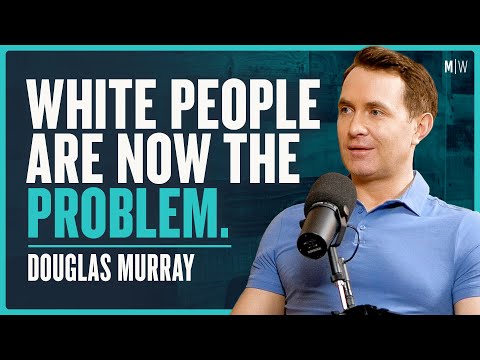
Why Do Western People Hate Themselves? - Douglas Murray
Douglas Murray (guest), Chris Williamson (host), Narrator, Narrator, Narrator, Narrator, Narrator
In this episode of Modern Wisdom, featuring Douglas Murray and Chris Williamson, Why Do Western People Hate Themselves? - Douglas Murray explores douglas Murray Explains How the West Learned To Loathe Itself Douglas Murray discusses what he calls a "war on the West": an elite-driven cultural and intellectual project that pathologizes Western history, "whiteness," and traditional heroes while largely ignoring non‑Western abuses and histories.
Douglas Murray Explains How the West Learned To Loathe Itself
Douglas Murray discusses what he calls a "war on the West": an elite-driven cultural and intellectual project that pathologizes Western history, "whiteness," and traditional heroes while largely ignoring non‑Western abuses and histories.
He argues that anti‑white rhetoric, race‑based overcorrections, and institutionalized guilt (via DEI training, bestsellers like *White Fragility*, and figures like Ibram X. Kendi) are both racist and politically dangerous, eroding social trust and democratic confidence.
The conversation ranges from Hollywood’s hypocrisy over China and LGBT issues, to the doxxing of Libs of TikTok, to the financial conduct of BLM, as examples of what Murray sees as cynical moral grandstanding and double standards.
In the final third, Murray reflects on personal motivations, work ethic, regret, and intellectual legacy, framing his own prolific output as a bid for freedom, responsibility to predecessors, and a determination not to waste limited time.
Key Takeaways
Racial double standards are now normalized when directed at white people.
Murray argues that phrases like "white privilege," "white rage," and claims that there is "no good form of being white" would be immediately condemned as racist if applied to any other group, yet are institutionalized in schools, corporations, and even the military.
Get the full analysis with uListen
Attempts to rectify historical injustice via present‑day discrimination are self‑defeating.
He criticizes Ibram X. ...
Get the full analysis with uListen
Western self‑loathing creates strategic openings for authoritarian rivals.
By relentlessly framing the West as uniquely oppressive while ignoring, for example, ongoing slavery and ethnic repression in China and the Middle East, Murray says Western elites demoralize their own societies and hand propaganda material to adversarial regimes.
Get the full analysis with uListen
Historical critique has become ideologically selective, sparing Marx while damning others.
Murray notes that figures like Churchill and the American Founders are relentlessly attacked for racism and slavery, whereas Karl Marx—who wrote far more explicitly racist material—is largely exempt, which he interprets as evidence of a pro‑Marxist, anti‑Western bias.
Get the full analysis with uListen
Activist and media ecosystems often reward outrage, opacity, and “crybullying.”
From Taylor Lorenz’s doxxing of Libs of TikTok to BLM’s mansion controversy, Murray sees a pattern: activists and journalists bully or smear opponents, then present themselves as victims when criticized, while leveraging moral narratives to raise money and social status.
Get the full analysis with uListen
Eroding trust in institutions fuels conspiratorial thinking on the right and left.
He argues that whiplash COVID messaging, tech censorship around topics like the lab‑leak theory, and politicized intelligence or media behavior have understandably convinced many that "the system" is rigged, pushing some into reflexive contrarianism and conspiracy.
Get the full analysis with uListen
Meaningful work often requires accepting specific, chosen regrets and social costs.
Drawing on Christopher Hitchens, Murray says everyone must "choose their regrets": he would rather risk career damage, isolation, or hostility than live with the regret of not saying what he believes to be true, and sees his relentless work ethic as a response to life’s brevity and inherited opportunities.
Get the full analysis with uListen
Notable Quotes
“If you took what is now said about white people in America, Britain, and elsewhere, and said it about any other group, you would be regarded, rightly, as a racist.”
— Douglas Murray
“You punish people who look like people who did a bad thing in the past on behalf of people who look like people to whom a bad thing was done.”
— Douglas Murray
“The past was pretty much hell for pretty much everyone.”
— Douglas Murray
“You have to choose your regrets. Your instincts don’t always lead you right, but they’re the only things that ever lead you right.”
— Christopher Hitchens (as quoted by Douglas Murray)
“I don’t think I’m better than anyone else because of my skin color or my sex, but I also don’t think anyone else is better than me because of theirs.”
— Douglas Murray
Questions Answered in This Episode
Where is the line between legitimate historical reckoning and destructive self‑hatred of Western culture?
Douglas Murray discusses what he calls a "war on the West": an elite-driven cultural and intellectual project that pathologizes Western history, "whiteness," and traditional heroes while largely ignoring non‑Western abuses and histories.
Get the full analysis with uListen AI
How should societies address real past injustices without creating new forms of racial essentialism or collective guilt?
He argues that anti‑white rhetoric, race‑based overcorrections, and institutionalized guilt (via DEI training, bestsellers like *White Fragility*, and figures like Ibram X. ...
Get the full analysis with uListen AI
To what extent are critiques of "whiteness" genuinely anti‑racist versus serving other ideological or political agendas?
The conversation ranges from Hollywood’s hypocrisy over China and LGBT issues, to the doxxing of Libs of TikTok, to the financial conduct of BLM, as examples of what Murray sees as cynical moral grandstanding and double standards.
Get the full analysis with uListen AI
How can institutional trust be rebuilt when media, tech, and government have repeatedly appeared partisan or inconsistent?
In the final third, Murray reflects on personal motivations, work ethic, regret, and intellectual legacy, framing his own prolific output as a bid for freedom, responsibility to predecessors, and a determination not to waste limited time.
Get the full analysis with uListen AI
Is it possible to defend Western achievements robustly without sliding into nationalism or ignoring the West’s genuine failures?
Get the full analysis with uListen AI
Transcript Preview
If you said, "There is no good form of Blackness, none, and don't ever try to stop being Black because you can't, you can't get out of it," we'd go, "Wow! That's a racist."
(laughs)
"That's a big racist right there." Well, it's racist when they do it about white people as well. If you took what is now said about white people in America, Britain, and elsewhere, and said it about any other group, you would be regarded, rightly, as a racist.
Douglas Murray, welcome to the show.
Great to be with you, and great to be with you in person for the first time.
It's been too long since you've been on the show, but this is-
(laughs) .
... our first time in person.
When was I last on? (laughs)
Two years ago-ish, paperback of Madness of Crowds.
That's right, and the world's only got better.
Oh, it's so much better. So we've got a couple of hours today, and hopefully we'll go through some stuff that maybe you haven't spoken about before at the end. But first, there is some more pressing news. As you are aware, Dumbledore is a proud member of the LGBT community.
(laughs)
But as you may not be aware, he is not allowed to be his true self in China. Did you see this?
No.
Let me tell you about this.
I mean, Dumbledore kept coming out -I don't know.
It's, it, it was-
He came out more times than Sam Smith.
(laughs) So references to a gay relationship were edited out of Fantastic Beasts: The Secrets of Dumbledore by Warner Bros. for the film's release in China. "As a studio, we're committed to safeguarding the integrity of every film we release, and that extends to the circumstances that necessitate making nuanced cuts in order to respond sensitively to a variety of in-market factors," Warner Bros. said in a statement to Variety. "Our hope is to release the features worldwide as released by their creators, but historically, we have faced small edits made in local markets."
How gay was Dumbledore in ... let's see.
Six seconds of dialogue.
What, is it, like ... It's dialogue?
It's dialogue.
Oh, it's dialogue, not-
Yeah, you know, it's not a-
... not actual-
... full frontal scene. Come on.
It's not.
It's a film for children.
Okay. (laughs)
But my point is that, uh, he said something to this guy about how, "I used to love you," or something like that, uh, and it's been cut from -
Wasn't there ... Now we saw Harry Potter on stage in New York with Jordan and Tammy Peterson only a couple months ago, and if I remember rightly, there was some very slight allusion to gayness there.
Yeah. Whole thing was homoerotic.
Install uListen to search the full transcript and get AI-powered insights
Get Full TranscriptGet more from every podcast
AI summaries, searchable transcripts, and fact-checking. Free forever.
Add to Chrome