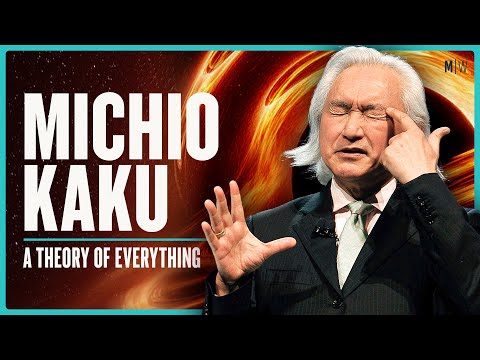
Black Holes, Big Bangs & Quantum Theory - Michio Kaku | Modern Wisdom Podcast 323
Michio Kaku (guest), Chris Williamson (host)
In this episode of Modern Wisdom, featuring Michio Kaku and Chris Williamson, Black Holes, Big Bangs & Quantum Theory - Michio Kaku | Modern Wisdom Podcast 323 explores michio Kaku Explains String Theory, Multiverses, And Humanity’s Cosmic Future Michio Kaku discusses his lifelong pursuit of a “God equation” – a single, mathematically consistent framework (string theory) that unites relativity and quantum mechanics and explains the origin and structure of the universe. He uses intuitive metaphors—music, bubbles, higher dimensions, Flatland, and fish in a pond—to explain strings, extra dimensions, and the multiverse, including ideas like pre–Big Bang universes, wormholes, and dark matter as higher string vibrations.
Michio Kaku Explains String Theory, Multiverses, And Humanity’s Cosmic Future
Michio Kaku discusses his lifelong pursuit of a “God equation” – a single, mathematically consistent framework (string theory) that unites relativity and quantum mechanics and explains the origin and structure of the universe. He uses intuitive metaphors—music, bubbles, higher dimensions, Flatland, and fish in a pond—to explain strings, extra dimensions, and the multiverse, including ideas like pre–Big Bang universes, wormholes, and dark matter as higher string vibrations.
Kaku outlines recent cracks in the Standard Model (muon magnetic moment anomalies) and future experiments like LISA and next‑generation colliders that could test string theory via gravitational waves, dark matter, higher dimensions, and deviations from Newton’s laws. He argues that mathematics may uniquely determine a consistent universe and that string theory could be the only viable candidate for a Theory of Everything.
Beyond physics, he reflects on the universality of scientific laws versus cultural artifacts, critiques unfalsifiable ideas like simulation theory and reincarnation as metaphysics, and considers the ethical and existential need for space colonization and even escaping a dying universe via wormholes. Kaku frames our current era as the inflection point of scientific progress, where we first learn the fundamental rules of reality.
Key Takeaways
String theory offers a unified picture where particles are musical notes on tiny vibrating strings.
Different vibration modes of a fundamental string manifest as different particles (electrons, quarks, neutrinos), making physics the harmonies on strings, chemistry their melodies, and the universe a ‘symphony of strings’—with the ‘mind of God’ as cosmic music in higher-dimensional space.
Get the full analysis with uListen AI
Relativity and quantum mechanics conflict mathematically, and string theory could be the bridge.
Relativity describes smooth spacetime; quantum mechanics chops reality into discrete quanta. ...
Get the full analysis with uListen AI
Recent anomalies in the muon’s magnetic moment hint at physics beyond the Standard Model.
Two experimental groups have measured the muon’s magnetic properties deviating from Standard Model predictions, suggesting a new particle and a possible ‘fifth force’—which Kaku interprets as evidence for a higher vibrational octave of the string.
Get the full analysis with uListen AI
String theory naturally leads to a multiverse of bubble universes and pre–Big Bang scenarios.
Instead of a single bubble universe expanding from the Big Bang, string theory envisions many bubbles that can collide, split, or be connected by wormholes, implying universes before ours and parallel realities beyond our observable cosmos.
Get the full analysis with uListen AI
Forthcoming experiments could make string theory empirically testable rather than purely speculative.
Kaku highlights LISA’s gravitational-wave measurements from the instant of the Big Bang, next-generation colliders that could see higher string modes, dark matter searches, and precision tests of Newton’s inverse-square law at small scales to detect higher dimensions.
Get the full analysis with uListen AI
Mathematical consistency may uniquely select our universe—and possibly string theory.
Kaku claims string theory is only self-consistent in 10–11 dimensions and that small deviations cause mathematical breakdowns (e. ...
Get the full analysis with uListen AI
Long-term survival of humanity may require leaving Earth, then the galaxy, and eventually the universe.
Given asteroid threats, stellar death, and the second law of thermodynamics, Kaku argues we’ll eventually need an ‘insurance policy’—space colonization and, in the ultra-long term, mastering Planck-scale energies to create wormholes as dimensional lifeboats to younger universes.
Get the full analysis with uListen AI
Notable Quotes
“Physics is the harmonies you can write on vibrating strings; chemistry is the melodies you can play on interacting strings; the universe is a symphony of strings.”
— Michio Kaku
“The mind of God is cosmic music resonating through hyperspace.”
— Michio Kaku
“The dinosaurs didn’t have a space program. That’s why they’re not here today.”
— Michio Kaku
“We only see these wondrous things for the first time once… We are privileged to be alive at the cusp of some of the greatest revolutions in human history.”
— Michio Kaku
“String theory is not guaranteed to be correct, but it has no alternatives that satisfy relativity, the Standard Model, and mathematical consistency.”
— Michio Kaku (paraphrased from his criteria explanation)
Questions Answered in This Episode
If string theory is currently untestable at the Planck scale, what specific experimental results in the next 20–50 years would most convincingly support or refute it?
Michio Kaku discusses his lifelong pursuit of a “God equation” – a single, mathematically consistent framework (string theory) that unites relativity and quantum mechanics and explains the origin and structure of the universe. ...
Get the full analysis with uListen AI
How would our philosophical and religious worldviews change if LISA or other experiments found strong evidence for a multiverse or a ‘cosmic umbilical cord’ to a parent universe?
Kaku outlines recent cracks in the Standard Model (muon magnetic moment anomalies) and future experiments like LISA and next‑generation colliders that could test string theory via gravitational waves, dark matter, higher dimensions, and deviations from Newton’s laws. ...
Get the full analysis with uListen AI
What ethical frameworks should guide decisions about multi-generational space missions where descendants never chose to be born on a starship?
Beyond physics, he reflects on the universality of scientific laws versus cultural artifacts, critiques unfalsifiable ideas like simulation theory and reincarnation as metaphysics, and considers the ethical and existential need for space colonization and even escaping a dying universe via wormholes. ...
Get the full analysis with uListen AI
If mathematics is what ultimately ‘selects’ a consistent universe, what does that imply about the relationship between math, physical reality, and concepts like God or purpose?
Get the full analysis with uListen AI
At what point does a speculative idea (like simulation theory or certain multiverse models) become scientifically meaningful rather than purely metaphysical—what threshold of testability should we demand?
Get the full analysis with uListen AI
Transcript Preview
But what happened before the Big Bang? What happened before creation? Is there a white hole on the other end of a black hole? Can time go backwards? Are there other dimensions? Are there other parallel universes out there? Is there a multiverse of universes? These are all questions that are beyond our present understanding. (rocket taking off)
What is the problem that you're trying to solve with a Theory of Everything?
Well, I first encountered the problem when I was eight years old. A great scientist had just died. It was in all the newspapers, and all they did was, uh, publish a picture of his desk. That's all they did, publish a picture of his desk. And on that desk was a book that was opened, and the caption said, "The greatest scientist of our time could not finish that book." Well, (laughs) I was stunned. What? Why didn't he ask his mother? Why didn't he simply treat it as a homework problem? What? He couldn't finish it? So I went to the library, and I found out this man's name was Albert Einstein, and that book was the Unified Field Theory, the Theory of Everything, an equation no more than perhaps one inch long that would allow us to, quote, "Read the mind of God." Well, I was hooked. (laughs) I had to know what was in that book, what was so hard. So when I was about 17 years of age, I wanted to be part of this great revolution. I went to my mom, and I said, "Mom, can I have permission to build an atom smasher in the garage, a 2.3 million electron volt betatron particle accelerator in the garage?" And my mom said, "Sure, why not? And don't forget to take out the garbage." Well, I took out the garbage. I got 400 pounds of transformer steel, 22 miles of copper wire, and I built a six-kilowatt, two million electron volt betatron accelerator in the garage. Now, every time I plugged it in, I would (laughs) blow out all the circuit breakers in the house. So my poor mom, she must have said, "Why couldn't I have a son who plays baseball? Maybe if I bought him a basketball. And for God's sake, why can't he find a nice Japanese girlfriend? Why does he have to build these machines in the garage?" Well, I went to a national science fair, and I met an atomic scientist there, Dr. Edward Teller, father of the hydrogen bomb. And he offered me a scholarship, a scholarship to Harvard, so I, I took it. And then when I graduated from Harvard, he offered me a job, and that job was to design hydrogen warheads, to be part of Los Alamos and Livermore National Laboratories. Well, I respectfully and graciously declined that very generous and kind offer because I wanted to work on even bigger explosion. I wanted to work on something even more powerful than a hydrogen bomb, and that is the Big Bang, the creation of the universe. I wanted to find the God equation, the equation that set the Big Bang into motion, that created the Big Bang, that caused the bang to happen. You see, we just know that there was a bang. That's all we know. (laughs) That's all we know. There was a bang. We don't know why it banged, how it banged. We don't know anything about the bang other than the fact that there was an expanding universe. Anyway, so I said to myself, "That's what I wanna work on rather than designing hydrogen warheads."
Install uListen to search the full transcript and get AI-powered insights
Get Full TranscriptGet more from every podcast
AI summaries, searchable transcripts, and fact-checking. Free forever.
Add to Chrome