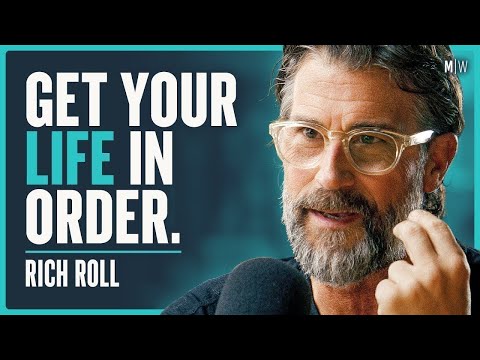
From Addiction & Rock Bottom to Redemption & Purpose - Rich Roll (4K)
Chris Williamson (host), Rich Roll (guest)
In this episode of Modern Wisdom, featuring Chris Williamson and Rich Roll, From Addiction & Rock Bottom to Redemption & Purpose - Rich Roll (4K) explores rich Roll on Reinvention, Addiction, Pain, and Purposeful Persistence Chris Williamson interviews Rich Roll about his journey from addiction and professional collapse to sobriety, ultra-endurance sport, and a purpose-driven media career. They unpack the myth of overnight reinvention, emphasizing that change happens through long, unseen periods of confusion, micro-actions, and persistence. A major theme is shifting from ego-driven achievement, pain addiction, and people-pleasing toward authenticity, service, and heart-centered living. They also explore the power of environment and companions, the danger of using anger and suffering as fuel, and the necessity of rest, reflection, and spiritual or philosophical grounding for sustainable success.
Rich Roll on Reinvention, Addiction, Pain, and Purposeful Persistence
Chris Williamson interviews Rich Roll about his journey from addiction and professional collapse to sobriety, ultra-endurance sport, and a purpose-driven media career. They unpack the myth of overnight reinvention, emphasizing that change happens through long, unseen periods of confusion, micro-actions, and persistence. A major theme is shifting from ego-driven achievement, pain addiction, and people-pleasing toward authenticity, service, and heart-centered living. They also explore the power of environment and companions, the danger of using anger and suffering as fuel, and the necessity of rest, reflection, and spiritual or philosophical grounding for sustainable success.
Key Takeaways
Reinvention is slow, confusing, and built on micro-actions, not magic moments.
Both emphasize that meaningful life change is less about a single epiphany and more about years of small, uncomfortable decisions—new boundaries, honest conversations, and tiny daily behaviors that eventually compound into visible transformation.
Get the full analysis with uListen AI
Impatience and entitlement sabotage change; persistence and willingness enable it.
People often quit because results don’t appear quickly, or they feel they “deserve” an outcome; Rich stresses that you control only your attention and actions, and real change demands rigorous consistency and a willingness to do whatever it takes over long periods.
Get the full analysis with uListen AI
Your companions quietly set your ceiling; curate them intentionally.
The concept of “lower companions” from recovery applies beyond addiction—friends who normalize mediocrity or undermine your aspirations will slowly drag you down, while a self-chosen ‘board of advisors’ and high-vibration peers can radically elevate your trajectory.
Get the full analysis with uListen AI
Suffering is a powerful but dangerous success strategy.
Rich’s early equation—‘more pain = more success’—worked in swimming and work but became a compulsive pattern; he now sees that insisting on suffering as proof of worth leads to burnout, and that ease, collaboration, and better systems can produce equal or greater quality.
Get the full analysis with uListen AI
Using anger, resentment, or insufficiency as fuel is unsustainable.
Launching from “I’ll show them” can get you from zero to one, but staying powered by spite or insecurity ultimately corrodes your life; transcending these lower motives can unlock a larger, healthier form of ambition rooted in service, joy, and self-respect.
Get the full analysis with uListen AI
Direction and reflection matter more than raw speed and hustle.
Through his annual month-long ‘Manuary’ sabbaticals, Rich learned that stepping away from constant output is a ‘growth accelerator’—it restores energy, tests your systems, and lets you reassess whether your work, relationships, and path still align with your values.
Get the full analysis with uListen AI
Authenticity requires aligning what you think, say, and do—and listening to your heart.
Both men describe personas built to win praise rather than love; moving toward authenticity means noticing where your actions don’t match your inner truth, quieting mental noise, reconnecting with your younger self, and allowing heart-driven impulses to guide decisions.
Get the full analysis with uListen AI
Notable Quotes
“If you're gonna be a phoenix, you have to burn first.”
— Rich Roll
“Sobriety isn't for people that need it. It's for people that want it.”
— Rich Roll
“The prize doesn't go to the fastest. It goes to the person who slows down the least.”
— Rich Roll (via his coach)
“The persona is incapable of receiving love. It can only receive praise.”
— Aubrey Marcus (quoted by Chris Williamson)
“Most people are trying to solve a problem of the mind with the mind that created it.”
— Rich Roll
Questions Answered in This Episode
How do I know whether I’m genuinely reinventing myself versus just changing surface-level details while keeping the same patterns underneath?
Chris Williamson interviews Rich Roll about his journey from addiction and professional collapse to sobriety, ultra-endurance sport, and a purpose-driven media career. ...
Get the full analysis with uListen AI
What practical steps can I take this month to upgrade my ‘board of advisors’ and reduce time with lower companions without blowing up my social life?
Get the full analysis with uListen AI
If my motivation is mostly fueled by insecurity or anger, how do I transition to a healthier fuel source without losing my drive?
Get the full analysis with uListen AI
What would a realistic ‘mini-sabbatical’ or reflection period look like for me, and what questions should I sit with to reassess my direction?
Get the full analysis with uListen AI
How can I distinguish between healthy hard work and a compulsive need to suffer in order to feel worthy or creative?
Get the full analysis with uListen AI
Transcript Preview
At what age did you start sorting your life out?
(exhales) That's a good question. I think the moment where I began to really look inward and take stock and inventory of my life, legitimately for the first time, was probably when I was 31 and found myself in a treatment center in rural Oregon. Uh, faced with confronting a decade plus, uh, problem with drugs and alcohol, uh, nowhere to escape, just a bunch of counselors and a bucolic countryside, and 100 days to really start to understand why I had ended up in this place, which certainly was not the plan for my life, I can tell you, uh, and what I was gonna do about it in order to create a new life for myself that would be more in alignment with a truer version of who I was. I didn't know the answer to that question, but that's where that very long journey probably began, consciously.
It seems to me that a good chunk of your story is a series of reinventions.
Yes. I think that we are all reinventing ourselves all the time. I've said this before, but I think the great delusion that we walk around with is that we are in some kind of perpetual stasis. We are the way we are, the world is the way that it is, this person behaves this way, they're always gonna behave that way. Uh, but the reality is that everything is changing all the time, from the subatomic level all the way to, eh, you know, the vastness of the universe. There is no stasis. Everything is in flux and in, and is in motion. Um, the question is how much are you directing that change versus, uh, reacting to the world around you? Um, and yes, my life has been punctuated by a couple kind of significant Rubicon changes or, or reinventions, uh, to be sure. Um, but I'm always in the process of trying to evaluate where I'm at, where I wanna be, where I wanna head to. Uh, but yeah, I've had a couple sort of, uh, moments in my life that, uh, were sort of s- uh, line in the sand moments for sure.
Yeah, you have this really famous tweet talking about all of the things you've done successfully and the fact that you didn't do them before a particular age.
Mm-hmm.
I hadn't started my podcast until... I hadn't run my first endurance race until... I didn't write my first book until... And I think in a, an age where social media allows us to see successes from people very young, um, it gives a good bit of solace to people who, uh, feel like "I'm 40 now. I've missed... I'm in the, I'm on the back nine and I haven't even started swinging the golf club yet."
I know what that feels like. You know, I was that guy. Certainly, you can always reinvent yourself. There's always hope, there's always opportunity. I think now more than ever, with all the tools that are available to people to craft their own career paths, to find ways to support themselves through, uh, pursuits that, that they're curious about or that light them up, I think this is a real golden age in terms of that. Uh, but that didn't exist when I was your age or when I was younger, and I grew up in a very traditional household. Education was paramount, expectations were set very high, and I learned early and often how to play that game of upward mobility. I was an awkward, insecure kid who had difficulty making friends, but at some point I locked in on the sport of swimming, and that's a whole story I'm happy to go into. And what I learned in the swimming pool transferred into the classroom and I became a better student. I had always struggled in school, but by the time I graduated from high school, I was top of my class and got very good at playing the game of getting into all the colleges and going to the right place and getting the right job without ever any self-reflection on what it was that I wanted to do or what excited me or what was unique about me or how I wanted to show up in the world or express myself. Uh, I was just trying to excel, and that path was very narrow at the time. Like, go to this school, get this job, show up early, work late, you know, sort of climb that corporate ladder. Went to law school, was on the partnership track at a law firm, did all of that and had to basically suffer an existential and health crisis e- as a reckoning in order to look inward on myself and reflect upon the, the reasons why I made those decisions, why they were leading me astray, and begin the process of opening the aperture of my vision to, to allow space for something new and different.
Install uListen to search the full transcript and get AI-powered insights
Get Full TranscriptGet more from every podcast
AI summaries, searchable transcripts, and fact-checking. Free forever.
Add to Chrome