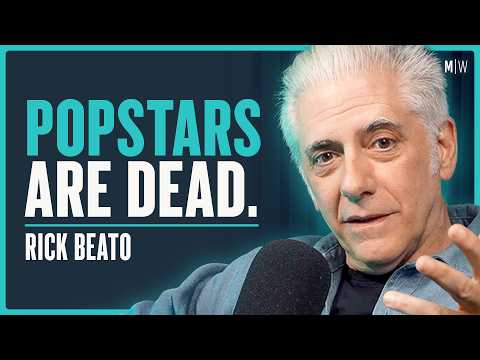
How AI and TikTok Are Breaking the Music Industry - Rick Beato
Rick Beato (guest), Chris Williamson (host)
In this episode of Modern Wisdom, featuring Rick Beato and Chris Williamson, How AI and TikTok Are Breaking the Music Industry - Rick Beato explores tikTok, AI, And Algorithms: How Modern Tech Reshapes Music Itself Rick Beato and Chris Williamson dissect how the music industry has shifted from artist- and album-centric to platform- and algorithm-centric, with TikTok, Spotify, and AI now driving what gets heard and how songs are made.
TikTok, AI, And Algorithms: How Modern Tech Reshapes Music Itself
Rick Beato and Chris Williamson dissect how the music industry has shifted from artist- and album-centric to platform- and algorithm-centric, with TikTok, Spotify, and AI now driving what gets heard and how songs are made.
They explain the hidden factory of modern songwriting—producer-driven tracks, writing camps, and Nashville’s industrialized song pipelines—contrasting it with legacy bands, live musicianship, and older production craft.
The conversation explores homogenized sound from digital tools, the outsized importance of social media and pre-existing fame, the rise of popified country, and the economic reality that live shows and diverse income streams now sustain most artists.
They close by wrestling with AI music and voice cloning, the ethics and business incentives behind AI-generated artists, and the likely emergence of ‘human-only’ platforms in response.
Key Takeaways
Most mainstream pop songs are factory products, not personal confessionals.
Beato details how many stars contribute minimally to songwriting beyond top-line tweaks or concept ideas, while professional writers and producers build the actual songs—yet marketing still encourages fans to read deep personal meaning into them.
Get the full analysis with uListen AI
TikTok virality is now a prerequisite for breaking many songs.
Labels can still help, but without a 10–15 second viral moment on TikTok or Shorts, it’s increasingly difficult for singles to gain traction; artists who can self-produce frequent short-form content have a huge structural advantage.
Get the full analysis with uListen AI
Digital tools make music easier to produce but more sonically homogenous.
Amp modelers, DAWs, presets, samples, and AI mastering standardize the palette, and with fewer top-tier producers/mixers in rock, many tracks share the same sonic fingerprints instead of the unique character of older, amp- and room-based recordings.
Get the full analysis with uListen AI
Artists must now be entrepreneurs, not just musicians.
Surviving artists stack revenue from touring, merch, online lessons, plugins/gear collabs, VIP experiences, and YouTube—because streaming alone often doesn’t pay enough unless you’re at the very top of the charts.
Get the full analysis with uListen AI
Country’s recent boom is driven by pop production and rock refugees.
Modern country borrows pop drum loops and hooks while offering guitars and storytelling, attracting former rock listeners and ex-metal musicians who now power much of the country scene’s sound and touring.
Get the full analysis with uListen AI
AI music is moving from background filler to test case for full ‘artists’.
Beato highlights Spotify playlists already stocked with AI tracks and a suspicious ‘band’ (Velvet Sundown) as likely experiments, warning that if fully generative works could be copyrighted, platforms would be incentivized to flood playlists with zero-royalty AI music.
Get the full analysis with uListen AI
The only defensible moat against AI is live performance and human narrative.
Both argue that while AI can generate convincing tracks and even cloned voices, it cannot yet replicate the story, physicality, and communal emotion of live shows—so touring and an authentic persona remain the most future-proof differentiators.
Get the full analysis with uListen AI
Notable Quotes
“Most pop songwriters, not all, have very little to do with their songs other than choosing them.”
— Rick Beato
“You can have the greatest record in the world, a revolutionary new trend in music—and if you don’t have those 15 seconds, it doesn’t really matter.”
— Rick Beato
“Music is too easy to make and too easy to consume.”
— Rick Beato
“If AIs are able to create better music than you as an artist can, you either need to up your game or you’re going to be defeated by the robots.”
— Chris Williamson
“The people that do well nowadays aren’t just writing songs and going on tour. They’ve all got their own recipe of income streams.”
— Rick Beato
Questions Answered in This Episode
If fans knew how little many stars contribute creatively to their songs, would it change how they listen and who they support?
Rick Beato and Chris Williamson dissect how the music industry has shifted from artist- and album-centric to platform- and algorithm-centric, with TikTok, Spotify, and AI now driving what gets heard and how songs are made.
Get the full analysis with uListen AI
How can emerging artists practically design songs and campaigns for TikTok without feeling like they’re betraying their artistic integrity?
They explain the hidden factory of modern songwriting—producer-driven tracks, writing camps, and Nashville’s industrialized song pipelines—contrasting it with legacy bands, live musicianship, and older production craft.
Get the full analysis with uListen AI
What specific production or recording choices today could help artists stand out sonically from the preset- and plugin-driven norm?
The conversation explores homogenized sound from digital tools, the outsized importance of social media and pre-existing fame, the rise of popified country, and the economic reality that live shows and diverse income streams now sustain most artists.
Get the full analysis with uListen AI
Should streaming platforms be required to visibly label AI-generated music and AI-assisted vocals, and if so, how granular should that labeling be?
They close by wrestling with AI music and voice cloning, the ethics and business incentives behind AI-generated artists, and the likely emergence of ‘human-only’ platforms in response.
Get the full analysis with uListen AI
In a world where artists must be entrepreneurs, what’s the minimum viable ‘business stack’ a serious young musician should build alongside their music?
Get the full analysis with uListen AI
Transcript Preview
I just saw this video of Beyoncé the other night. She was up in the-
Oh, in a car? In the car-
Yeah, and the car started going...
Dude, could you imagine if you were the guy that killed Beyoncé?
(laughs) .
Oh, you could, you... She was stood on top of a car. Beyoncé dies in Eddie Guerrera-style catastrophe.
It, I was thinking, uh, d- I was wondering, like, what in the world is she thinking while she's up there? She's gotta be scared. I mean, it, she was up really high.
Is she harnessed in?
I, I think that she was.
Gotta have some sort of backup.
Has to.
Yeah. I mean-
I mean, they have to have-
... could you imagine the fucking insurance policy-
Yeah.
... on Beyoncé?
Has to be. Oh, yeah.
It would bankrupt-
But that was-
It would bankrupt a country.
That was crazy to see that, to imagine some type of a, a problem like that. You know that that's not gonna happen again, though.
Uh, Ronnie Radke, one of his... Was it his drummer who got second-degree burns, uh, from flames that came, uh, d- somewhere? And he just fired everybody. "Everybody's fired except for the band. Everybody's fired. No one's allowed to do this again. Run it back, we'll get somebody new."
You know, you're, when you're, when you're dealing with that kind of stuff, w- a- any type of pyro... When, when I was at the Metallica show, I was 30 feet from the stage, but, but at the same level. And when they... And th- and I asked Kirk, I said, "How do you know that... to kn- What happens if you're somewhere you're not supposed to be?" He goes, "Oh, they're in our ears saying, 'Okay, pyro's coming, pyro's coming.'"
"Get the fuck away." (laughs)
"Get to the..." No. "Get to a m- get to a mic."
Oh, because all the mics are in safe-
Yes.
... areas?
Yeah.
Right. Okay.
So, but it's, it's hot from, uh, when you're 30 feet away. And I said, "How hot is it onstage?" He was like, "Oh, man, it's insanely hot onstage."
Like, inferno.
"These thing, these things are going... The flames are up, going up 20 feet."
You seen the Rammstein build, where they have that big set of exhausts that come out-
Oh, yeah.
... the top?
Yeah. I mean, it's... The, the, those kind of setups are... It's gotta be a nightmare to do that, really, to, um... The liability with that, and, um, and to make sure that that's right every night, where nobody gets-
Hmm.
... nobody gets blown up. But it used to be... Havi- having accidents, you know, was not an uncommon thing, uh, in the past.
Install uListen to search the full transcript and get AI-powered insights
Get Full TranscriptGet more from every podcast
AI summaries, searchable transcripts, and fact-checking. Free forever.
Add to Chrome