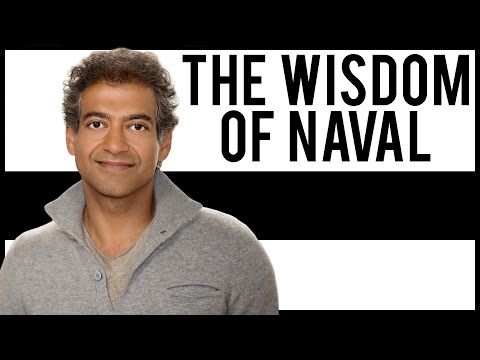
The Wisdom Of Naval Ravikant | Eric Jorgenson | Modern Wisdom Podcast 225
Eric Jorgenson (guest), Chris Williamson (host)
In this episode of Modern Wisdom, featuring Eric Jorgenson and Chris Williamson, The Wisdom Of Naval Ravikant | Eric Jorgenson | Modern Wisdom Podcast 225 explores naval Ravikant’s Playbook: Leverage, Wealth, Desire And Learned Happiness Chris Williamson and Eric Jorgenson unpack the core ideas behind *The Almanack of Naval Ravikant*, focusing on Naval’s practical philosophy of wealth and happiness. Eric explains why he turned Naval’s scattered tweets, podcasts, and essays into an organized, evergreen book structured around two pillars: building wealth through leverage and equity, and cultivating happiness as a trainable skill. They dive into Naval’s concepts of specific knowledge, leverage (capital, labor, code, and media), accountability, and the idea of “productizing yourself” to escape linear time-for-money work. In the second half, they explore happiness as something learned rather than gifted, the danger of unchecked desire, and the tension between stoic ideals and real-world relationships and family life.
Naval Ravikant’s Playbook: Leverage, Wealth, Desire And Learned Happiness
Chris Williamson and Eric Jorgenson unpack the core ideas behind *The Almanack of Naval Ravikant*, focusing on Naval’s practical philosophy of wealth and happiness. Eric explains why he turned Naval’s scattered tweets, podcasts, and essays into an organized, evergreen book structured around two pillars: building wealth through leverage and equity, and cultivating happiness as a trainable skill. They dive into Naval’s concepts of specific knowledge, leverage (capital, labor, code, and media), accountability, and the idea of “productizing yourself” to escape linear time-for-money work. In the second half, they explore happiness as something learned rather than gifted, the danger of unchecked desire, and the tension between stoic ideals and real-world relationships and family life.
Key Takeaways
Wealth comes from leverage and equity, not just higher hourly pay.
Naval’s framework says long-term wealth is built by combining specific knowledge, accountability, and leverage, then owning equity in businesses or assets that earn while you sleep. ...
Get the full analysis with uListen AI
“Productize yourself” to escape linear time-for-money work.
Turning your unique skills and experiences into scalable products—courses, software, media, or systems—lets your work be replicated at near-zero marginal cost. ...
Get the full analysis with uListen AI
Specific knowledge sits at the intersection of what you’re uniquely good at and what the market values.
Naval’s “specific knowledge” is not generic skill—it’s the unusual combination of your talents, obsessions, and experiences that others naturally seek you out for, and that can be scaled. ...
Get the full analysis with uListen AI
Leverage now increasingly comes from code and media, which are permissionless.
Beyond capital and labor, modern leverage comes from software and content that can be replicated infinitely—podcasts, apps, newsletters, online tools—without asking anyone’s permission. ...
Get the full analysis with uListen AI
Happiness is a skill you can train, not a condition you wait for.
Naval frames happiness as an internal practice—habits like savoring small pleasures, staying present, and noticing when you’ve unconsciously attached your well-being to future outcomes. ...
Get the full analysis with uListen AI
Desire is “a contract to be unhappy until you get what you want.”
The more desires you stack—status, possessions, achievements—the more conditions you create for being unhappy. ...
Get the full analysis with uListen AI
Wealth buys you freedom, which then gives you space to pursue happiness and philosophy.
Naval doesn’t romanticize poverty; money solves money problems and creates time to think, reflect, and be present. ...
Get the full analysis with uListen AI
Notable Quotes
“Whoever is listening to this, you are more unique and valuable than you think you are.”
— Eric Jorgenson (channeling Naval’s philosophy)
“Productize yourself is basically the summary of the entire tweetstorm.”
— Eric Jorgenson
“If you can’t be happy with a cup of coffee, you won’t be happy with a yacht.”
— Eric Jorgenson (describing a Naval-ism he practices)
“Desire is a contract you make to be unhappy until you get what you want.”
— Naval Ravikant (quoted by Eric Jorgenson)
“Any moment that you are not happy, you’re not doing anyone any favors.”
— Eric Jorgenson (summarizing Naval’s view on happiness and perception)
Questions Answered in This Episode
How can I practically identify my own “specific knowledge” and begin to productize it in a small, low-risk way?
Chris Williamson and Eric Jorgenson unpack the core ideas behind *The Almanack of Naval Ravikant*, focusing on Naval’s practical philosophy of wealth and happiness. ...
Get the full analysis with uListen AI
In my current life, what are the clearest examples of linear, time-for-money work—and how could I introduce leverage or equity into them?
Get the full analysis with uListen AI
Which desires in my life are actually making me chronically unhappy, and what would it look like to reduce or eliminate just one of them?
Get the full analysis with uListen AI
Am I playing status games (seeking appearances and hierarchy) instead of wealth games (creating value and assets), and how would my day change if I focused only on the latter?
Get the full analysis with uListen AI
If happiness is a skill, what one daily habit—like savoring a coffee, sunlight, or a walk—could I implement to train my attention toward contentment?
Get the full analysis with uListen AI
Transcript Preview
Whoever is listening to this, you are more unique and valuable than you think you are. And everyone is kind of an incredible combination of their genetics and their experience and their perspectives and their beliefs. And everyone is unique and everyone has some sort of skill or insight that they can bring to other people if you can learn it and package it the right way, and just see what people respond to that, that you wanna bring to them. That's probably even before the kind of logistical stumbling blocks, is just the belief that there's something there for you to do and for you to add value. (airplane whooshing)
Eric, welcome to the show.
Thanks for having me. I've been excited about this ever since I listened to you and George Mack fucking around on here. I was like, "This is gonna be a good time. I'm gonna like this."
Yeah, it's, uh, it's all the boys club up in here, isn't it? So today is Naval Fest 2020. Welcome to Naval Fest 2020. This, there's big dick energy. We're just marinading in it today, and we're gonna see how much we can jerk off over Naval over the next 60 minutes.
A, a couple hundred pages, probably, worth, um, and then, and then edited material. So we got a lot to go on.
DVD extras, pay-per-view, OnlyFans, like, additional content.
D- DVD commentary, bonus scenes, director's cut. We got it all.
I love it. So why are you writing a book about Naval? Why did you... L- Like, what makes him worthy of a book? Who is he?
Uh, I've been following Naval for 10 years now, maybe. Uh, he was the first person I kind of got introduced to in the Valley. Not personally, but when I was, you know, just a wet-behind-the-eears kid from Michigan who had never left Michigan and was, like, trying to get into the startup world, somebody was like, "Go read all of Venture Hacks, follow Naval, do everything he says." Um, uh, him and Paul Graham were kind of like, those are the lighthouses of the Valley. Like, go listen and follow. Um, so that, I, I've been kind of following for a long time, and I learned a ton from him. And as he's kind of evolved over the years and started sharing more and more stuff, I've learned more and more, and I found myself recommending, you know, his podcast, his tweets, and for, to more and more people, for more and more reasons. And I realized, uh, kind of how hard it is for people outside of, like, the Twitterverse and the podcast world to kind of pick up that and run with it and learn from it. But the stuff that he talks about, um, is, can be so life-changing for so many people at, at many different stages, I think. And there's just so much value there that I really wanted, like, an easy on-ramp, and I wanted a, a tight package. And I'm watching these, like, high-value, you know, h- p- huge pieces of wisdom, um, just kind of slide into the, like, Twitter nothingness. Um, and it broke my heart, and I'm like, "I, I need to turn this into something more evergreen, something more permanent." And, you know, there's no better package than a book. Everybody knows what to do with a book. Everybody, um, you know, that's, it's easy to gift. It's easy to read through. Um, it's, people know kind of what to do with it, and it'll, hopefully it'll live on, you know, and it'll stay relevant for a really long time.
Install uListen to search the full transcript and get AI-powered insights
Get Full TranscriptGet more from every podcast
AI summaries, searchable transcripts, and fact-checking. Free forever.
Add to Chrome