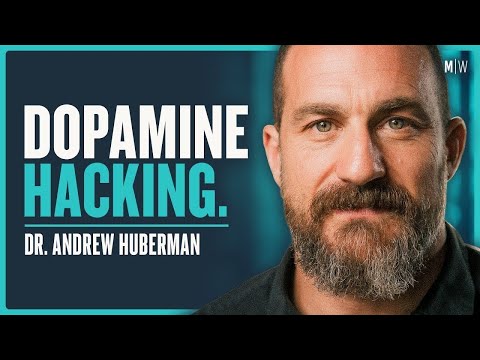
Breakups, Sadness, Focus & Rebuilding Yourself - Andrew Huberman (4K)
Andrew Huberman (guest), Chris Williamson (host), Mary Harrington (guest)
In this episode of Modern Wisdom, featuring Andrew Huberman and Chris Williamson, Breakups, Sadness, Focus & Rebuilding Yourself - Andrew Huberman (4K) explores harnessing Stress, Heartbreak, and Dopamine: Rewiring Your Nervous System Andrew Huberman explains why you often can’t “control the mind with the mind” and instead need to use the body—breathing, vision, movement, temperature—to shift your autonomic state and regain cognitive control.
Harnessing Stress, Heartbreak, and Dopamine: Rewiring Your Nervous System
Andrew Huberman explains why you often can’t “control the mind with the mind” and instead need to use the body—breathing, vision, movement, temperature—to shift your autonomic state and regain cognitive control.
He breaks down the neuroscience of stress, fear, grief, heartbreak, and dopamine, showing how attachment, loss, and modern stimuli like phones and porn hijack ancient motivational circuits.
The conversation covers practical stress inoculation (cold, heat, breathwork), how to process trauma and breakups, and how expectations and mindset can literally change physiology and performance.
Huberman also touches on hormones, testosterone, lifestyle design (light, sleep, training, routines), and why deliberate discomfort plus genuine desire—not anger—are the most sustainable fuels for growth.
Key Takeaways
You often can’t control the mind with the mind—start with the body.
In high-stress or low-energy states, thoughts narrow and feel endless. ...
Get the full analysis with uListen AI
Stress narrows both vision and thinking; lowering arousal widens options.
Stress dilates pupils and creates a ‘soda-straw’ view of the world and problems, making it hard to see alternatives. ...
Get the full analysis with uListen AI
Grief and heartbreak are motivational states trying to close an impossible gap.
The brain’s map of space, time, and closeness is shattered when someone dies or a relationship ends, driving a desperate urge to regain connection. ...
Get the full analysis with uListen AI
To process trauma and loss, you must feel—not bypass—intense emotions.
Avoidance, distraction, substances, or overwork can prolong trauma because the nervous system never fully experiences and remaps the painful state. ...
Get the full analysis with uListen AI
Dopamine peaks without effort (drugs, extreme porn, endless scrolling) blunt motivation.
Very strong, frequent dopamine surges cause subsequent drops below baseline and raise the threshold for feeling motivated or excited. ...
Get the full analysis with uListen AI
Cold and heat can safely raise your stress threshold and improve mood if dosed right.
Short bouts of uncomfortable cold (≈11 minutes/week total) and sauna (≈57 minutes/week total) trigger adrenaline, dopamine, and growth hormone in beneficial ways. ...
Get the full analysis with uListen AI
Expectations and mindset can measurably change physiology and performance.
Studies show that beliefs about genes, stress, food, and aging can alter lactate thresholds, hormone responses, hunger, and even longevity. ...
Get the full analysis with uListen AI
Notable Quotes
“If you can’t control the mind with the mind, look to the body to control the mind.”
— Andrew Huberman
“Grief is a motivated state to bridge the distance in time and space, and yet it’s impossible.”
— Andrew Huberman
“Dopamine that arrives without prior effort destroys people.”
— Andrew Huberman
“Love and the loss of love and death grief are virtually identical in the brain.”
— Andrew Huberman
“It is essentially infinite how much energy you can derive out of genuine desire to engage with something or somebody.”
— Andrew Huberman
Questions Answered in This Episode
How can I build a simple, daily ‘body-first’ toolkit to interrupt stress spirals in real time?
Andrew Huberman explains why you often can’t “control the mind with the mind” and instead need to use the body—breathing, vision, movement, temperature—to shift your autonomic state and regain cognitive control.
Get the full analysis with uListen AI
What would it look like to process a past breakup or loss using Huberman’s space–time–closeness framework instead of just distracting myself?
He breaks down the neuroscience of stress, fear, grief, heartbreak, and dopamine, showing how attachment, loss, and modern stimuli like phones and porn hijack ancient motivational circuits.
Get the full analysis with uListen AI
Which super-stimuli (social media, porn, junk food, etc.) are most likely blunting my dopamine system—and what specific ‘dopamine detox’ experiment could I run for 2–4 weeks?
The conversation covers practical stress inoculation (cold, heat, breathwork), how to process trauma and breakups, and how expectations and mindset can literally change physiology and performance.
Get the full analysis with uListen AI
How might I deliberately add ‘limbic friction’ (controlled discomfort) to my week—via cold, heat, or hard tasks—to raise my stress threshold without burning out?
Huberman also touches on hormones, testosterone, lifestyle design (light, sleep, training, routines), and why deliberate discomfort plus genuine desire—not anger—are the most sustainable fuels for growth.
Get the full analysis with uListen AI
What long-term life changes, like Huberman’s pivot at 19, am I currently avoiding out of fear, and how could I use that very fear as the primary fuel to act?
Get the full analysis with uListen AI
Transcript Preview
If we were to look at ourselves through the lens of an experiment, like we would an animal experiment, we'd think that animal is sick. If you saw an animal digging in the corner, looking, looking, looking, looking for a bone, the dog, looking, looking, looking, looking, looking, you'd think, "That's really sad." That's us. Right? That's us. I'm pointing at myself intentionally. That's us. (wind blowing)
Dr. Andrew Huberman, welcome to the show.
Great to be here. It's been a long time coming.
A very long time coming. What do you mean when you say you cannot control the mind with the mind?
Yeah, that statement really emerges from the fact that if we are in a pretty relaxed state or if we are happy, we generally feel like we can do what we want to do. We can maneuver through our environment. We can make choices that are reasonable. But oftentimes, we're not in relaxed and happy states. That's just part of the human experience, obviously. And there's a fundamental feature to the nervous system, which is this thing they call the autonomic nervous system, which is just fancy nerd speak for the components of your nervous system that raise your levels of alertness or bring them way down. Sometimes we hear fight or flight, rest and digest, but this system governs all that, but a lot more. And basically what happens is when we are at the extremes of the autonomic, what I call seesaw, of very, very alert to the point of being really stressed or panicked or concerned, or if we are very close to sleep and we're drowsy and we're exhausted, at those points along the autonomic nervous system, our thoughts become a bit like a runaway train. You know, if you're very upset, it's hard to talk yourself out of it. If you're stressed, it's hard to think yourself out of it. In fact, you can start doing all sorts of third personing and rationalization. You can call someone, you can text somebody. It's very hard to get yourself out of those states with thinking alone. But the beauty of the autonomic nervous system is that it traverses the brain and the body and it connects to essentially all the organs of the body. And it's a two-way street such that certain behaviors, even certain patterns of breathing, etc., allow us to shift where we are on the autonomic continuum between very, very alert and stressed and very calm, and thereby give our mind a shift also in terms of the kinds of thoughts that we can entertain, the sorts of actions that we can engage in. To make this concrete, if you're very, very stressed, if you're very, very upset, two things happen. One, it's very hard to take your focus off whatever it is that's upsetting you, and if you don't know what's upsetting you, you know, pure anxiety but you don't know why, it's very hard to take your mind off of the feelings of anxiety. In those states of mind, there's another component which is that for whatever reason, and no one really understands why this is, it feels as if the state that you're in will go on forever. Now, when we're in happy, relaxed states, rarely do we think, "Gosh, this is gonna go on forever." And yet when we are in these unfortunate states of mind, we get the idea somehow, it sort of hijacks our perception of time, and we feel like this is never going to stop. If we turn to the body and certain behaviors, let me talk about what those are, we are able to move ourselves along the autonomic continuum and at that point when we've done that successfully, and it's actually quite straightforward to do, we are able to think about things differently. We start to get a sense that the way we feel might not be the way we're gonna feel forever, and it's in those shifts that we start to realize, "Ah, my mind actually is not my best friend at these extremes," but there's a lot more to it. You're only getting the tip of the iceberg in those states. So, that's why I say if you can't control the mind with the mind, look to the body to control the mind.
Install uListen to search the full transcript and get AI-powered insights
Get Full TranscriptGet more from every podcast
AI summaries, searchable transcripts, and fact-checking. Free forever.
Add to Chrome