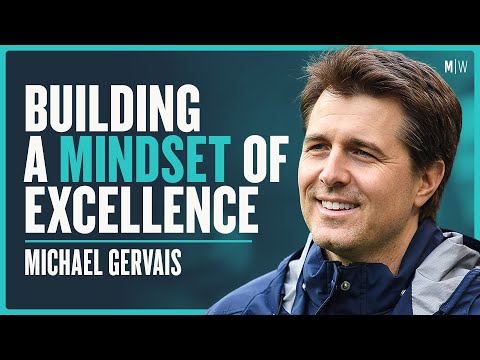
The Art Of High Performance Psychology - Dr Michael Gervais
Dr Michael Gervais (guest), Chris Williamson (host)
In this episode of Modern Wisdom, featuring Dr Michael Gervais and Chris Williamson, The Art Of High Performance Psychology - Dr Michael Gervais explores mastering Inner Skills: Dr. Michael Gervais On High Performance Psychology Dr. Michael Gervais discusses how high performance psychology focuses on building internal capabilities to match external demands, illustrated through his work with Felix Baumgartner on the Red Bull Stratos jump.
Mastering Inner Skills: Dr. Michael Gervais On High Performance Psychology
Dr. Michael Gervais discusses how high performance psychology focuses on building internal capabilities to match external demands, illustrated through his work with Felix Baumgartner on the Red Bull Stratos jump.
He explains techniques like systematic desensitization to extinguish debilitating fear, and argues that psychology must sit alongside technology and physical preparation in elite performance.
The conversation explores purpose, personal philosophy, emotional range, and the dark side of high achievement, including loneliness, agitation, and the risk of living out of alignment with one’s capabilities.
Gervais predicts a future where psychological skills, ancient wisdom, and technology (including VR and AI) converge, making inner skills a central competitive advantage in sport, business, and life.
Key Takeaways
Internal skills must be developed as rigorously as external skills.
Red Bull Stratos stalled not because of engineering, but because Felix’s psychological capacity lagged behind; investing in his inner skills unlocked a multi-year, multi-million-dollar project.
Get the full analysis with uListen
Systematic desensitization can move fear from debilitating to neutral.
By gradually exposing Felix to the suit and capsule—from imagination to full pressurized environments—Gervais helped extinguish, not just manage, claustrophobic fear so he could function in extreme conditions.
Get the full analysis with uListen
Front-load psychological skills before stress hits, not after.
Like physical conditioning, mental skills must be built in advance; otherwise, when real pressure and fatigue arrive, people discover they don’t have the “goods” to last the long game.
Get the full analysis with uListen
Clarifying personal philosophy, purpose, and vision aligns daily choices.
Knowing your first principles (e. ...
Get the full analysis with uListen
Capacity grows by going to the edge and recovering intelligently.
Most people underestimate how much they can do; real growth comes from spending time at your limits and pairing every unit of stress with high-quality recovery—while eliminating “leaky bucket” negative thought patterns.
Get the full analysis with uListen
Emotional range is a performance asset, not a liability.
Learning to feel and work with core emotions (happiness, sadness, fear, anger) increases your range so you can enter more environments—boardrooms, finals, public talks—without being constrained by anxiety or reactivity.
Get the full analysis with uListen
High performance has a dark side that must be faced consciously.
Pursuing mastery often brings loneliness, agitation, financial strain, and a sense of being misunderstood; rather than avoiding these, Gervais urges people to examine whether they’re living in alignment with their capabilities.
Get the full analysis with uListen
Notable Quotes
“The craft of high-performance psychology is really anchored in the storied traditions of science and laboratories… and making that science come to life in high-stakes environments.”
— Dr. Michael Gervais
“If you don’t front-load the psychological skills, those stressors happen, the demands of the moment take place, and people go, ‘I actually don’t have the goods to stay the long game here.’”
— Dr. Michael Gervais
“What are your first principles? And if you don’t know ’em, oh, man, it’s perfect. I’m competing against you; I love it.”
— Dr. Michael Gervais
“There’s no rival for introspection. There’s no competition when it comes to the investigation—and sometimes the interrogation—of looking deeply within.”
— Dr. Michael Gervais
“We’re playing an old game. Our ancient brain is trying to survive, and modern day stressors are different… so we have the same stress response to a presentation at work as to a saber-toothed tiger.”
— Dr. Michael Gervais
Questions Answered in This Episode
How can an ordinary person design their own “systematic desensitization” ladder to reduce a specific fear that holds them back?
Dr. ...
Get the full analysis with uListen AI
What practical steps can I take this week to clarify and compress my personal philosophy into a short, usable statement?
He explains techniques like systematic desensitization to extinguish debilitating fear, and argues that psychology must sit alongside technology and physical preparation in elite performance.
Get the full analysis with uListen AI
How do I distinguish between being on a healthy growth edge and quietly running myself into burnout?
The conversation explores purpose, personal philosophy, emotional range, and the dark side of high achievement, including loneliness, agitation, and the risk of living out of alignment with one’s capabilities.
Get the full analysis with uListen AI
If FOPO is the biggest constrictor of potential, what daily practices most effectively weaken my dependence on others’ opinions?
Gervais predicts a future where psychological skills, ancient wisdom, and technology (including VR and AI) converge, making inner skills a central competitive advantage in sport, business, and life.
Get the full analysis with uListen AI
How should we be preparing—psychologically and ethically—for a future where machines have higher cognitive and emotional intelligence than humans?
Get the full analysis with uListen AI
Transcript Preview
I love this struggle. I think that this is materially important for people to examine their life and say, "What am I doing? Am I living in alignment with my capabilities? Am I truly front-loading and investing in the skills for this small 80 to 100 years that I have here on this planet? Am I maximizing the way that I would love to live?" (wind blowing)
Michael Gervais, welcome to the show.
Uh, stoked to be here with you, Chris. Thank you.
Am I right in saying that you worked with Felix Baumgartner?
You are right.
That Red Bull Stratos thing was one of the most inspiring periods that I think I've ever seen. Can you tell people the story, how you got working with them and, and, and what happened throughout that process?
It was... It's one of the most meaningful projects I've ever been on. So we can start by just level setting that, I think for everybody that was involved in this project, it was life-impacting. And so the origin story was, um, I was part of the Red Bull High Performance Program that was being built out at that time. And we're probably about three or four years into it. And, uh, I got tapped by the Head of High Performance, Andy Walsh. And, um, so he tapped me on the shoulder. He's like, "Hey, you know, the Red Bull Stratos program, well, it's, it's come to a halt." I said, "What do you mean?" And he says, "Yeah, you know, like we've been at this thing like three and a half years, and uh, Felix can't continue." "What do you mean?" "Well," he cried. And I'm, I'm not sharing anything, Chris, that's not public, okay? So let's be very clear about that. But Felix is in the airport- airport, and he's like totally broken down that he can't handle, um, moving forward because he's, he's just terrified. Well, it makes sense. You know, he was n- none, none of the, none of the teammates were investing in his internal capabilities. And so this is a project that's never been done before. Uh, hardened, crusty old dogs that, you know, really have been around as test pilots and, um, aerospace engineers and like just a hardened crew. And they built the capsules, the technology. They had the strategy dialed in. They had everything like to nails. And then when it came to the internal capabilities, what had taken place is that he r- you know, raised his arms like two years in, like, "Hey, my chest feels tight. I'm breathing kind of funny when I'm in the suit." And so the suit is a special customized suit from NASA that... A- actually, I don't know if it was from NASA, but it was a specialized suit that there was two of them. They're about $2 million each. And, um, "I just feel tight." So they said, "Oh, okay, we'll see if we can make some modifications in the suit." So, right, we go to tech and kit first. (laughs) Uh, he waves his arms again, uh, about two and a half years in and goes, "Still I'm breathing funny when I'm in the suit." And they go, "Right, let's get your fitness up." (laughs) And so, um, he was doing all the right fitness stuff and he's like, "This isn't it." Like, "I'm fit." And then so he comes back and he's like, "Right, uh, I can't do this anymore." Like, "I'm terrified." And so that's when they brought me in. And so, you know, he had developed, quote unquote, claustrophobia. And as adults, we don't just develop claustrophobia, but he had developed that. And they bring me in because this XX millions of dollars project, um, brightest minds in aerospace team, four years in of these minds and this money were now at a screeching halt because we lacked the internal skills of the person, the only person that was going to go to 130,000 feet and jump from the edge of space. When the brightest minds in aerospace were not sure if he passed through a double sonic boom, because he was definitely, well, most likely going to do the speed of sound, that his arms and legs would rip off. And so incredibly-
Install uListen to search the full transcript and get AI-powered insights
Get Full TranscriptGet more from every podcast
AI summaries, searchable transcripts, and fact-checking. Free forever.
Add to Chrome