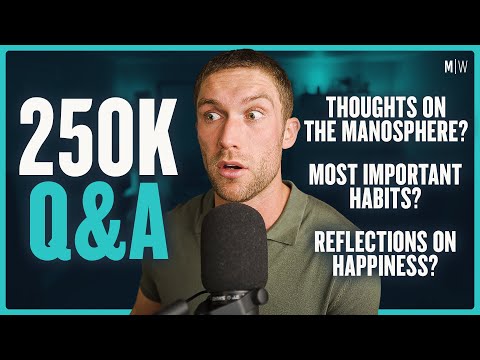
250k Q&A - Habits, Happiness & Red Pill
Chris Williamson (host), Narrator
In this episode of Modern Wisdom, featuring Chris Williamson and Narrator, 250k Q&A - Habits, Happiness & Red Pill explores chris Williamson on growth, integrity, and designing a meaningful life Chris Williamson celebrates reaching 250,000 YouTube subscribers with an extended Q&A covering podcasting, personal growth, online culture, and ethics. He reflects on how he chooses guests, resists audience capture, and manages creative decisions under public scrutiny. The discussion ranges from lighthearted hypotheticals to serious topics like COVID commentary, the treatment of non-offending pedophiles, the red-pill space, and the tension between self-acceptance and ambition. Throughout, he emphasizes deliberate life design, action over consumption, and building impact while protecting integrity and mental health.
Chris Williamson on growth, integrity, and designing a meaningful life
Chris Williamson celebrates reaching 250,000 YouTube subscribers with an extended Q&A covering podcasting, personal growth, online culture, and ethics. He reflects on how he chooses guests, resists audience capture, and manages creative decisions under public scrutiny. The discussion ranges from lighthearted hypotheticals to serious topics like COVID commentary, the treatment of non-offending pedophiles, the red-pill space, and the tension between self-acceptance and ambition. Throughout, he emphasizes deliberate life design, action over consumption, and building impact while protecting integrity and mental health.
Key Takeaways
You don’t need to feel inadequate to pursue self-improvement.
Williamson argues that growth should come from wanting to make the most of limited time, not from a belief that you’re broken; progress won’t fill an inner void unless you already regard yourself as ‘enough’.
Get the full analysis with uListen AI
Resist audience capture by staying within your competence and values.
He’s deliberately avoided taking strong COVID stances because he lacks the expertise and believes many creators are leaning into polarizing positions purely for clout, plays, and money.
Get the full analysis with uListen AI
Treat creative work as long-term skill acquisition, not instant performance.
New creators should accept being ‘white belts’, expect to fail repeatedly, and see early missteps as necessary reps rather than evidence they shouldn’t be doing the work.
Get the full analysis with uListen AI
Design friction against tech addiction with simple, structural changes.
Strategies like keeping your phone out of the bedroom, time-bound ‘phone fasting’, removing apps from the home screen, disabling search, and using a separate, Wi-Fi-only social phone can radically change your relationship with technology.
Get the full analysis with uListen AI
Focus on execution over endless consumption of self-help content.
He warns that podcasts and books can become sophisticated procrastination; choosing one clear priority and ruthlessly culling non-essential efforts is more powerful than broad, unfocused learning.
Get the full analysis with uListen AI
Criticism, even when uncomfortable, can be a powerful growth tool.
Williamson describes how being critiqued by ‘Decoding the Gurus’ was painful but ultimately improved his interviewing, skepticism, and preparation—he now actively seeks and applies substantive feedback.
Get the full analysis with uListen AI
Moral nuance requires empathy even toward highly stigmatized groups.
He argues that non-offending pedophiles, who recognize their attractions as wrong and don’t act on them, need some societal sympathy and integration, despite the topic’s deep discomfort and unpopularity.
Get the full analysis with uListen AI
Notable Quotes
“You do not need a feeling of insufficiency in order to motivate yourself to go and become a better version of yourself.”
— Chris Williamson
“This progress is not going to fill the hole that you feel inside of yourself. That hole can only be filled by you feeling like you are enough already.”
— Chris Williamson
“You do not need to live your life by default. You can live it by design.”
— Chris Williamson
“A criticism that has value in it is a gift.”
— Chris Williamson
“It is easier to theorize than it is to do the practical work, so most people theorize most of the time.”
— Chris Williamson
Questions Answered in This Episode
How can someone practically start shifting from a ‘life by default’ to a ‘life by design’ without becoming overwhelmed?
Chris Williamson celebrates reaching 250,000 YouTube subscribers with an extended Q&A covering podcasting, personal growth, online culture, and ethics. ...
Get the full analysis with uListen AI
Where is the line between responsible platform use and audience capture, and how should creators know when they’ve crossed it?
Get the full analysis with uListen AI
What structures or support systems could society realistically build to handle non-offending pedophiles in a way that’s both compassionate and protective?
Get the full analysis with uListen AI
How can ambitious people calibrate their drive so that they still pursue excellence without relying on self-loathing as fuel?
Get the full analysis with uListen AI
In what ways does the red-pill/meninist space help men understand evolutionary psychology, and where does it slide into gratuitous hostility toward women?
Get the full analysis with uListen AI
Transcript Preview
You do not need a feeling of insufficiency in order to motivate yourself to go and become a better version of yourself. You can do that simply because you want to become better, simply because your time on this earth is limited, and in that time, you want to make the most of your minutes here and leave the world in a better place than you found it. That does not mean that you need to feel terrified and insignificant and broken and fragile and insufficient without making progress. This progress is not going to fill the hole that you feel inside of yourself. That hole can only be filled by you feeling like you are enough already. (whoosh) Hello, everybody. I'm back. I'm back. I made it. I made it back from Austin all the way to the UK. That flight nearly destroyed me because it was 24 hours basically without any sleep, but I managed to catch up and woke up to find that we'd hit 250,000 subscribers on YouTube, which is good news. It's the- that was the outcome goal, the one outcome goal that we had for the channel this year was 250,000 subs before Christmas. We've done it with three days, four days to spare, so still considering it a win. As is tradition, thought that I would do a Q&A episode and there were a lot of questions, so I'm very sorry if I didn't get to yours. Either I haven't had time or it wasn't interesting enough. So, uh, yeah, let's get into it. George Mack, "What podcast, yours or others', have you re-listened to the most?" Naval on Joe Rogan. That podcast, it's the best podcast of all time as far as I'm concerned. It's absolutely phenomenal. If you haven't listened to it, go and check it out. Naval just drops calm, mind-blowing wisdom for a couple of hours and then leaves and then says, "I'm not going back on for a long, long time because I want to have new thoughts." The guy's ... like he's just such a p- force of nature. Awesome, awesome episode. Sam Flett, "Any thoughts on how you approach political arguments these days? Just seems pointless debating anything regarding politics, gender, race, et cetera as everyone is convinced they're right." Yes. Humor is a really, really good tool for this, and this is only something I've realized recently that if you try and take it too seriously, and I'm aware that these can be serious topics, but if you can approach them with a little bit of humor, people are ... it- it allows a let-off valve for all of the people in the conversation. It stops it from getting too serious. So whenever I- I don't talk about it that much. It's a culture war issue, but in- outside of the show, I'm not really that bothered. Like, it's- it is a big cost that you have to pay and I'm not very interested in the outcomes, at least not personally. So use humor, like remember that it's just a game and everybody is going to die and in three generations no one will remember your name. So taking anything too seriously seems a little bit dumb, especially stuff which isn't directly applicable to you. Like these are group dynamics that you're talking about here. So remember that it's all a game. Paul Campbell, "Have you felt compelled to share your stance on how COVID has been/is being handled? Vaccinations and lockdowns and masks and more. It seems many of the podcasters have diverted their content toward this topic more than Modern Wisdom. And are you going to break the Spotify app with five-star ratings now that Spotify podcast ratings have been launched?" Okay, so second question first. Yes. Uh, if you haven't checked your Spotify app, you can now rate. You can give star ratings like an Apple Podcasts on Spotify. So if you haven't done that already, please find Modern Wisdom and go and give me five stars. That would make me very, very happy. And I want to hit 1K because we've got a thousand s- reviews on Apple Podcasts and I need the same on Spotify. So go do that. Link will be somewhere. Uh, have I felt compelled to share my stance on how COVID has and is being handled? So yes, what you've seen is a lot of podcasters have become what's called audience captured. So they have found that they can get clout and plays and money through plays by leaning into either a pro or an anti-vaccine, pro or anti-lockdown message. The whole COVID thing to me is ... it would take an awful lot of research to have a sufficiently well-researched opinion. The background reading that I would need to do in order for me to get to the level of competence and understanding around COVID that I would need is higher than I'm prepared to put in. And there are so many other podcasters out there that are leaning into this topic. Plus it just seems like the- the information is very, very difficult to parse. David Fuller from Rebel Wisdom has done more reading than pretty much anyone that I know on the planet and even he still has questions around this. So yeah, I've purposefully kind of steered away from that. If a guest wants to talk about it, I'm happy to have a chat, but I- I don't fancy adding more noise into the tiny, tiny amount of signal that's out there about COVID. Like I ... not an epidemiologist, I'm not a virologist. I don't understand publi- public health. I have my own opinions, but this is quite a serious situation. So I think, you know, letting the experts speak, at least on this one, like this is the one that I cannot give my cod psychology bro science opinion on. I'll leave, leave the experts to this one. Terry The Tuff Cunt, "Someone somewhere sometime did the biggest fart in the history of humanity. Question, what country and what era do you think they were from? Guesses on duration." I love everything about this question, including the name. Um, what country, what person and time would have had the most ... Well, it's got to be modern day, I think. More processed foods in the modern day.I mean, there's some, there's some big boys in America. I saw some big boys while I was traveling. Um, but then they eat lots and lots of greens in somewhere like Japan. And you could imagine some little Japanese grandmother just cracking out a big one. Just a big fat one out of nowhere. Uh, I'm gonna go with the, I'm gonna go with the little Japanese lady. I'm gonna say modern day Japan, like one of the... Just a village in Japan. Uh, guess is on duration? Well, what, what are you looking for here? Is the biggest fart how long it went for? 'Cause she could have just squeezed a little one out for a long amount of time. Or is it a... Is it the volume of gas that's left out? Or is it the size of the noise? Is it how loud the, the actual fart itself was? Um, if I was gonna say duration, I can't see how much longer than about a five second, five seconds of actual gas passage. I don't think that you can beat that, so I'll say five seconds. Could have heard it... Easily could have heard it next door, maybe two houses away. Uh, Japanese lady. @realpauldano, "Do you regret talking to Gad Saad after the gurus pod?" So, for people who aren't aware of what any of this means, there is a podcast called Decoding the Gurus. They featured an episode that I did with Gad Saad, and they had some, uh, less than complimentary things to say about it. Uh, and then I went on the- their podcast to do a right of reply and kind of explain my position and stuff, and that, that seemed to go down really well. Uh, I was really happy with the, with the response to people, to my response. Um, I don't regret speaking to Gad at all, no. That whole process of being featured on Decoding the Gurus and then speaking to the guys afterwards has been really, really valuable. I mean, it wasn't very comfortable. It was... Like, it's not nice to have someone critique something that you really, really care about. But some of the things that they brought up have led me to become a better podcaster. So, I- I'm all for it. The ends justify the means, even if the means were kind of pretty shitty, at least in terms of my experience. Aaronhasherpes, "What do you feel has been the formula/circumstances that significantly increased your popularity on YouTube?" Man, I don't know. A- again, fucking what a, what an absolutely awesome username. I don't know where we're at with YouTube at the moment. It still feels... I- I'm a bit biased, right? But I think that Modern Wisdom is hopelessly under subscribed, and press subscribe obviously if you haven't done already. But like, I really, really... I've always loved the conversations. I've always loved the guests that we've had on here. If I wasn't running this show, I would subscribe to it, and that's why I've made it. Um, when I look at some of the stuff out there that is crushing it in terms of plays, I do sometimes think like, "What are we missing?" I don't know what it is. I know that we've... We're doing well, and a quarter of a million subs is nothing to sniff at. But maybe it's just a case that we're playing catch up. Uh, maybe the difference... I feel like there's a difference between the quality of the content, the quality of the conversations, and where the channel is at. And I feel like that there's still a lot of low-hanging fruit for us to pick up. But the biggest difference this year has been that we got really serious about clips. We did a rebrand, so all of the thumbnails look really nice and beautiful, and they're all consistently designed so that you can kind of get this signature style. You know that it's us. Just simple stuff. And then, you know, continuing to pick up good name guests, but then, you know, you look at an episode like Vincent Jaramillo or Adam Lane-Smith. These guys are essentially nobodies, right? Internet, in terms of internet clout, they're nobodies. You put them on the internet and have an awesome conversation with them and it absolutely bangs. So, focusing on clips, making sure that we were consistent with that, improving the quality of the thumbnails, just like little things. But personally, I'm hoping that there is a... We feel like we're in a hockey stick, right? I'm really hoping that this just is the very beginning of the hockey stick and we've got tons of headroom above. Also, if you want to help, just comment for the algo. In fact, you can comment commenting for the algo. Just do that. Whenever you see an episode, just click on it and, and comment, and then we can speed up this manipulating of YouTube's algorithm in a completely unethical way. AlanaMarie1, "Why is it so stressful to try and niche down?" Good question. So I'm guessing that this is someone who's a creator. What she's referring to is that when you begin a channel, often gids (sic) -given advice is that you're supposed to niche down. You're supposed to find a particular microcosm of a broader subject area, and you're supposed to really, really focus on that, because it means that you can find love within a community very quickly. The reason that it's so stressful to do that is that by choosing to do one thing very, very tightly, you're choosing to say no to all of the other things that you could be doing. So that causes you to... It's just FOMO, basically. You're looking at all of the other topics that you might be able to do and thinking, "Oh, well, by, by focusing on fitness, that means that all of my insights about fucking cryptocurrency, they- they're not gonna work." Or, "Because I'm gonna do things to do with cooking at home, that means that my dog walking content is gonna go down the pan." So, you need to give up one thing for another thing. You... By niching down, you are inevitably saying no to a whole bunch of other stuff, which is why choosing the niche is really important. But that being said, I'm not the best person to speak to about niches. I just stuck my middle finger up at niches and decided to speak to, you know, a porn star and a philosopher and a psychologist and a whatever back to back to back. Um, so personally, depending on what the type of content is, I think that you can get away with rapid growth without niching down. And if you want to do it, you are going to suffer some stress, especially if you have a wide range of interests, 'cause you're going to see all of the things, that interesting buffet of options that you are not choosing to look at.adamdixon95. (text plops) "Do you limit your phone use, and if so, what strategies do you use?" Yes, I do. Massive into phone reduction and tech reduction. So, sleep with your phone outside of your bedroom, don't use your phone before a certain time and don't use it after a certain time. So, like, intermittent fasting for your phone. All of the apps off your main home screen. Remove Siri search so you can't search for it. Uh, and ... What's the other one? Mm. There is another one. That, I mean, uh, do that, do those things, and you will change, you will have a, a hugely redefined relationship with your phone. Oh, take social media off your main phone and get ... I have a second phone which is for Instagram and Twitter and stuff, and that is wifi only. So when I go out of the house, I can't use social media. Um, those, those'll make a huge difference. Even just sleeping with it outside of your room and the don't use it before a time and don't use it after a time, that's a game changer. MindfulMitch. (text plops) "Would you rather fight a Komodo dragon or a drunk pit bull?" (sniffs) Do you mean, do you mean Pitbull, the rapper, drunk? Or do you mean a dog which has been inebriated? Because Pitbull the rapper kind of looks like he's drunk all the time, and I ... I don't know. I feel like a drunk pit bull dog would make it easier to fight, and I think a Komodo dragon is already pretty ... Uh, gimme pit bull. I want, I don't want ... Because you've been insufficiently precise with your language here. I don't want a drunk Pitbull the dog. I'll take on Pitbull the rapper, drunk any day of the week, and then I'll feed him to the Komodo dragon once I'm finished. (sniffs) "Anything that would make your life more fulfilling right now?" from jojomclaff. Um, more impact, I think, would be, is gonna be one of the things that I push for next year. Um, I really want to use ... We've worked hard at building a platform, right? And although I still feel like we're hopelessly undersubscribed, the, we get to reach, you know, a few million people a month. And I really want next year to try and push a lot to do things that optimize for impact and optimize for making people's lives better. Uh, I did a free end of year review template process thing, which you can get if you haven't done your end of year review yet. It'll appear up here at chriswillex.com/review. You can go and get it for free. Um, and that was cool. People messaged me and said, "Hey man, just wanted to let you know I've finished the end of year review. I've got really clear about the things that I want next year." Uh, and it made me feel very, very cool. So more stuff like that, more high impact things. But life's pretty fulfilling as it is. So yeah, if, if I can beat where I'm at at the moment, I'll be pretty impressed. connbavedas, "What is something that motivates you to make content? I've been watching you for some time now, and it seems very grueling and intimidating to get interviews and put out podcasts when you're just starting. How did you cope with that and work through it?" Um, there's two, two separate questions here. So motivating me to get through the grueling side, and then intimidating when you first start. Uh, intimidating when you first start, just don't take it too seriously. Know that you're ... Basically go, you're a newb, right? You're a white belt at whatever it is that you're trying to pursue. So just treat it like that. Okay, you're gonna mess up more times than you're successful for the first however long that you do whatever your pursuit is. You know, let's use content creation for that. But it's the same with anything. You're gonna fuck up over and over and over and over again. Just accept that. "Okay, this is just another lesson that I need to add to the pile." And every single time that you get one of those, it is one time fewer that you're going to make a mistake in future. So that would be ... That, that's exactly how I saw it when I first started. Like, it's skill acquisition, and this is a skill which is incredibly complex and lots and lots and lots of people are very, very good at. And if I compare myself to them, then I'm going to feel, like, terrible. Uh, and then something that motivates me now, I guess, to keep going is ... It's like a habit, man. Like, if I didn't have two to three conversations for a couple of hours per week, I would feel like there was something wrong. I would feel like, uh, uh, I don't know, like I'm thirsty and need a drink, but the drink is a conversation. It's just, it's sh- it shows the power of routine. Look at a really punishing schedule, which I still find difficult, and yet when you slowly build it up over time, you go from one a week to two a week to three a week, plus guesting, plus editing, plus clips on YouTube, plus content on YouTube, plus the newsletter, plus everything else. Like, you just get there step by step. And that's the whole it takes 10 years to become an overnight success thing. You look at people that have been doing whatever it is for a long, long, long time, and you think, "God, they seem almost superhuman." And you don't realize that all that they've done is taken some very, very, very slow steps over time, consistently, and they get there. And to them they're just like, "Oh, this is just what I do." Like, yeah, I've ... I'm all right at this. But yeah. Slowly, slowly. That's the way to do it. Uh, m- (text plops) ml- mlaycock, mlaycock23, "Loved your openness to chat and learn with Decoding the Gurus. Very refreshing." Thank you. Yes. I was the first person, uh, actually that had asked to go back on to go and have a chat with them. That was one of the more, um, not stressful, but I was excited. Like, I was really, really excited to go and speak to them, uh, and, and sort of put myself up against two guys that are ... They can be quite disagreeable. They're smart dudes. They're quick. Um, and I was looking forward to having a conversation, and it was ... It went better than I think any of us could have hoped. And me and Chris Kavanagh, the host of Decoding the Gurus, had already had this big three-hour chat, so I al- I already had a sensation that it could be really good and, like, a really amazing episode, and it ended up being great. So, I appreciate the guys for being good sports and letting me come on.... inexorable. What belief/beliefs do you hold that you suspect your subscribers would most disagree on or find surprising? (sighs) So, I've- I really got changed by the conversation I had with Andrew Gold when he spoke about spending time with pedophiles and pedo-criminals, uh, the difference being that pedophiles are attracted to children and pedo-criminals act on it. But the pedophiles don't. They sort of understand that their sexuality is something which they can't act on. And, um, just increasingly, the more that I learn about that section of the world, people who are born with an attraction to children and choose not to act on it, but are still- they still feel incredibly alienated from society and, you know, unsurprisingly... The belief would be that pedophiles, it seems to me like they need a- they need sympathy. Um, you know, we- we need to find a way to make these people that don't choose to act on their impulses, but they- they are working hard to try and control something which they've just been cursed with... You know, they didn't choose their sexuality. You do not get to choose what you are sexually attracted to, and yet somebody who's working so hard simply to try and not do something that they know all of society is going to hate them for, but then finding out that they- they're alienated and, you know, lambasted by all of society, like, it just- it makes me feel real uncomfortable. I don't know what the solution is either, and, like, we should be understanding of people who aren't acting on their impulses but do find children attractive, is... I mean, that's not a particularly popular line of thinking, uh, and, you know, people that read tabloids, it's quite easy to, like, "Lock 'em up, lock 'em up! Fucking nonces." And you go, "Well, yeah, the ones that act on it, I'm happy to castrate them. But the ones that don't, like, they didn't choose to be this way." And this, uh, th- that's just my empathy kicking in that I really struggle to just imagine that. Like, imagine that that was the way that you were born, that that was what life had gifted you as your sexual proclivity. Could have been gay, could have been straight, could have swung both ways. No, had to get given this. And yeah, it- that's something that increasingly, I think, will be more and more of a conversation, right? We need to integrate people into society. So, that would be one. Jake Rok, "Thots on Bitcoin." Uh, so I think this is supposed to be "thoughts on Bitcoin," but you've spelled it as "thots," so I'm going to talk about thoughts on Bitcoin, and yes, you are right. There are loads and loads of girls that look like they should be on OnlyFans that promote crypto and NFTs. And w- what you're seeing there is basically decentralized OnlyFans. All that you've got is girls who are fit with big Instagram followings or big Twitter followings talking about NFT drops and stuff, and then guys that want to simp for them are buying these NFTs or investing in this crypto thing, hoping that they're going to get attention from the girl that talked about it. So, that is my thoughts on thots on Bitcoin. Sam H Smith, "Do you think that the podcast space develops ideas or does it simply propagate the ideas that individuals have on their own?" That is a fucking great question. Um, this has come from The Locals, by the way, which has some terrifyingly smart people in. Modern Wisdom Locals is like, I don't know, a radically sensible group of cultists. Um, does this... So, I definitely think that there's new things that come out of it because when two people are putting their ideas forward and they're focused on the conversation in front of them, they can end up synthesizing things in a new way. For instance, (sighs) yeah, for instance, I had a conversation with Vincent Haranam a little while ago and neither of us said it, but both of us realized that one of the implications of having a vast class of, uh, underclass of sexless men and women who are struggling to find a partner which is up and across their dominance hierarchy, one of the potential solutions, probably one- an unpopular one, would be to have one woman, uh, sorry, one man with many women and just pick the men that are the- they've got the most status, the- the Elon Musks of the world, right? He can fund the lives of 30,000 women the same as one millionaire. Now, I'm not proposing that as an idea. However, that was something that neither of us had thought of before that podcast. So, I do think that it develops ideas. However, there is a lot of just regurgitation, and I see this in myself, right? Like, I'm having a conversation with somebody about something, they bring up a topic, and I have my answer, I- I have the line that I've- I have said in the past. So, good podcasters try, when that comes up, to reassess, "Okay, sh- do I just release the same sequence of words that I usually do, or should I try and assess whether or not I have a new insight around this?" And that's really, really difficult, especially if you're podcasting multiple times per week, because you don't have a bottomless pit of things to tap into, you know? You're not this endless well of insights, so you are going to repeat yourself. Um, however, I think that there are some new things that come out of the podcast space. How many people act on them and make changes in the world because of it? It's probably a bit of a different question. Uh, Hawaii Escape Co, "Did you know the Petersons were going to recruit you to teach? What will you teach?" Uh, so that isn't my announcement about the Petersons. I'm afraid that that's a swing and a miss for Hawaii Escape Co. Uh, that's not what's happening next year. ButterflyBasher, "Just curious, can't find any interviews with women on the scroll down of your page."... do you only talk to men and is that on purpose/what you've based your podcast on? Uh, you haven't looked hard enough, I'm afraid. There are many interviews with women on there. Anna Lembke this year has been one of the most played. Um, however, it is much easier to find men who want to say yes. Uh, the public intellectual space is still dominated by men. If you look at most of the people that are writing nonfiction in the areas that I talk about, it is dominated by men, so there is a skew that way. Uh, and being honest, it is easier to get men to say yes to come on the podcast. I don't know why, but my strike rate with getting guys on is easier. Uh, I definitely don't have... I'll have my biases I'm unaware of, but there's no... I don't think, "I'm not going to get that person on because it's a woman." I'm going out of my way to try and find interesting women to speak to. But, you know, if you've got suggestions, if you have... Uh, this is the same thing I always say, whenever someone pipes up and says there's not enough of whatever type of person, my first answer or my question back is, "Who would you suggest? Who do you want from the subgroup? So if you can't find interviews with women on the podcast, what women would you like me to speak to?" Tell me and I'll get their emails and I will reach out to them if they're interesting. Zero Gratification: favorite Bring Me The Horizon song/era? Fucking great question. Uh, probably Sempiternal's got to be the album, um, because that was just... That, that entire live show was amazing. The production was phenomenal. Me and my buddy Mark went to go and see them at Manchester, maybe at the NEN, I think. And it was just, it was outstanding. And then, or was that Drown? Was that, uh... whatever the one with the umbrella was? I don't know. But that and probably Avalanche, favorite song. Politically Homeless: how can you bring in new people that may not be on the radar but who have ideas that deserve to be explored? This is a fucking awesome question as well. So increasingly now, as the show grows and as we do more and more plays and get more and more reach, this is... This shit fires me up so much, finding someone that is an absolute animal and doesn't yet have a platform, and now I can be that person who can take this little unknown rough-hewn diamond and just give them enough, uh, boost, boost that signal, and they can go and absolutely smash it. So Adam Lane-Smith is a perfect example of that from this year. He did this awesome Twitter thread. I saw it, I said, "If he can podcast one fucking tenth as well as he can tweet, this guy's going to be an animal." Sure enough, came on, smashed it. Second most highly played episode of the year, which is behind... It's Jordan Peterson and then Adam Lane-Smith, nobody, psychotherapist from the middle of Fuckno's Bumfuck. And that, that gasses me up so much. It's so interesting, so cool, that I can now be a magnifying glass or a megaphone for people who really deserve it, who've got talent but just haven't managed to find a platform. Vincent Jaramillo is the same thing. Lauren Johnson, that, um, mental performance coach who worked with the New York Yankees for years, exactly the same. And then Adam goes and does Mikhaila Peterson's podcast and launches a course and does a bunch of other things. Lauren Johnson, after she did me, she went and did Ben Bergeron's show. Uh, Vincent Jaramillo. Jordan Peterson has reached out to me and said that he wants an introduction to him after the episode that I did. So it's, it's so cool. Like, that's the best thing. And it's, it's weird, because I can still remember the time, you know, when you begin a podcast where you're desperately asking for other people's assistance to grow your clout. And that's, you know, not to say that I'm not still doing that. But I can be that person now for other people, and that's like... it's so dope. Lyndon: wonder if you think there is a small town mentality in the Northeast that keeps a lot of people from venturing very far, both spiritually, mentally, and physically? Yes, absolutely. I mean, this is probably the same anywhere, right? Small town mentality, people that are born, live, and die here, they find their partners here, they get married here, they have their kids here, their kids maybe even go the same school that they did or they're in this similar sort of catchment area. It's probably the same all over the world, but it's a part of the Northeast that makes me, like, kind of uncomfortable. It's like, it... the small mindedness is, is my least favorite part of it, and I go out of my way to find... If you look at the list of friends that I have that are from the Northeast, they're people that you wouldn't think were from there. And that's not to say that there's nothing, that there's something wrong with a small town mentality, but it's not the sort of life that I want to live. And that means that if I'm not careful, I'll start to adopt a bunch of values from people that I don't want to inculcate myself. So yeah, it, it absolutely does. And if that's you, if you're around those people, then just find yourself a new community of people. They are out there. It's a little bit more difficult to find in, you know, spit and sawdust, salt of the earth, working class towns, but they're there. Ryanjiham, Ryanham, (laughs) uh, have you ever, have you ever had a guest who was that much of a dickhead that you had to not air the episode? So I've never had someone be a dickhead, but maybe one in 50 just don't go very well, and I'll choose to not air it for a couple of reasons. Firstly, it doesn't show the guest in a good light.Like, if, if I have a conversation with someone and it's just not that interesting or they're not in that game or they're not making sense, like, it's not good for them. So let's say it's for, through a publisher or it's for their new book or whatever, it's not good for them to have that content out there. And you guys dedicate, you know, an hour or 90 minutes three times a week to the podcast. And although I could hopefully ride the waves of a few months' worth of, like, subpar episodes and you would still come back and listen to more, and I am conscious of the fact that there is a, a high competition for people's a- attention online, and you're really only as good as the next thing that you put in front of your audience. And yeah, over time, hopefully the loyalty that's being built up means that people have confidence in me even if there's an episode that isn't quite for them. But I do try and avoid that. Like, it is one really good way to cannibalize your own audience very quickly, is to just put out a bunch of shit episodes or a bunch of, of shit content. Um, so yeah, there's maybe one in 50, so, like, what's that? 2%. Like, a 2% failure rate on bringing people on. Uh, and the most annoying thing about it is not only obviously I've taken up the guest's time, but, like, it was them that was the shit guest, so it's not my fault. Uh, the worst thing about it is that I've taken up a slot recording with that person, which means that I now need to record four the following week just so that I can keep on with the same publishing schedule. And if I'm already behind or if I've maybe only got one booked in this week, I'm like, right, okay, so that's a five-day week next week for me to record in order for me to just stay on track with how many I need in the bank. Abby Swan, "Do you think you'll ever do any live events like James and Diran, et cetera?" Uh, yeah, I'd love to. Seeing James Smith, who is a fitness PT guy from the UK, for those of you who don't know, uh, and Diran Cartel, who's, like, his other half, um, they both do live events around their books, around their courses, or around just things that they've been talking about. And watching that live is powerful. It's really cool. Uh, so I would love to do that. I don't know whether we're at the stage whether that's realistic. Um, there's a few conversations being had behind the scenes about some cool shit that we might do over the next year to 18 months. Um, and if I was to write a book, then I would almost definitely try and do a live tour off the back of that, just because it would be awesome to speak about it in front of an audience and then get audience feedback. Um, yeah, it's, it's fun. I don't know... I don't know that there's probably gonna be any bigger of a buzz than to talk about something that you genuinely care about on stage in front of a group of people who all know you, who all are built similar to each other, who are familiar with your stuff. Uh, like, the, the way that you must feel after you do that is, is amazing. Next up, Jack Dankiels, "Do you consider jacking off to be a sport?" Uh, depends how frantically you do it. Like, vigorous, vigorous fapping would make for a high intensity workout, but it's probably going to be pretty short, um, and also perhaps dangerous. But... "Do you consider jacking off to be a sport?" I wouldn't like to see the channel that tries to commercialize that. You know, if we get, you know, in th- these dystopian futures 500 years in the future and all of society's just descended into this limbic hijack gray hell, um, when jacking off becomes a sport, I think we can just... The simulation can just get turned off. Like, that's, that's the final horseman of the apocalypse, when jacking off is a sport. LJ 22, "You've mentioned before that it is difficult for content creators who are learning their craft and building a following to keep to a path signposted by the moral compass when there are so many incentives to plump for audience capture instead. Now that you've reached 250K, which do you feel has potentially been dialed down more, the devil's on, devil on the shoulder that tells you to, uh, tells you that the data on a larger group of people would allow you to grow the channel at a faster rate by giving them what they seem to respond to best, or the angel on the shoulder that says that the larger audience now allows you to potentially play with a narrative that could challenge people to listen to views across the aisle, e.g. David Pakman, or to a more rounded set of contributors, e.g. Patrick Moore, Eisenstein, Richard Betts? Ultimately, do you feel more compelled to grow by giving the people what they want, or more freedom to challenge the audience you have built, or neither, or both?" Uh, this is a fucking sick question. It's another one that's come from the locals, as you can tell. Um, fuck, this is so good. (sighs) I would be... I, I don't think that audience capture right now is something that I need to be too worried about. Like, I'm... My integrity is sufficiently high at the moment. (laughs) It might change in future. But I'm concerned about having interesting conversations with people. I'm concerned about trying to have optimizing for impact next year, you know, really, really trying to add to people's lives, having, making them listen to conversations that's awesome. That being said, bringing someone on like a David Pakman that challenges views heavily for an audience that has become... that has started to expect a particular style of argumentation, that requires a really... The only people that are really, really interested in that are super, super academic or really, really intellectually minded, or people that go out of their way to find that sort of stuff. And it's going to take time for me to gently introduce that sort of content that's like, "Look, the whole purpose of this episode that you're about to listen to is to kind of make you feel a bit uncomfortable or to challenge your current understandings and your current beliefs." So...I would really love it if I get to the stage where I understand exactly what works in terms of still continuing to grow the channel, because, you know, we want to hit a lot more subs than we've got, whilst also being able to bring on people that challenge, um, everyone's existing ideas. Um, that's... The more and more that I get feedback from the audience, from you guys, the more that you comment, the well-meaning ones, not the ones that are just like a- a- an emoji of boobs, like where you do the, you do the two brackets and then you do the nipples with full stops, and a capital Y. Like, the- the really good comments, (laughs) they help and the messages really, really help because they help to direct me toward what is, what is working and what's not. But I can't have conversations that don't land. You need to have conversations that actually grow the channel or else what's the point? If you're just stuck at, whatever, that's a quarter of a million, that's the most that you're ever gonna get, that's- that's not good enough for me. I'm leaving too much on the table. So, I think over time, the challenges of a creator change. As you get bigger, there is a combination of more responsibility, but also more freedom to be able to speak to different people. Um, I don't like the idea that there is... I don't like someone thinking that there is any sort of limitation on who I can or can't speak to, but realistically, there is going to be people out there, you know, the Charles Murray's of this world who wrote The Bell Curve, bringing him on comes with a whole imp- load of baggage, even if there's equal sides contesting whether or not that baggage is true. I'm like, oh, okay, right. So I need to go and research whether or not this guy is as bad as people say he is, and that's contested, and then if I bring him on, I have to have a conversation where, do I bring up his old stuff that we're not sure if it's true or not sure if it's bad or not sure if it's good? It's- it's a difficult one. And increasingly, it's kind of becoming politicized even in the creative space. We saw this with the Decoding The Gurus thing, right? But, yeah, I think over the next year, hopefully continue to do what we've done this year. I think we've had a relatively well-balanced conversation. There's been people from the left and the right, there's been people that have been pro and against. I don't want to have to do that for everything. I don't want to bring someone on that's pro one position and think, "Right, here we go. Here's a series of conversations about fucking abortion or whatever, because I've decided to bring one person on because I thought that they were interesting." Um, but I also think that having that impulse, just having that reminder, it- it keeps me, not in the straight and narrow, but it keeps me moving in the right direction.
Install uListen to search the full transcript and get AI-powered insights
Get Full TranscriptGet more from every podcast
AI summaries, searchable transcripts, and fact-checking. Free forever.
Add to Chrome