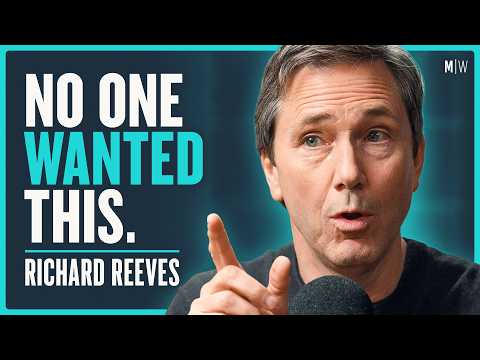
The Masculinity Debate Is A Huge Mess - Richard Reeves
Chris Williamson (host), Richard Reeves (guest)
In this episode of Modern Wisdom, featuring Chris Williamson and Richard Reeves, The Masculinity Debate Is A Huge Mess - Richard Reeves explores reeves and Williamson untangle men’s issues, politics, and modern masculinity narratives Reeves argues the boys-and-men conversation has moved into real political space, citing new gubernatorial initiatives and Congressional bills aimed at men’s health and post-fatherhood mental health support.
Reeves and Williamson untangle men’s issues, politics, and modern masculinity narratives
Reeves argues the boys-and-men conversation has moved into real political space, citing new gubernatorial initiatives and Congressional bills aimed at men’s health and post-fatherhood mental health support.
Both speakers criticize grievance-driven activism and “deficit framing” (e.g., toxic masculinity, deadbeat dads) for alienating young men and creating a vacuum filled by polarizing influencers.
They contend the core cultural message to young men should be “we need you,” not pity, and that fatherhood and service provide pro-social purpose that society under-recognizes.
The episode challenges common claims about gender dynamics—such as women’s workforce participation causing fertility decline—and emphasizes timing, perceived readiness, and shifting norms as major drivers.
Reeves advocates “boring, institutional” solutions (education, mental health access, male teachers, fatherhood supports) and a calibrated optimism to avoid self-fulfilling pessimism.
Key Takeaways
The boys-and-men issue has entered mainstream policy—now accountability matters.
Reeves cites executive actions (e. ...
Get the full analysis with uListen
Grievance communities often resist progress because success threatens identity.
They discuss the idea that activists can be “psychologically reluctant to succeed,” leading to dismissal of imperfect wins and perpetual escalation (“slaying smaller dragons”).
Get the full analysis with uListen
Stop framing men as the problem; frame them as needed contributors.
Reeves argues young men respond better to “we need you” than to pity or blame; this supports engagement without encouraging victimhood and aligns with civic-service needs (mentoring, coaching, youth programs).
Get the full analysis with uListen
Language choices shape trust—‘masculinity’ has become pre-loaded with condemnation.
Because many young men hear “masculinity” mainly in “toxic/healthy” constructions, even neutral talk can sound accusatory; better conversations require careful vocabulary and less moralizing tone.
Get the full analysis with uListen
The ‘feminization’ debate misses the real labor-market issue: where jobs are growing.
Reeves disputes claims that professions like law deteriorated due to women’s presence, but flags genuine feminization in K–12 education, social work, psychology, and healthcare—areas where more men are needed as the economy shifts.
Get the full analysis with uListen
Fertility decline can’t be reduced to women working; timing and perceived readiness are central.
Reeves notes female labor-force participation rose sharply while US fertility did not fall in parallel during key decades; they emphasize delayed first births, shifting “vitality curves,” and rising subjective prerequisites for parenthood.
Get the full analysis with uListen
Fatherhood is a uniquely powerful pro-social ‘male institution’ worth defending on its own merits.
Reeves rejects both the ‘dad is useless early on’ view and the ‘paternity leave only for gender equity’ rationale, arguing fathers matter to children and communities and should be supported accordingly.
Get the full analysis with uListen
Notable Quotes
“I can’t credibly say anymore, ‘No one’s paying any attention to this.’”
— Richard Reeves
“Activists are always psychologically reluctant to succeed.”
— Richard Reeves (citing David Wolpe)
“We need you… not despite being a man… we see you being a man as a feature, not a bug.”
— Richard Reeves
“We used to inform men how to be men by telling them everything they shouldn’t do.”
— Chris Williamson
“It is much less about the wife you choose than it is about the husband you become.”
— Richard Reeves
Questions Answered in This Episode
What specific metrics should be used to judge whether initiatives like Newsom’s men-and-boys executive order are succeeding (and on what timeline)?
Reeves argues the boys-and-men conversation has moved into real political space, citing new gubernatorial initiatives and Congressional bills aimed at men’s health and post-fatherhood mental health support.
Get the full analysis with uListen AI
Which policy changes would most directly improve boys’ literacy and school engagement without treating boys as inherently ‘defective’ learners?
Both speakers criticize grievance-driven activism and “deficit framing” (e. ...
Get the full analysis with uListen AI
If ‘masculinity’ is linguistically poisoned for young men, what alternative terms or framing can institutions use without sounding euphemistic or patronizing?
They contend the core cultural message to young men should be “we need you,” not pity, and that fatherhood and service provide pro-social purpose that society under-recognizes.
Get the full analysis with uListen AI
How big is the looksmaxxing/body-dysmorphia problem in measurable terms, and what interventions would be most effective for boys versus girls?
The episode challenges common claims about gender dynamics—such as women’s workforce participation causing fertility decline—and emphasizes timing, perceived readiness, and shifting norms as major drivers.
Get the full analysis with uListen AI
Reeves argues jobs growth is in healthcare and care work—what would a realistic pipeline look like to recruit men into those fields at scale?
Reeves advocates “boring, institutional” solutions (education, mental health access, male teachers, fatherhood supports) and a calibrated optimism to avoid self-fulfilling pessimism.
Get the full analysis with uListen AI
Transcript Preview
What has changed or how has the debate about boys and men adapted since we last spoke? What's new?
I think when we last spoke, I was still frustrated that there was no sort of political space for this. I think people have become aware things aren't great with boys and men. There was raised awareness of it, but I still felt mainly particularly on the center left, that it was difficult to actually do anything about it, and that's changed. I used to say-- One of my talking points used to be that it was very hard to get people, especially on the political left, to actually do anything about this problem. First of all, we have to get them to talk about it. A, it's a problem. B, we can talk about it and then C, we can do something about it. And I can't say that anymore. We've got governors, Governor Newsom, Governor Whitmer, Governor Wes Moore in Maryland, also Governor Spencer Cox in Utah, all of whom have got pretty serious initiatives now to try and promote boys and men. We've got as, as I'm speaking to you now, two bills have just been introduced to Congress to create a men's health strategy and office and to help men with their mental health after fatherhood, right? The Men Matter Bill, and there are a bunch of stuff happening in states. And so I can't credibly say anymore, "You know what? No one's paying any attention to this."
Mm.
I can't sort of say anymore like you're shouting into the wilderness. And I used to say like, I'm banging my head against the brick wall, especially on the Democrat side of the aisle.
Mm.
That is just not true anymore. And there's some politics behind that, of course. I will-- I, I think it... I have to be honest that I felt like I was banging my head against the brick wall with Democrats until November twenty twenty-four.
Mm.
And then there was an election, and then my inbox started filling up with Democrats. And then-
Because they saw how much they'd fallen behind with men, especially young men.
I mean, peop- they can read a poll, and there's no question that one of the things that happened in the '24 election was that Democrats lost men and especially young men in a very, very big way.
Mm.
And I don't think it's a coincidence that many of the Democrats I've just mentioned and that we're working with are very often also mentioned as potential presidential candidates. And so they've-
Mm
... they've realized that we can't win without young men. Uh, so they-- I'm not gonna lie, I think there's a political dimension to this, but I don't... Unlike many people, I don't blame politicians for doing politics, [chuckles] right? So some of the more men's rights-y people have said about Governor Newsom's initiative, for example, which is a serious initiative.
What is it?
Uh, so he signed an executive order last year saying, telling his administration to come back to him with comprehensive plans to help boys and men in, uh, K-twelve education, employment, and especially mental health. He's already done a male service challenge. He's done a call to get ten thousand more men in California into service, into mentoring, into coaching. Um, they're following that up with a big push on getting more men into teaching, like male role models in the classroom would be a good idea. And it was very interesting that the men's rights-y folks, if I can use that language for now-
Install uListen to search the full transcript and get AI-powered insights
Get Full TranscriptGet more from every podcast
AI summaries, searchable transcripts, and fact-checking. Free forever.
Add to Chrome