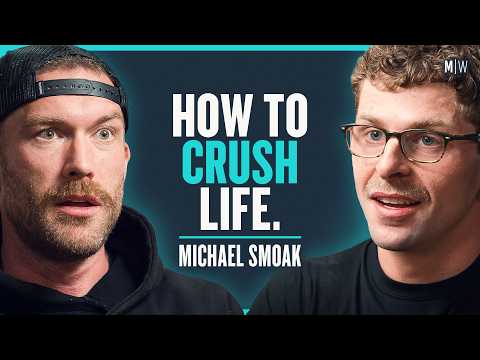
16 Brutal Life Lessons for Ambitious People - Michael Smoak
Chris Williamson (host), Michael Smoak (guest)
In this episode of Modern Wisdom, featuring Chris Williamson and Michael Smoak, 16 Brutal Life Lessons for Ambitious People - Michael Smoak explores ambition, grief, cancellation, and resilience: brutal lessons for growth-minded people High achievers often treat wins as obligations, so learning to celebrate progress is essential to avoid burnout and perpetual dissatisfaction.
Ambition, grief, cancellation, and resilience: brutal lessons for growth-minded people
High achievers often treat wins as obligations, so learning to celebrate progress is essential to avoid burnout and perpetual dissatisfaction.
Emotional healing requires feeling and revealing; suppressing grief, anger, or shame prolongs suffering and silently shapes behavior.
Hardship can expand stress tolerance, dissolve ego, and sharpen priorities, as shown through Smoak’s experience caring for his dying father and Williamson’s protracted health issues.
Public perception and online narratives can paralyze creators, but authenticity, surrender-with-agency, and audience discernment help withstand “soft cancellation.”
Success is usually “the obvious thing for an extraordinary time,” and communication skill—clarity plus conviction—can transform confidence, influence, and opportunity.
Key Takeaways
If success feels like the minimum standard, you’ll never feel ‘done.’
They describe how high standards turn wins into obligations, creating a permanent ‘gap’ mindset where ambition outpaces satisfaction; deliberately celebrating small wins counters habituation and burnout.
Get the full analysis with uListen
You can’t heal what you can’t feel—and you can’t feel what you won’t reveal.
Smoak argues that being unable to talk about an experience signals unprocessed emotion; allowing anger, grief, and guilt to move through you reduces resistance and prevents subconscious spillover into work, relationships, and health.
Get the full analysis with uListen
Surrender isn’t passivity; it’s accepting reality while still taking right action.
They distinguish surrender (dropping resistance to what you can’t control) from nihilistic inaction; the goal is to keep caring and acting without trying to force outcomes.
Get the full analysis with uListen
Fear of being perceived is the real ceiling for many people.
Whether it’s posting online, public speaking, or making a bolder creative move, the wall is often “what will they think? ...
Get the full analysis with uListen
Words hurt not only when you believe them, but when you fear others will believe them.
Williamson challenges Smoak’s aphorism by pointing out the ‘false narrative’ hell: reputational damage can sting even if you don’t endorse the accusation, because it can limit future reach and opportunities.
Get the full analysis with uListen
Most ‘comment on X’ requests are really ‘agree with me about X.’
They coin “Smoak’s razor”: audiences often want creators to echo their stance, not provide nuance; resisting that pressure preserves integrity but may trigger backlash.
Get the full analysis with uListen
Exceptional results usually come from boring consistency over an exceptional duration.
Their prescription is unglamorous: keep publishing, keep training, keep showing up—most people stop right before compounding effects appear (they cite podcast attrition and social posting drop-off as examples).
Get the full analysis with uListen
Communication is a trainable edge that creates perceived competence.
Smoak’s “clarity + conviction = perceived confidence/competence” underpins his public-speaking challenge; repeated reps (daily 60-second recordings) reduce filler words, raise composure, and build real-world confidence—while also acknowledging charisma can be used without substance.
Get the full analysis with uListen
Notable Quotes
“Success turns from a cause for celebration into the minimum level of acceptable performance.”
— Chris Williamson
“You cannot heal what you cannot feel, and you cannot feel what you are unwilling to reveal.”
— Michael Smoak
“Pain is inevitable, but suffering is optional.”
— Michael Smoak
“Adversity is a terrible thing to waste.”
— Chris Williamson
“If you want exceptional things, you have to be willing to work toward them for exceptional periods of time.”
— Michael Smoak
Questions Answered in This Episode
How do you practically ‘celebrate small wins’ without losing the hunger that drives high performance?
High achievers often treat wins as obligations, so learning to celebrate progress is essential to avoid burnout and perpetual dissatisfaction.
Get the full analysis with uListen AI
Smoak’s razor: where’s the line between ‘I won’t be your puppet’ and a creator dodging moral responsibility on public issues?
Emotional healing requires feeling and revealing; suppressing grief, anger, or shame prolongs suffering and silently shapes behavior.
Get the full analysis with uListen AI
Williamson’s rebuttal: how should someone protect their reputation when they’re targeted by selective editing or false narratives? What actions actually work?
Hardship can expand stress tolerance, dissolve ego, and sharpen priorities, as shown through Smoak’s experience caring for his dying father and Williamson’s protracted health issues.
Get the full analysis with uListen AI
In grief, what does ‘processing emotion’ look like day-to-day (journaling, therapy, prayer, conversations)—and how do you know you’re not just intellectualizing it?
Public perception and online narratives can paralyze creators, but authenticity, surrender-with-agency, and audience discernment help withstand “soft cancellation.”
Get the full analysis with uListen AI
You both talk about surrender-with-agency—what are concrete examples of when to fight for change vs accept the outcome?
Success is usually “the obvious thing for an extraordinary time,” and communication skill—clarity plus conviction—can transform confidence, influence, and opportunity.
Get the full analysis with uListen AI
Transcript Preview
I have a hard time celebrating my achievements because in my mind it was my obligation to achieve it
Ugh. The dilemma of the high achiever. I know, I know you don't struggle with this at all, right? I know this truly.
Game recognizes game, as they say.
Yes, yes. All, all from a place of deep wounds and the desire to be adequate and enough. Yeah. I have a hard time celebrating my achievements and wins because it was in my mind, in my mind it was my obligation to achieve them. And not only that, I think the group of people we hang out with, you hang out with, I hang out with, makes the exceptional seem extremely normal. I was having a conversation the other day with a friend who both of us had long runs, and I was running sixteen, he was running twenty, and there was a time a couple of years ago where you couldn't have paid me thousands of dollars to do anything but drive sixteen miles. And the fact of the matter is, the average person thinks that's crazy, and there was a time where I was extremely proud of that. I remember running my first ten miles. I remember where I was, I remember what I was doing. It was sunny, we were in Atlanta on the BeltLine, and I remember when it hit ten and I hit stop on the Apple Watch, and I went, "Holy shit, I just ran ten miles." And then now it's just, it's just a normal.
Mm.
And the carrot keeps moving for the high achiever. So I think the battle has now become learning to be content in the things that we achieve.
Mm.
You know? This w- this was a goal of mine, sitting down with you and being on this podcast. I've listened to it for years.
Mm.
And it's incredible to be in it with you right now. It's truly an honor, because you could interview anybody in the world, and yet here I sit. And so what, what is the, what is the line between sitting in the pride and the humility and the graciousness and gratitude of the achievement, and then moving the needle? And I think you alluded to this in an episode you did a while ago, talking about how you forgot to celebrate the wins along the way, which led to an inevitable case of burnout.
Mm.
And when we were here at the podcast, at the four-way podcast the other day with [clears throat] Sean and George, we talked about the importance of romanticizing every single thing in your life, so that way when the big achievement comes, it doesn't feel like an obligation, it feels like a victory, and you can truly sit in it before you move on to the next thing.
It's strange, yeah. I think people that have high standards assume that they should always win, they should always succeed, and that turns success from a cause for celebration into the minimum level of acceptable performance.
Install uListen to search the full transcript and get AI-powered insights
Get Full TranscriptGet more from every podcast
AI summaries, searchable transcripts, and fact-checking. Free forever.
Add to Chrome