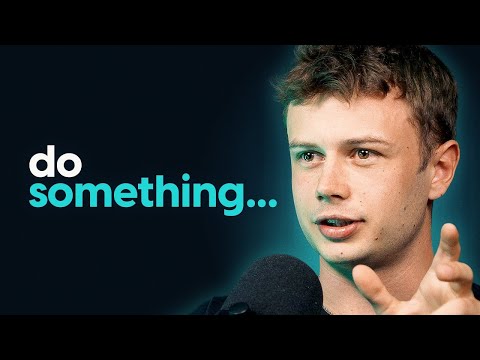
The Real Reason Your Life Is Still The Same - Angelo Somers
Chris Williamson (host), Angelo Somers (guest)
In this episode of Modern Wisdom, featuring Chris Williamson and Angelo Somers, The Real Reason Your Life Is Still The Same - Angelo Somers explores ambition, Nihilism, And Meaning: Escaping The Trap Of Self-Optimization Chris Williamson and Angelo Somers explore the downsides of extreme self-optimization, social comparison, and relentlessly "trying for 20" in every domain of life.
Ambition, Nihilism, And Meaning: Escaping The Trap Of Self-Optimization
Chris Williamson and Angelo Somers explore the downsides of extreme self-optimization, social comparison, and relentlessly "trying for 20" in every domain of life.
They examine how self-belief, trauma, nihilism, addiction, and internet self-help culture intertwine to create cycles of upward and downward spirals in young men, especially around work, status, and dating.
The conversation weaves philosophy (Nietzsche, Taleb, Frankl, Haidt, Adler), psychology, and personal stories to show how people retrofit narratives to cope with pain, misdiagnose their real problems, and mistake talking or learning for actually changing.
They end by emphasizing that meaning, character, and a healthy relationship with ordinary days matter more than chasing peak experiences, external validation, or perfectly optimized lives.
Key Takeaways
Relentless over-optimization can secretly be driven by lack, fear, and comparison.
The "try for 20" ethos often yields high achievement but keeps you reactive to others, anchored in scarcity, and chasing ever-escalating, often unrealistic goals instead of acting from internally chosen values.
Get the full analysis with uListen AI
Belief and proof form feedback loops that can spiral you up or down.
Self-belief doesn’t simply follow evidence or precede it; they co-create each other. ...
Get the full analysis with uListen AI
We retrofit stories to soothe pain, often confusing cope with truth.
After breakups, failures, or social pain, people construct narratives that protect their ego rather than reflect reality. ...
Get the full analysis with uListen AI
Talking, venting, and consuming advice can masquerade as real change.
Imagining yourself following good advice or venting frustrations gives emotional relief and a feeling of progress, but it often dissipates the motivational energy needed to actually act, leaving underlying patterns untouched.
Get the full analysis with uListen AI
Addiction and self-destruction are powerful teachers about self-deception.
Somers’ experience with drugs and nihilism shows how resentment toward life can turn into a “slow suicide,” and how addiction exposes the mind’s capacity to lie to itself—insight that later becomes invaluable if you face it honestly.
Get the full analysis with uListen AI
Comparing your inner chaos to others’ outer polish fuels inferiority.
We see our doubts in high resolution but only witness others’ actions in low resolution, so we assume they’re composed and we’re defective. ...
Get the full analysis with uListen AI
Meaning matters more than pleasure, but chasing only meaning can be another escape.
Some people distract themselves from their inability to feel simple joy by over-indexing on meaning, hard things, and self-denial. ...
Get the full analysis with uListen AI
Notable Quotes
“"The belief that the juice is worth the squeeze is not a product of the juice; the juice is a product of the belief that it’s worth the squeeze."”
— Angelo Somers
“"The line between grandeur and delusions of grandeur is just one good day."”
— Chris Williamson
“"You can end up getting really good at shit you don’t actually care about."”
— Angelo Somers
“"The reason to win the game is so that you don’t need to play it anymore."”
— Chris Williamson
“"Ultimately, it is the desire, not the desired, that we truly love."”
— Angelo Somers (paraphrasing Nietzsche)
Questions Answered in This Episode
How can someone distinguish between genuinely meaningful ambition and an achievement pattern driven primarily by fear, lack, or comparison?
Chris Williamson and Angelo Somers explore the downsides of extreme self-optimization, social comparison, and relentlessly "trying for 20" in every domain of life.
Get the full analysis with uListen AI
What practical steps can a chronically self-analytical person take to stop overthinking and start building real-world experience and character?
They examine how self-belief, trauma, nihilism, addiction, and internet self-help culture intertwine to create cycles of upward and downward spirals in young men, especially around work, status, and dating.
Get the full analysis with uListen AI
In a world saturated with advice, how can we tell the difference between helpful wisdom and narrative cope that merely makes us feel better?
The conversation weaves philosophy (Nietzsche, Taleb, Frankl, Haidt, Adler), psychology, and personal stories to show how people retrofit narratives to cope with pain, misdiagnose their real problems, and mistake talking or learning for actually changing.
Get the full analysis with uListen AI
How should young men approach dating and masculinity without falling into either victimhood, red-pill resentment, or shallow performance identities?
They end by emphasizing that meaning, character, and a healthy relationship with ordinary days matter more than chasing peak experiences, external validation, or perfectly optimized lives.
Get the full analysis with uListen AI
If life will always contain a baseline of dissatisfaction, what does a psychologically healthy relationship to ambition, meaning, and ordinary days actually look like?
Get the full analysis with uListen AI
Transcript Preview
What does trying for 20 mean to you?
Um, as with most things people tend to do, it has a positive and negative side, um, I'm sure you're aware of that, um, the idea is just that, you know, when everybody else is trying for 10, you're gonna be the guy that tries for 20. And so the positive side of that is you can end up getting a lot done, you can end up building a podcast with a billion plays, um, but the negative side of it is, uh, you're constantly anchoring your actions and your behaviors to what you see other people around you doing. Um, so, in some sense it kind of reduces your freedom but, um, can increase your actual output, or at least like what you're managing to achieve.
Mm-hmm.
So it's kind of like this comparative, competitive, sort of testosterone maxing thing where you're just like, "Whatever the other guy does, I'm gonna do more."
Mm-hmm.
Um, I think it was in the Hormozi episode or something when it came to meditation, it was something like, "However much everyone else is meditating for inner peace, I'm gonna meditate more." And it's like, you, if you're a hammer everything is a nail, and so if that's the type of guy you are, you're probably gonna achieve a lot of cool stuff, um, but yeah, you might not be the happiest while you're doing it, but you never know, maybe you will be as well.
Because the position is always lack, it's always, you always feel behind the eight ball and you're trying to catch up.
Mm-hmm.
Not only do you need to be better than everybody else, but you have set your sights so much higher than them, double-
Yeah.
...that you're always going to be setting a, uh, chasing an unrealistic opportunity.
100%. And also you're living in a reactive state, right, like you're, you're not actually affirming something that's like an internally generated idea of what you should be doing with your time, you're just reacting to the environment, oftentimes out of like a sense of lack or a fear. I mean, we have these like adaptive personalities that we create where we'll, like something bad will happen and then, um, I don't know, maybe like you're kind of outcast in school, that was my example-
Mm.
...and then you kind of create this adaptation which is like, okay, to avoid that sort of pain you're gonna do everything you can to not be in that position again-
Mm.
...which often means just doing better than the next guy. Um, but the problem, you, you can end up just getting really good at shit you don't actually care about, um, or making a lot of progress along a dimension that you wouldn't have otherwise pursued.
What line- Give me an example.
Um... Well, I was just in LA, and I feel like this is a hub of that, um, there's a lot of people sort of playing the status game. It seems to be like the, the center of the status game in, in many ways. Um, and oftentimes it's to overcome a sense of lack. Um... But you know, Nietzsche always spoke about like creating your own values, um, and there's kind of a lot of debate about the extent to which you're actually capable of doing that. Um, people like Peterson are kind of saying, like, "You can't do it," Jung says, "You can't do it," um, but I think it's because there's, it's not because we're actually confused about what we mean when we say values or like the capacity, um, or where they come from, it's because we're generally quite confused about this term you. Like I, like what actually is that? What's the scope of it?
Install uListen to search the full transcript and get AI-powered insights
Get Full TranscriptGet more from every podcast
AI summaries, searchable transcripts, and fact-checking. Free forever.
Add to Chrome