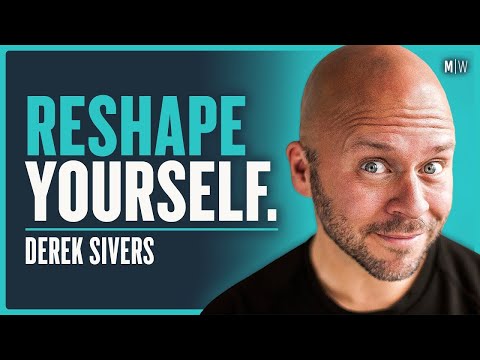
The Life-Changing Power Of Changing Your Perspective - Derek Sivers
Chris Williamson (host), Derek Sivers (guest), Narrator
In this episode of Modern Wisdom, featuring Chris Williamson and Derek Sivers, The Life-Changing Power Of Changing Your Perspective - Derek Sivers explores derek Sivers Explains Why ‘Useful, Not True’ Can Transform Life Derek Sivers and Chris Williamson explore Sivers’ core philosophy of choosing beliefs and perspectives based on their usefulness rather than their literal truth. They argue that almost everything we think and say is perspective, not objective fact, and that conscious reframing is the main lever for better strategies, emotions, and life outcomes.
Derek Sivers Explains Why ‘Useful, Not True’ Can Transform Life
Derek Sivers and Chris Williamson explore Sivers’ core philosophy of choosing beliefs and perspectives based on their usefulness rather than their literal truth. They argue that almost everything we think and say is perspective, not objective fact, and that conscious reframing is the main lever for better strategies, emotions, and life outcomes.
Using stories—from car crashes and Olympic medals to rules, religion, and split‑brain patients—they show how narratives shape our reality far more than raw facts do. Sivers emphasizes judging ideas, rules, and even people by their practical effects on our actions and wellbeing, not by ideological purity or absolute accuracy.
They also challenge authenticity culture, free‑will fatalism, and cancel culture, suggesting we focus on output over intention and treat philosophies as tools in a diversified “thought portfolio.” Throughout, Sivers models a radically pragmatic, minimalist, and future-focused way of living.
The conversation ultimately invites listeners to deliberately pick perspectives that make them stronger, kinder, and more effective—even when those perspectives are not strictly, universally true.
Key Takeaways
Treat beliefs as tools selected for usefulness, not literal truth.
Sivers consciously adopts beliefs (e. ...
Get the full analysis with uListen AI
Reframing past your first reaction is where real insight lives.
Your initial interpretation of events is just one option; forcing yourself to generate many alternative framings often produces better strategies, emotional relief, or unique angles others miss.
Get the full analysis with uListen AI
Separate facts from perspectives; facts can be true, perspectives never are.
A single number (e. ...
Get the full analysis with uListen AI
See rules as ‘useful, not true’ system-level heuristics.
Social rules (queues, traffic lights, disabled toilets, constitutional structures) exist to coordinate behavior on average; understanding their purpose lets you know when bending or breaking them is actually more moral and efficient.
Get the full analysis with uListen AI
Stop over-trusting your reasons; actions matter more than stories about them.
Research on split-brain patients shows the brain invents plausible explanations for behavior; Sivers concludes that we and others rarely know our real motives, so it’s wiser to judge by observable actions than by stated intentions.
Get the full analysis with uListen AI
Curate a diversified ‘thought portfolio’ from very different worldviews.
Just as you diversify investments, you should deliberately adopt and inhabit conflicting perspectives—from different cultures, politics, and religions—so no single worldview failure collapses your entire mental model.
Get the full analysis with uListen AI
Prioritize output and chosen identity over authenticity and internal feelings.
Sivers argues authenticity (doing what you “really feel”) is overrated; you become what you repeatedly pretend to be—kind, social, brave—so judge yourself by what you actually do, not by how you felt or what you intended.
Get the full analysis with uListen AI
Notable Quotes
“I choose beliefs because they’re useful to me, not because they’re true.”
— Derek Sivers
“The facts can be true, but the perspective is never true.”
— Derek Sivers
“Reframing is everything… all the best stuff in my life has come from the deliberate process of conscious reframing.”
— Derek Sivers
“You are at a massive disadvantage if the only people that you can learn from are people that you usually agree with.”
— Chris Williamson
“You are what you pretend to be, so if you pretend to be kind or social, by doing those actions you are being that.”
— Derek Sivers
Questions Answered in This Episode
Where in my life am I clinging to beliefs because I think they’re ‘true’ instead of asking whether they are actually useful for my goals and wellbeing?
Derek Sivers and Chris Williamson explore Sivers’ core philosophy of choosing beliefs and perspectives based on their usefulness rather than their literal truth. ...
Get the full analysis with uListen AI
What is one painful memory or grievance I could deliberately reframe from another person’s perspective, and how might that change how I feel about it?
Using stories—from car crashes and Olympic medals to rules, religion, and split‑brain patients—they show how narratives shape our reality far more than raw facts do. ...
Get the full analysis with uListen AI
Which rules or norms do I follow unthinkingly that might be safely bent or ignored if I focused on their underlying purpose instead of their surface form?
They also challenge authenticity culture, free‑will fatalism, and cancel culture, suggesting we focus on output over intention and treat philosophies as tools in a diversified “thought portfolio. ...
Get the full analysis with uListen AI
If I built a ‘thought portfolio,’ which radically different worldviews (cultures, politics, philosophies) should I intentionally study and inhabit to reduce my cognitive blind spots?
The conversation ultimately invites listeners to deliberately pick perspectives that make them stronger, kinder, and more effective—even when those perspectives are not strictly, universally true.
Get the full analysis with uListen AI
In what concrete way could I start judging myself more by my visible actions and outputs—and less by my internal narratives, intentions, or feelings about those actions?
Get the full analysis with uListen AI
Transcript Preview
What do you mean when you talk about useful, not true?
Oh, diving right in. (laughs)
Oh, yeah.
Um, for years, I write things that are sharing my point of view on something. I share a point of view I find useful, and I state it as a fact. I say, for example, um, "Men and women are the same." And I choose that belief, for example, uh, to counterbalance my tendency to think of men and women as more different than they actually are. So, I would deliberately choose a belief that helps counteract my tendencies, right? In the same way that somebody who has a tendency to be late to things might leave, start leaving what seems unreasonably early, which helps them get there on time, right? So, there are many beliefs in life that I choose as a countermeasure. But when I express this belief publicly, there was often somebody saying, "But that's not true. Men and women are different." I'd say, "I know it's not true. True is not the point. What the hell is true anyway? I'm choosing this belief because it's useful to me, not because it's true." And this subject came up a few times, even when I was writing a book about business. I would say something like, "Marketing is just another way of being considerate," and there would always be somebody to say, "Hmm, well, that's not always true," and I'd say, "I know it's not true, but this is a nicer way of thinking of marketing. Instead of thinking, like, 'How can I annoy people and spam them?' If you think of marketing as whatever you're doing to be considerate, to help people remember you, to help people find you, uh, it's a better way of thinking about it. I find it more useful to think that way." So, I realized there was a theme underneath my previous four books, which is that I choose beliefs because they're useful, not because they're necessarily true.
I love this idea. So, you, uh, I think George Mack, a good friend of mine, uh, phenomenal writer, got a copy of your book before maybe it'd even been announced, or maybe early on, and, uh, we'd been talking about something which is literally true but functionally false for two years, two and a half years? Uh, or functionally true but literally false. And I was like, "Oh, Derek's got it. Like, he's nailed it. This is the exact thing that we've been talking about for ages." So, I was super excited to be able to have this conversation, because it's kind of a pet project of mine too. Um, the best examples that I've got, something which is, uh, functionally true but literally false, porcupines can throw their quills. No, they can't. They're not darts players. They can't throw their quills. But if you treat a porcupine as if it can throw its quills-
(laughs)
... you're less likely to go away from it. Um, walking under a ladder is bad luck. No, it's not. I- I- I- I am yet to see any evidence that people who have walked under a ladder result in worse luck over the next however many decades of their life. But if you evade walking under ladders, you are less likely to have paint cans, and plant pots, and humans dropped on your head. Uh, pigs are morally dirty creatures, and that means that you should never touch them or eat them. Not true- As far as I'm aware, the moral status of pigs is equivalent to that of cows and chickens and everything else. But their flesh does carry a higher pathogen load on average, so if you avoid eating it, adaptively, that's protective to you, especially if you were perhaps, let's say, in the Middle East, in a place which is quite warm and doesn't have great sanitary conditions, and it's the Middle Ages. Uh, and the reverse, something which would be, uh, literally true but functionally false, much harder to find, at least in my opinion, uh, would be free will doesn't exist. So, a deterministic view of the world, uh, one which may, laws of physics and a bit of philosophy kind of seems to say to people smarter than me that this might be the case. Uh, but when you actually try and functionally use that or usefully use that in your life, uh, it kind of results in a lot of people becoming nihilistic or fatalistic or apathetic or just a bit sad or something. Uh, and I guess another one, uh, sort of, like, always treating the gun like it's loaded is-
Install uListen to search the full transcript and get AI-powered insights
Get Full TranscriptGet more from every podcast
AI summaries, searchable transcripts, and fact-checking. Free forever.
Add to Chrome