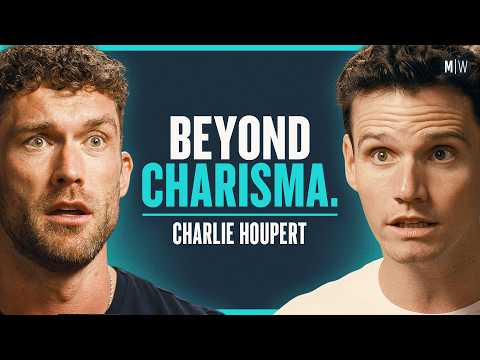
How to Survive the Death of Your Old Self - Charlie Houpert (4K)
Chris Williamson (host), Charlie Houpert (guest), Charlie Houpert (guest)
In this episode of Modern Wisdom, featuring Chris Williamson and Charlie Houpert, How to Survive the Death of Your Old Self - Charlie Houpert (4K) explores charlie Houpert on ego death, loneliness, and spiritual integration for men Charlie explains his personal arc from shy “victim consciousness” to disciplined self-improvement, to achieving the dream (business, relationship, money) and then encountering an inexplicable emptiness that led him to unconsciously “break” parts of his life.
Charlie Houpert on ego death, loneliness, and spiritual integration for men
Charlie explains his personal arc from shy “victim consciousness” to disciplined self-improvement, to achieving the dream (business, relationship, money) and then encountering an inexplicable emptiness that led him to unconsciously “break” parts of his life.
They frame growth as a pyramid/sequence—results → behaviors → emotions → spirituality—where each transition creates a “lonely chapter,” a dip in performance, and pressure from others to stay the same.
A major theme is the trade most people resist: giving up proven, outwardly rewarded optimization for inward work that feels irrational, “feminine,” uncertain, and initially less effective—yet ultimately produces wholeness, presence, and a deeper capacity to serve.
They use mythology (Jung/Campbell/Peterson) as a bridge to interpret modern male development, and they discuss why a “third wave” of the manosphere may need to include emotional sensitivity without abandoning competence and real-world outcomes.
Key Takeaways
Success can expose the real problem instead of solving it.
Charlie describes hitting the classic milestones—money, friends, girlfriend, dream business—only to feel emptier, then begin sabotaging relationships and work because the underlying emotional/spiritual needs were unaddressed.
Get the full analysis with uListen AI
Growth often requires a performance dip and social isolation.
Moving from outcomes to behaviors, then behaviors to emotions (and beyond) reliably makes you look “worse” in the old paradigm and can cost friendships—until you find new community aligned with your next stage.
Get the full analysis with uListen AI
You’re “supposed” to make certain mistakes—shame is the extra tax.
They argue that many core lessons (money/fame/achievement won’t fix self-worth) are “unteachable” because people must live them; the inner “I told you so” voice prolongs suffering and blocks learning.
Get the full analysis with uListen AI
Emotional control isn’t numbness; it’s a bigger container.
They differentiate masculine containment (feeling fully without dumping or reacting) from the shortcut of shutting feelings down—an approach that can increase productivity and wealth but deadens joy and intimacy.
Get the full analysis with uListen AI
Intuition gives the next step, not the full plan.
Unlike analytical planning, intuition stays “foggy” about the destination; to benefit, you must follow successive small prompts (breathwork, nature, art, conversations) long enough to reveal the larger arc.
Get the full analysis with uListen AI
The ‘feminine’ is often just the part that can receive.
They suggest many high-achievers keep chasing validation because they can’t receive what’s already present; cultivating receptivity (pleasure, beauty, appreciation) reduces compulsive goalpost-moving.
Get the full analysis with uListen AI
Mythology can act like a diagnostic and navigation tool.
Using Jung/Campbell structures (belly of the whale, temptation, return), Charlie describes recognizing his own life moments—e. ...
Get the full analysis with uListen AI
Notable Quotes
“I discovered a second lonely chapter… when you bottom out on the optimizing thing, and your friends are still very much in that optimized zone.”
— Charlie Houpert
“Once I had all the different results… the most cliché thing happened… there was an emptiness that I could not pinpoint or explain.”
— Charlie Houpert
“The mind… becomes something that you can deploy… but not something that… chats the entire time.”
— Charlie Houpert
“Each man enters the forest at the point that looks darkest to him.”
— Chris Williamson
“It asks you to trade in your identity of who you were… it is an ego death every time.”
— Charlie Houpert
Questions Answered in This Episode
Charlie, can you give a concrete example of what “unconsciously breaking things” looked like day-to-day in business and relationships when the emptiness showed up?
Charlie explains his personal arc from shy “victim consciousness” to disciplined self-improvement, to achieving the dream (business, relationship, money) and then encountering an inexplicable emptiness that led him to unconsciously “break” parts of his life.
Get the full analysis with uListen AI
In your pyramid (results → behaviors → emotions → spirituality), what are the most common signs that someone is ready to move levels—especially from behaviors to emotions?
They frame growth as a pyramid/sequence—results → behaviors → emotions → spirituality—where each transition creates a “lonely chapter,” a dip in performance, and pressure from others to stay the same.
Get the full analysis with uListen AI
You warn that early vulnerability can look like being a “raw nerve.” What practices helped you build containment so sensitivity didn’t become emotional dumping?
A major theme is the trade most people resist: giving up proven, outwardly rewarded optimization for inward work that feels irrational, “feminine,” uncertain, and initially less effective—yet ultimately produces wholeness, presence, and a deeper capacity to serve.
Get the full analysis with uListen AI
How do you personally distinguish intuition from craving or escapism—especially in big decisions like relationships or career pivots?
They use mythology (Jung/Campbell/Peterson) as a bridge to interpret modern male development, and they discuss why a “third wave” of the manosphere may need to include emotional sensitivity without abandoning competence and real-world outcomes.
Get the full analysis with uListen AI
You frame the spiritual layer as a “separation from life/God.” What experiences made that feel true for you beyond intellectual belief?
Get the full analysis with uListen AI
Transcript Preview
You're in a very different place now to when you started doing your thing-
Mm-hmm.
-online. What's the unifying thread? Is there one between sort of all of this stuff, or do you see it as different Charlies? How do you come to sort of construct the narrative of what your interests have been and y- your personal growth over the last decade and a bit?
Sure. The terror was in not having a thread. So there was a time about three years ago where I could not form a story that connected who I had been in my twenties to who I was becoming in my thirties. And I was thinking about this. I've heard you talk about the lonely chapter, where you go from, "I'm just blending in," to, "I'm gonna take control of my life, and I'm gonna dial in these optimizing things. I'm gonna start my business, get in shape, eat the right food, et cetera." I've, I discovered a second lonely chapter [chuckles] which is when you, you bottom out on the optimizing thing, and your friends are still very much in that optimized zone, and I did not know where to go, but I just knew that it wasn't working.
Wow!
So the common thread for me was that there was this problem in my life that started with, "I'm too shy. Nobody wants to talk to me." And you start off in victim consciousness, which is, "This is just who I am, and I will just deal with this for the rest of my life." You read The Game, which is what I did. You have this breakthrough, re-read Dale Carnegie, read all these other guys, and you go, "Oh, my gosh, I can change my behavior, get different results." But then once I had all the different results, which was I was thirty years old, had this business that I dreamed of, the girlfriend that I'd imagined myself dating, a bunch of friends, money was coming in. The most cliché thing happened, which is there was an emptiness [chuckles] that I could not pinpoint or explain, and things-- I started unconsciously breaking things because I didn't know where to go from there. So to answer your question, the thread has been I'm tr-- I try to attend to the greatest problem in my life-
Right
... and figure out who I can learn from to solve it.
What does breaking things look like?
It looks like I'm in the business that I love, that I dreamed of. There was a... One day, it was like, if I could just make two thousand dollars a month, live in Latin America, and do work that I found meaningful, that's the dream. And I hit that, and then I moved the goalpost, and I moved the goalpost, and all of a sudden I'm complaining, and I go, "I have to make one video a week." Three years prior was, "I get to do this," and it became, "Ugh, [chuckles] so annoying. These people are asking me, and I have to h- hit all these targets that I'd set for myself to surpass views and all sorts of things." I started having issues in my friendships. I started having issues in different kinds of relationships, and I did not know that what was happening, and I would say, is like my soul was waking up. I had no concept of a soul. I wasn't a religious person, but the lack of emotional and spiritual nourishment that I'd allowed myself to experience for the last decade plus had caught up with me, is what happened.
Install uListen to search the full transcript and get AI-powered insights
Get Full TranscriptGet more from every podcast
AI summaries, searchable transcripts, and fact-checking. Free forever.
Add to Chrome