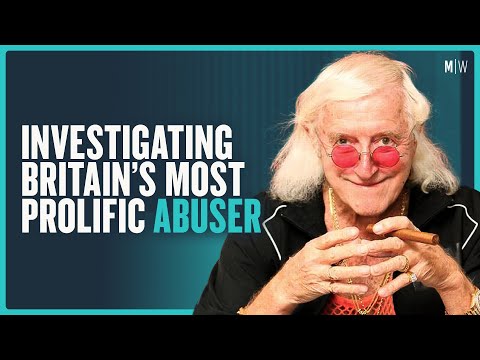
The Story Of Exposing Jimmy Savile - Mark Williams-Thomas | Modern Wisdom Podcast 369
Mark Williams-Thomas (guest), Chris Williamson (host), Mark Williams-Thomas (guest), Narrator
In this episode of Modern Wisdom, featuring Mark Williams-Thomas and Chris Williamson, The Story Of Exposing Jimmy Savile - Mark Williams-Thomas | Modern Wisdom Podcast 369 explores inside Jimmy Savile’s Exposure: Power, Failures, And Media Justice Former detective-turned-investigative reporter Mark Williams-Thomas explains how he uses police-style methods within the media to expose dangerous offenders, most famously Jimmy Savile. He details Savile’s pattern of abuse, the institutional failures that let him offend for decades, and how the ITV documentary fundamentally shifted public and institutional attitudes toward powerful sex offenders.
Inside Jimmy Savile’s Exposure: Power, Failures, And Media Justice
Former detective-turned-investigative reporter Mark Williams-Thomas explains how he uses police-style methods within the media to expose dangerous offenders, most famously Jimmy Savile. He details Savile’s pattern of abuse, the institutional failures that let him offend for decades, and how the ITV documentary fundamentally shifted public and institutional attitudes toward powerful sex offenders.
Mark contrasts what independent investigators can do versus the police, highlighting both their limitations (no warrants, limited records) and advantages (trust from victims, focus, and media leverage). He also discusses wrongful convictions, unsolved murders, and how TV investigations can force authorities to reopen cases and correct miscarriages of justice.
The conversation ranges from Savile, Rolf Harris and Max Clifford to Chris Watts, Making a Murderer, Line of Duty, and global police corruption, illustrating common patterns of power abuse, investigative bias, and offender psychology.
Williams-Thomas closes by acknowledging the heavy psychological toll of working in such dark subject matter, while reaffirming his commitment to using media investigations to catch offenders, free the wrongfully convicted, and pressure systems to change.
Key Takeaways
Media investigations can achieve justice when formal systems fail.
Williams-Thomas’s Savile documentary and other TV projects gathered victim testimony, exposed institutional failures, and created public pressure that led to new police inquiries, overturned inquests, and even cleared suspects, showing how journalism can act as a parallel accountability mechanism.
Get the full analysis with uListen AI
Power and perceived untouchability are central tools for sexual offenders.
Savile leveraged celebrity, charity work, and litigiousness to appear indispensable and intimidating, which discouraged victims, witnesses, and institutions from challenging him and allowed offending across age groups and settings for decades.
Get the full analysis with uListen AI
Victims often trust independent investigators more than the police.
Without police powers, Mark relies on rapport, ethics, and focus; many victims who refused to speak to police were willing to talk to him, giving him information that official investigations never accessed.
Get the full analysis with uListen AI
Investigative bias can turn hypotheses into wrongful convictions.
Senior officers sometimes build a theory and then selectively fit evidence to it, as in cases where suicides were prosecuted as murders or where fabricated/implausible forensic narratives were accepted in court, highlighting the need for independent review and robust challenge.
Get the full analysis with uListen AI
Even prolific offenders expect to be caught eventually—but many aren’t.
In therapeutic prisons, serious offenders admitted they long anticipated arrest, yet Mark’s FOI work on unsolved murders shows how many homicides—some incredibly brutal—remain unresolved, motivating his cold-case focus.
Get the full analysis with uListen AI
True crime content is not just entertainment; it can be procedural leverage.
Programs like The Investigator, his podcasts, and case-specific documentaries are designed with a “back end”: to trigger new inquests, exhumations, DNA testing, CPS reviews, and police action that might otherwise never occur.
Get the full analysis with uListen AI
Working in constant proximity to trauma exacts a real mental health toll.
Williams-Thomas acknowledges experiencing significant mental health struggles and “dark days” from absorbing victims’ pain and living in a “dark world,” underscoring the psychological cost of this type of investigative work.
Get the full analysis with uListen AI
Notable Quotes
““No longer should people be untouchable.””
— Mark Williams-Thomas
““If this program doesn’t land right, we’ll never work in telly again.””
— Mark Williams-Thomas (on the Savile documentary)
““I’m not judge and jury. All I’m doing is presenting the facts. You are the judge and the jury.””
— Mark Williams-Thomas
““There is never, in my mind, a case where the means justifies the end.””
— Mark Williams-Thomas (on fabricating evidence)
““I live in a pretty dark world because of the type of work that I do.””
— Mark Williams-Thomas
Questions Answered in This Episode
How should legal systems formally integrate or respond to serious findings that originate from journalistic investigations rather than police work?
Former detective-turned-investigative reporter Mark Williams-Thomas explains how he uses police-style methods within the media to expose dangerous offenders, most famously Jimmy Savile. ...
Get the full analysis with uListen AI
What structural safeguards could reduce investigative bias, so detectives don’t simply fit evidence to their initial hypothesis?
Mark contrasts what independent investigators can do versus the police, highlighting both their limitations (no warrants, limited records) and advantages (trust from victims, focus, and media leverage). ...
Get the full analysis with uListen AI
Where should the line be drawn between necessary media exposure and trial-by-media that could undermine a fair legal process?
The conversation ranges from Savile, Rolf Harris and Max Clifford to Chris Watts, Making a Murderer, Line of Duty, and global police corruption, illustrating common patterns of power abuse, investigative bias, and offender psychology.
Get the full analysis with uListen AI
How can institutions be held accountable—not just individuals—when they ignore or enable serial offenders like Savile?
Williams-Thomas closes by acknowledging the heavy psychological toll of working in such dark subject matter, while reaffirming his commitment to using media investigations to catch offenders, free the wrongfully convicted, and pressure systems to change.
Get the full analysis with uListen AI
What support systems should exist for investigators, journalists, and police who routinely work with extreme trauma and abuse cases?
Get the full analysis with uListen AI
Transcript Preview
A large majority of sex offenders use power as an influence with their offending behavior, and I think that power played massively into him. You know, he was a completely narcissistic, egotistical control freak, and had his way, you know, nearly all the time. So when he thought that, "Well, I want it, I'll have it," he just went and did it. And of course, nobody challenged him. He was fairly untouchable. He was fairly unchallengeable. And he lived a consistent lie. (wind blowing)
How would you describe what you do for work?
Well, I, I think now, it's probably as an investigative reporter. I, I do do some private consultancy, and I also run a risk management consultancy where I investigate and help organizations with dangerous offenders. So I'm a pretty busy person.
But you used to be a police officer, right? So what's the difference between a police officer and an investigator?
So yeah, former police detective. Uh, and not a massive amount, certainly not the way that I do it. I mean, there, there are many different investigators out there who do things in different ways. But my ethos and the way I operate is very much along the same lines as if I were a detective. Obviously, I don't have the powers of being a detective. I don't have the warrant. But what I do have is the skills that I've learned from being a police detective, and I just transfer them into the roles that I do now. I have the same ethical approach. I have the same, uh, moral approach in terms of how I do things. And all of my investigations are built around as if I was doing it for a criminal investigation, so the same levels of standards apply.
What are some of the restrictions that you have placed on yourself? Obviously, you're not gonna be able to go and arrest people, so is it your job as an investigator to put together a, a kind of case and then pass that up to authorities that can bring people to justice? How does it work?
Yeah, so obviously, I don't have power of arrest, so I can't force people to talk to me. I can't force people to come with me and do things. But, uh, as an investigator, in the way that I work within the media, often, that actually doesn't make that much of a difference 'cause what it does mean is that people will talk to me, and they'll often talk to me when they wouldn't talk to the police. And they'll give me information that they wouldn't or don't give to the police. So I have a, a great opportunity, I think, when I go and do these investigations as not being a police officer. That said, of course, I don't have access to the records that police officers do, so I can't gain as much information about people. Uh, but what I have to use is my own sources and also, the open source data that exists around the internet to try and find information about people when I'm doing an investigation. My ethos always is about helping people. So whenever I take on any investigation, uh, the starting point is, can I make a difference? Because more often than not, by the time people have come to me is they've tried everything else. They've failed with the police. They've failed with all the other organizations or media outlets. And they come to me in desperation. Can I help them? And what I will never want to do is to give people false hope. It is about being realistic to them. So if I can't, genuinely can't see anything that I can do as far as adding value, I'm no wizard, but what I do is obviously, um, thoroughly investigate and use my skills very successfully. If I can't help them, then I'll be honest upfront and say, "Look, uh, there is, there is nothing I can do," because there's nothing worse than being given false hope.
Install uListen to search the full transcript and get AI-powered insights
Get Full TranscriptGet more from every podcast
AI summaries, searchable transcripts, and fact-checking. Free forever.
Add to Chrome