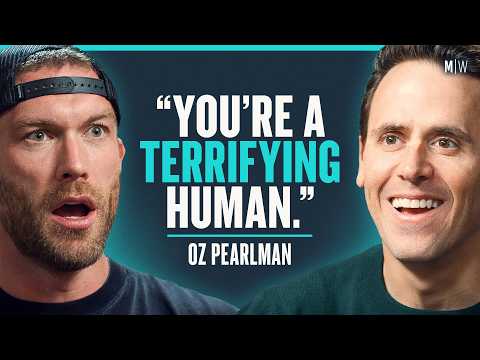
How to Steal Thoughts Out of Anyone’s Head - Oz Pearlman
Chris Williamson (host), Oz Pearlman (guest), Chris Williamson (host)
In this episode of Modern Wisdom, featuring Chris Williamson and Oz Pearlman, How to Steal Thoughts Out of Anyone’s Head - Oz Pearlman explores mentalist Oz Pearlman on illusion, influence, memory, and resilience training Pearlman frames mentalism as a learnable, repeatable, psychology-and-performance craft that differs from “psychic” claims because it relies on method, rapport, and controlled scenarios.
Mentalist Oz Pearlman on illusion, influence, memory, and resilience training
Pearlman frames mentalism as a learnable, repeatable, psychology-and-performance craft that differs from “psychic” claims because it relies on method, rapport, and controlled scenarios.
Live demonstrations show how spectators generalize a single “impossible” hit into broad beliefs about mind reading, highlighting how perception and inference can be hacked.
He argues the real product is the story and emotional imprint—making the participant the star—using silence, pacing, and peak-end moments to maximize memorability.
Practical tools are offered for everyday life: name-remembering via “listen, repeat, reply,” note-taking to preserve relationships, and vulnerability/value-framing to become indispensable.
He connects endurance training and a “fast-forward your feelings” mindset to confidence and performance under pressure, while admitting even experts remain manipulable in everyday contexts.
key_topics=[
Key Takeaways
Mentalism succeeds by engineering inference, not supernatural ability.
Pearlman emphasizes he can’t read minds; he creates tightly designed situations where spectators fill in the “then…” connector and overgeneralize what they witnessed.
Get the full analysis with uListen
Trust and rapport are the real gatekeepers of influence.
Whether in mentalism, sales, or hypnosis, he argues you can’t do it “against someone’s will” because participation and compliance are prerequisites.
Get the full analysis with uListen
Make the audience (or counterpart) the protagonist to create lasting impact.
A trick’s longevity comes from tying the moment to the participant’s identity or memories; people retell experiences that feel personally meaningful, not technically impressive.
Get the full analysis with uListen
Silence is a performance tool that amplifies emotion.
Like comedians who avoid “stepping on” laughs, he learned to stop talking during big reactions so the audience can fully process and deepen the moment.
Get the full analysis with uListen
Remembering names is mostly attention, repetition, and a quick hook.
His “listen, repeat, reply” method repeats the name immediately and anchors it via spelling, a compliment, or an association, dramatically reducing short-term forgetting.
Get the full analysis with uListen
Write things down to become ‘magical’ in relationships and business.
He uses notes/CRM-like recall to avoid the asymmetry where clients remember powerful moments that performers forget, turning preparation into perceived thoughtfulness.
Get the full analysis with uListen
Confidence can be accelerated by separating self-worth from rejection.
He describes creating an internal “agent” who absorbs rejection (restaurant tables, pitches), allowing the core self to remain intact while still learning and improving.
Get the full analysis with uListen
To spot deception, look for deviations from baseline—not one universal tell.
He notes liars often over-explain and change cadence; he predicts AI will outperform humans by modeling individual baselines and detecting objective timing/behavior shifts.
Get the full analysis with uListen
Use mental ‘time travel’ to defuse anxiety and procrastination.
His “fast-forward your feelings” hack treats dread as temporary chemistry: do the hard task now and borrow tomorrow’s calmer emotional state.
Get the full analysis with uListen
Endurance training reveals how often ‘I can’t’ is a misdiagnosis.
He credits ultras with teaching diagnostic coping (often blood sugar) and a decisive commitment mindset—finishing the Spartathlon after quitting once reset his self-belief.
Get the full analysis with uListen
Notable Quotes
““The lie is I can read people’s minds.””
— Oz Pearlman
““I’m giving the illusion of reading people’s minds—that’s the skill.””
— Oz Pearlman
““People, ‘Well, if you can do that, then…’ Remember that then connector.””
— Oz Pearlman
““I realized what I was selling… was making it about other people.””
— Oz Pearlman
““Listen, repeat, reply.””
— Oz Pearlman
Questions Answered in This Episode
In your card-and-birthday demonstration, what specific spectator behaviors are you tracking, and which ones are red herrings you purposely encourage people to overvalue?
Pearlman frames mentalism as a learnable, repeatable, psychology-and-performance craft that differs from “psychic” claims because it relies on method, rapport, and controlled scenarios.
Get the full analysis with uListen AI
You say mentalism is “rooted in science” and repeatable—what parts are genuinely evidence-based (e.g., ideomotor/muscle reading), and what parts are pure stagecraft and scripting?
Live demonstrations show how spectators generalize a single “impossible” hit into broad beliefs about mind reading, highlighting how perception and inference can be hacked.
Get the full analysis with uListen AI
Where do you draw the ethical line between ‘honest con man’ entertainment and techniques that could be weaponized in sales, relationships, or politics?
He argues the real product is the story and emotional imprint—making the participant the star—using silence, pacing, and peak-end moments to maximize memorability.
Get the full analysis with uListen AI
Your ‘agent’ model for handling rejection is powerful—how can someone adopt it without becoming detached, avoidant, or unable to take feedback?
Practical tools are offered for everyday life: name-remembering via “listen, repeat, reply,” note-taking to preserve relationships, and vulnerability/value-framing to become indispensable.
Get the full analysis with uListen AI
You predict AI deception detection will soon be strong—what would a responsible deployment look like, and where do you think it will fail (e.g., neurodivergence, anxiety, cultural differences)?
He connects endurance training and a “fast-forward your feelings” mindset to confidence and performance under pressure, while admitting even experts remain manipulable in everyday contexts.
Get the full analysis with uListen AI
Transcript Preview
You have said that your career is built on a lie.
Yeah.
What's the lie?
The lie is I can read people's minds.
You can't?
I can't. [laughs] I wish I could.
Okay. Why does what you do work then if you can't read people's minds?
Well, because I'm giving the illusion of reading people's minds, right? That's the skill. That's really... I'm crafting a narrative which in your mind plays out in such a way, kinda like the way a magic trick works, but the contract is different with the audience. Because most of us when we watch a magic trick, since we've been young and we kinda first experienced magic, we know that what's happening isn't real. De facto, the bird that appeared didn't really appear out of nowhere. The person doing this isn't God. They didn't cut a woman in half for real because you can't actually put her back together.
Hmm.
Right? Science has established what can and can't be done within reason. That's what we believe. So you can always look and see and say, "Well, there's a gimmick. There's a trick. There's a way that it's being done." And the funny part about what I do, it's called mentalism, it's a form of magic, is that you can't really find how it's being done because there's never that trick. There's never the gimmick. There's never the thing that you do to do it-
Hmm
... because it's a pure art. It's very similar to stand-up comedy. I can show up with nothing. I could do a show today for thousands of people with literally nothing. A marker helps, a pad of paper helps, but it's not mandatory.
Is that, you know, when you talk about the prestige when people talk, the reveal at the end-
Yep
... that's kind of the thing that appears to be missing?
The abracadabra, the ah.
Yeah.
Well, it's not... So the, we still get that moment of w- the wow, the ta-da.
Mm-hmm.
The, but the lead up to it typically doesn't have any form of something that looks like it's doing the trick, if that makes sense. It appears to be just a test of wills where I've trained my mind to see and observe things about you or influence you in such ways that the method seems to really be mind reading, and that's, that's the illusion I'm trying to present.
Who is the greatest mentalist from history in your opinion?
That's a tough question. I mean, there's a guy in the UK named Derren Brown-
Mm
... who's really been the, the godfather the last like two or three decades I would say who broke ground. You can't really th- throw... There's a guy named Kreskin, The Amazing Kreskin, who in the US was on, uh, the Tonight Show with Johnny Carson I don't even know how many times, over 80, and he was a real character and performed. He created that whole motif. But all of this started, don't quote me on this, but about 100 years ago where people used to just pretend to be psychics or, depending on what you believe, were psychics. And then magicians kind of observed the way psychics do their tricks or whatever you wanna call them. Maybe they're doing it real, maybe they're not. But they found methods. And the key thing to understand that's different between a psychic and me is what I'm doing is learnable, repeatable, and based in science. Those are very important things. You can't teach someone to be a psychic. I've never met a psychic that could teach me to also be a psychic. I could teach you to be a-
Install uListen to search the full transcript and get AI-powered insights
Get Full TranscriptGet more from every podcast
AI summaries, searchable transcripts, and fact-checking. Free forever.
Add to Chrome