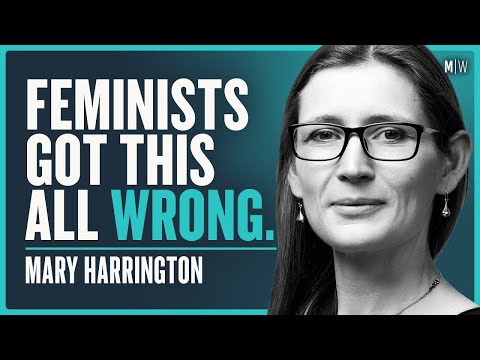
The Dark Side Of Feminism's "Liberation" - Mary Harrington
Mary Harrington (guest), Narrator, Chris Williamson (host), Narrator, Narrator
In this episode of Modern Wisdom, featuring Mary Harrington and Narrator, The Dark Side Of Feminism's "Liberation" - Mary Harrington explores mary Harrington Challenges Feminism, Freedom, and the Cyborg Future Mary Harrington argues that modern feminism is less a linear story of moral progress and more a reaction to changing material and technological conditions, from the Industrial Revolution to the pill and the internet.
Mary Harrington Challenges Feminism, Freedom, and the Cyborg Future
Mary Harrington argues that modern feminism is less a linear story of moral progress and more a reaction to changing material and technological conditions, from the Industrial Revolution to the pill and the internet.
She contrasts a “feminism of freedom” that prioritizes individual autonomy with a “feminism of care” that centers dependence, motherhood, and relational bonds, claiming the former has decisively won and left serious human costs.
Harrington critiques the sexual revolution, hormonal birth control, commodified online dating, porn, and OnlyFans as creating adversarial, transactional relations between the sexes and undermining trust, intimacy, and family formation.
She warns of a coming “cyborg theocracy” and transhumanist market in bodies and reproduction, and calls for a post-romantic, solidarity-based model of marriage, limits on technological “freedom,” and a renewed respect for female embodiment and dependence.
Key Takeaways
Reframe feminism as historical adaptation, not automatic progress.
Harrington urges listeners to see feminism as women’s strategic response to technological and economic upheavals (e. ...
Get the full analysis with uListen AI
Recognize the trade‑offs of the “feminism of freedom.”
Prioritizing autonomy, paid work, and detachment from dependency has delivered real benefits, but has also devalued motherhood, care work, and interdependence, leaving many women lonely, ambivalent about pregnancy, and structurally set against their own bodies.
Get the full analysis with uListen AI
Treat hormonal birth control as a powerful psychoactive technology with social costs.
Harrington and others report that the pill alters libido, attraction, and mood, and enabled hookup culture by decoupling sex from consequences; she argues a feminist “pushback” on routine pill use could reduce degrading sexual encounters and re-raise the bar for intimacy.
Get the full analysis with uListen AI
Interrogate how markets colonize sex, bodies, and relationships.
From Playboy to online dating to OnlyFans and surrogacy, once sex and reproduction are treated as private and consequence‑free, they quickly become sites of trade; Harrington warns that commodification tends to benefit elites while exploiting poorer women’s bodies and fertility.
Get the full analysis with uListen AI
Resist the slide into transhumanist treatment of bodies as modular parts.
She connects gender medicine, organ-for-sentence-reduction schemes, and commercial surrogacy to a broader “cyborg theocracy” that sees human bodies as Lego-like resources, arguing this will create class‑based markets in organs, wombs, and gametes unless politically resisted.
Get the full analysis with uListen AI
Shift from self-expressive romance to solidarity-based, post-romantic marriage.
Harrington suggests that in an unstable, expensive world, marriages built on radical loyalty, shared responsibility, and mutual dependence are more realistic and socially beneficial than endlessly “self-actualizing” unions that dissolve whenever they stop feeling optimal.
Get the full analysis with uListen AI
Protect single-sex spaces and male formation as a women’s issue too.
She argues that good men are formed primarily by other men, not by women’s nagging or policy, and that allowing all-male spaces (e. ...
Get the full analysis with uListen AI
Notable Quotes
“Pregnancy doesn’t just create a baby; it also creates a mother.”
— Mary Harrington
“Feminism isn’t about moral progress; it’s a response to material conditions.”
— Mary Harrington
“We’ve finished industrializing the world, so now we’re colonizing the human body and soul.”
— Mary Harrington
“Choosing one person is by definition settling, because everybody annoys their partner after a while.”
— Mary Harrington
“We need an Occupy Ourselves movement.”
— Mary Harrington
Questions Answered in This Episode
If feminism is largely a response to technology and economics, how should it adapt in a digital, post-industrial era without defaulting to more atomization and commodification?
Mary Harrington argues that modern feminism is less a linear story of moral progress and more a reaction to changing material and technological conditions, from the Industrial Revolution to the pill and the internet.
Get the full analysis with uListen AI
What would a practical, culturally acceptable alternative to widespread hormonal birth control look like for young women who still want control over their fertility?
She contrasts a “feminism of freedom” that prioritizes individual autonomy with a “feminism of care” that centers dependence, motherhood, and relational bonds, claiming the former has decisively won and left serious human costs.
Get the full analysis with uListen AI
How can societies draw legitimate ethical lines between helpful medical innovation and exploitative markets in organs, surrogacy, and gender-related surgeries?
Harrington critiques the sexual revolution, hormonal birth control, commodified online dating, porn, and OnlyFans as creating adversarial, transactional relations between the sexes and undermining trust, intimacy, and family formation.
Get the full analysis with uListen AI
What concrete steps could individuals and institutions take to revive a “feminism of care” that values dependence and motherhood without reimposing oppressive gender norms?
She warns of a coming “cyborg theocracy” and transhumanist market in bodies and reproduction, and calls for a post-romantic, solidarity-based model of marriage, limits on technological “freedom,” and a renewed respect for female embodiment and dependence.
Get the full analysis with uListen AI
Can a culture saturated with online dating, porn, and OnlyFans realistically rebuild trust and vulnerability between men and women, and if so, where would that shift need to start?
Get the full analysis with uListen AI
Transcript Preview
... pervasive cultural message that says commodifying yourself, even to the point of making yourself a subscription product on OnlyFans, is not only legitimate, but it's also empowering. It leaves people in the situation where you've got this incredibly kind of adversarial and incredibly hostile and incredibly exploitative dynamic between the sexes, such that it, it's now almost impossible to extend enough trust and enough vulnerability, I think, to another person to be willing to take the risk of loving someone. And I think that's catastrophic over the long term for people just being able to find happiness or kids or anything really. Tell me, how do you arrive at giving a critique of feminism? Why do you have any credentials to do this? (laughs) Well, I mean, I'm, I'm, I'm a woman, which is a start. Um, I was a fairly rabidly, fully paid up, um, second wave feminist in my teens, and then third wave/woke/ well, early adopter of the whole kind of woke, um, post-modern world view in my 20s, and did my level best to live it, I'd say, until I was about 28. And then for a whole load of very complicated reasons, kind of lost my faith in that way of living. Um, and in the process of kind of reassembling a world view which made sense, um, which, which I reckon took about seven years, um, having, having kind of hit that quarter life crisis, um, I came out the other end thinking, "Well, I don't believe in progress anymore." And then I thought, "Well, I've always thought of myself as a feminist, but if being a f- if feminism is held up as one of the kind of central planks in the, in the sort of evidence stack that says we're, we're on a sort of never-ending upward path of progress," right? Um, like, and people say, you know, the first thing people say when you say, "Well, you know, prove it," like, well, I- if you say, "I don't believe in progress," and they'll be like, "Well, how can you say that? You're a woman." Like, you know, things are much better for women now than they were before. Mm. You know, that's just kind of treated as self-evident. And I thought, "Okay, well, this, um, is it, is it still possible to be a feminist if you don't believe in progress?" And I thought, "Well, I still care about women's interests and I still think those are often sidelined." Um, but, but then I- that sort of started me down a whole rabbit hole of, um, you know, the, the relationship between feminism and progress, and, um, and that, in the course of which I got married, I had a baby, and having a baby made me think a great deal more about what feminism thinks, considers progress to mean, most of which seems kind of, um, structurally predicated on not being a mother, or, you know, being a mother, put, put it this way, like, being a mum and being, um, emancipated in the terms that are sort of normally set out by what I think of as magazine feminism, you know, the kind of Jezebel kind of cosmopolitan variant, um, (coughs) they just don't, they don't stack, they don't, they don't square very comfortably. And so I spent, I spent, uh, you know, personally quite a bit of time trying to, trying to make sense of that problem, um, pushing a buggy around the empty daytime streets of a small town in England, um, trying, um, you know, it's not like your mind stops working just 'cause you've had a baby. Um, so there I am, sort of pushing the buggy around, thinking about, thinking about second wave feminism and thinking about being a stay-at-home mum and thinking about how different it was actually to the impression that I'd always absorb- internalized of it from feminists, from the, the, the sort of liberal feminist orthodoxy which says there's, there's nothing more
Install uListen to search the full transcript and get AI-powered insights
Get Full TranscriptGet more from every podcast
AI summaries, searchable transcripts, and fact-checking. Free forever.
Add to Chrome